

Starting and Scaling a Coffee Business in Singapore: The 2026 Guide
Updated: Apr 3
What if the secret to a successful coffee business Singapore entrepreneurs dream of isn't a high-traffic storefront, but a smarter way to manage your overheads? You've likely felt the sting of rising commercial rents, which hit an average of S$9.50 per square foot in some central districts in late 2024. It's a hurdle that roughly 65% of new F&B owners cite as their primary stressor. We understand the challenge of balancing your passion for specialty beans with the reality of SFA and NEA regulations, alongside the technical steepness of roasting your own batches.
We believe there isn't one "correct" way to build a brand, because coffee is a personal journey and every palate perceives notes differently. This 2026 guide promises to give you a clear roadmap for launching your label, from accessing shared roasting labs to sourcing green beans directly from producers. You'll learn how to develop a signature profile that speaks to your vision, while keeping your initial investment manageable. We're diving into business models, regulatory requirements, and the art of experimental roasting. While we choose to focus on the vibrant clarity of light and medium profiles rather than dark roast coffee, we're here to help you find your own place in our community.
Key Takeaways
Navigate the transition from traditional kopitiams to the vibrant 2026 specialty scene by identifying the asset-light business models that best suit your vision.
Streamline your path to market with a clear roadmap for ACRA registration and SFA licensing, ensuring your coffee business singapore is built on a solid legal foundation.
Develop a unique product pillar through intimate farmer relationships and roasting techniques that serve as a guideline for discovery rather than a rigid set of rules.
Embrace the subjectivity of taste as you explore nuanced flavor profiles, moving beyond traditional dark roasts to find what truly resonates with your unique community.
Discover how a collaborative roasting hub can empower your brand to scale efficiently, turning your passion for coffee into a sustainable and impactful reality.
Table of Contents The Evolving Landscape of the Coffee Business in Singapore Defining Your Coffee Business Model: Beyond the Traditional Cafe The Product Pillar: Sourcing, Roasting, and the Subjectivity of Taste Essential Steps to Launching Your Coffee Venture in Singapore Partnering for Success: How Compound Coffee Co. Empowers Your Vision
The Evolving Landscape of the Coffee Business in Singapore
Singapore's relationship with caffeine is deep and historic. For decades, the backbone of this culture was found in Singapore's traditional kopitiams, where Robusta beans are wok-roasted with sugar and margarine to create a bold, viscous brew. While these spots remain cultural icons, the coffee business singapore is pivoting toward a more transparent, nuance-driven future. By 2026, the local coffee shop market is projected to reach a value of S$1.2 billion, driven by a new generation of drinkers who care about the story behind their cup.
This shift represents a move from commodity to craft. We're seeing a growing appetite for traceability, where customers want to know the specific farm and processing method of their beans. It's an exciting time to be part of this community. We view "Specialty" not as a rigid set of rules or a badge of elitism, but as a continuous journey of discovery. There isn't a single "best way" to brew or drink coffee because taste is entirely subjective. We believe that individuals perceive taste differently; what one person finds bright and floral, another might perceive as sharp. Our role is to act as a friendly guide, helping you find the profiles that make you smile.
From Kopitiams to Specialty Hubs
The transition from Robusta-based traditional brews to Arabica specialty beans is reshaping high-traffic areas like Kaki Bukit. In these industrial hubs, modern roasting facilities now sit alongside traditional workshops, blending old-school grit with new-age precision. Local culture influences this change; we're seeing a hybrid appreciation where people enjoy a Kopi-O in the morning and a V60 pour-over in the afternoon. Education is the bridge between these worlds. By hosting hands-on workshops, we help enthusiasts identify flavor notes like stone fruit or jasmine, empowering them to move beyond "bitter" or "sour." Since we don't currently sell dark roast coffee, we focus on showcasing how lighter roast profiles can unlock a spectrum of natural sweetness without the need for added sugar.
Why 2026 is the Year for Coffee Innovation
The year 2026 marks a turning point for the coffee business singapore because technology has finally lowered the barrier to entry for aspiring entrepreneurs. New AI-assisted roasting software and precision brewing tools allow small startups to achieve consistency that used to require decades of apprenticeship. We're also seeing a massive move toward direct relationships with producers. By cutting out unnecessary middlemen, more of the S$6 or S$7 you spend on a latte goes directly to the small farmers and their families. This creates a sustainable ecosystem where quality is rewarded at every step. We define the "Singapore Coffee Hub" as a center for regional experimentation where local roasters and international baristas collaborate to push the boundaries of coffee research. It's a collaborative environment where a rising tide lifts all boats. When one roaster innovates, the whole community learns, ensuring that Singapore remains at the forefront of the global coffee scene.
Defining Your Coffee Business Model: Beyond the Traditional Cafe
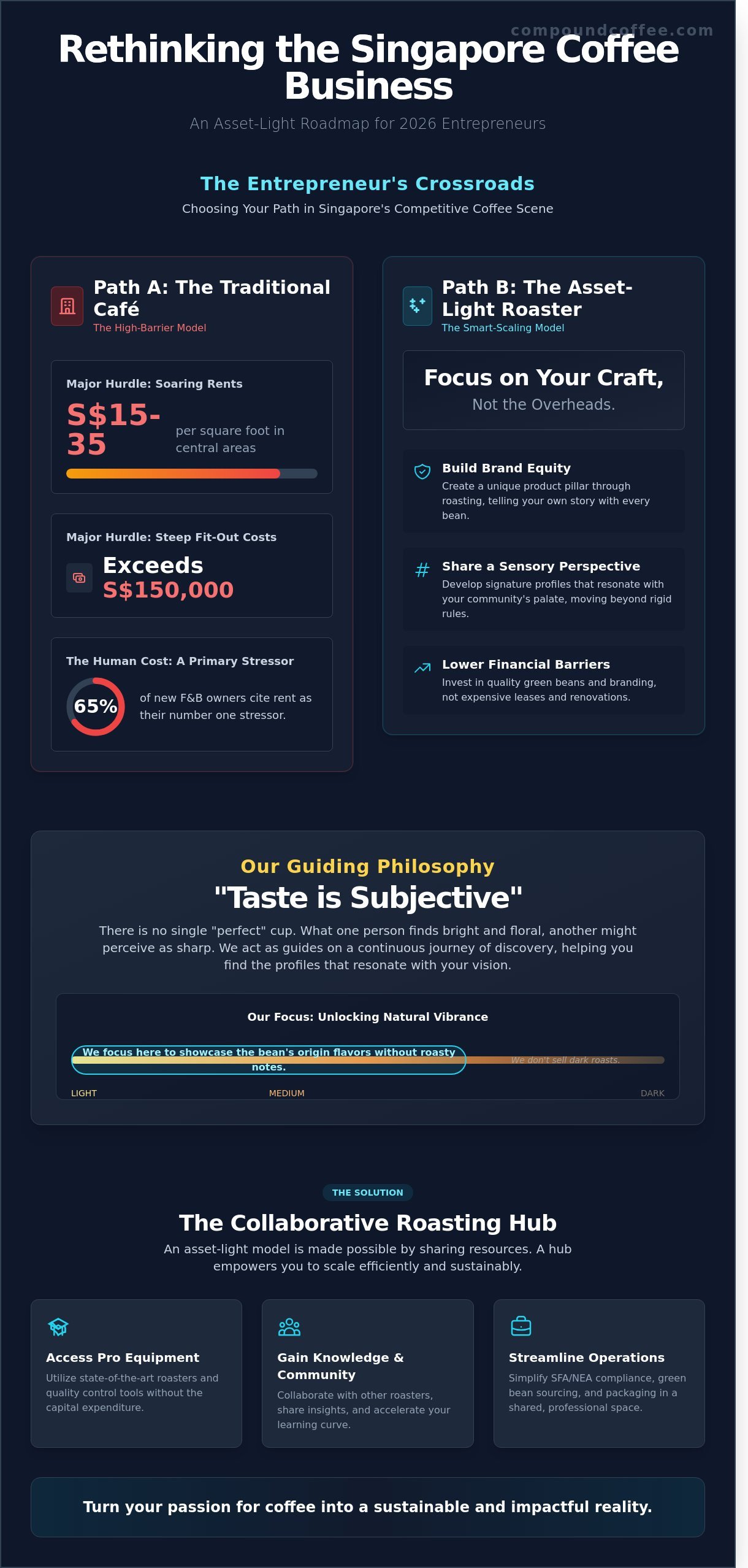
Starting a coffee business singapore entrepreneurs often find themselves at a crossroads. The traditional brick-and-mortar cafe remains a dream for many, but the financial reality in Singapore can be daunting. With shop rentals in central areas like Tanjong Pagar or Orchard often ranging from S$15 to S$35 per square foot, the initial capital required for a fit-out can easily exceed S$150,000. This high barrier to entry is why we encourage exploring asset-light alternatives that focus on the coffee itself rather than just the furniture.
The roaster-retailer model has emerged as a powerful way to build brand equity. When you roast your own beans, you aren't just selling a beverage; you're sharing a specific sensory perspective. At Compound, we believe that taste is entirely subjective. Individuals perceive taste differently, so we don't dictate what a "perfect" cup should be. Instead, we provide the tools for you to find a profile that resonates with your community. It's important to remember that our focus remains on showcasing the natural vibrance of the bean. We don't sell dark roast coffee, as we find lighter roast profiles better preserve the unique characteristics of the origin. This clarity in our product offering helps our partners define their own niche in the coffee business singapore market.
For those who want to test the waters without a long-term lease, mobile coffee carts offer a flexible entry point. A professional setup can be launched for between S$5,000 and S$12,000. These carts are perfect for corporate pop-ups or weekend events at places like Marina Bay. Before serving your first cup, you'll need to visit Singapore's official business registration portal to handle your ACRA registration and check for necessary SFA food stall licenses. This path allows you to gather real-world data on customer preferences before committing to a permanent location.
The Rise of Micro-Roasters and Co-Roasting
The co-roasting space rental model provides a low-risk environment for aspiring roasters. Instead of investing S$40,000 in a commercial roaster, you can rent time on professional-grade machinery. This setup includes access to quality control tools like Lighttells color analyzers, which ensure your roast degrees are consistent batch after batch. It's a communal space where you can transition from a home roaster to a micro-business while learning alongside other passionate professionals. We see it as a platform where your curiosity leads to tangible growth.
Private Label and Wholesale Opportunities
If your passion lies in branding and community building, private label coffee creation allows you to launch a brand without managing daily roasting operations. We collaborate with you to co-create signature profiles that align with your vision. This model is particularly effective for targeting the B2B market. Many small brands in Singapore now successfully supply 30 to 60 kg of coffee monthly to boutique offices and smaller cafes. By focusing on wholesale, you build a scalable business with lower overheads. If you're ready to start your journey, you can explore our roasting services to see which path fits your goals.
The Product Pillar: Sourcing, Roasting, and the Subjectivity of Taste
Launching a successful coffee business singapore requires more than just a great location and a shiny espresso machine. It demands a deep, foundational understanding of the product itself. At Compound Coffee Co., we view coffee as a collaborative journey between the land, the farmer, the roaster, and finally, the person holding the cup. We don't see ourselves as gatekeepers of "correct" taste. Instead, we act as guides, helping you explore the vast landscape of flavors that specialty coffee offers.
Our philosophy centers on the idea that coffee is a living product. This means our approach to sourcing and roasting is never static. We're constantly learning, tweaking, and experimenting to find new ways to highlight the hard work of our partners at origin. We believe in empowering our community by sharing this knowledge openly, ensuring that every brand we help launch has a soul and a story to tell.
Sourcing Quality Green Beans with Purpose
Traceability isn't just a marketing buzzword for us; it's a commitment to the people who make our industry possible. We build intimate relationships with small farmers and their families, ensuring they receive fair compensation for their labor. When you source beans for your business, you're buying into a supply chain. By choosing transparently sourced coffee, you protect your brand's reputation and contribute to a sustainable ecosystem.
Take our Semendo Green Beans as a prime example. These beans from South Sumatra undergo a meticulous honey process, which bridges the gap between the clean acidity of a washed coffee and the heavy sweetness of a natural. Understanding these processing methods is vital. A natural process bean might spend 20 days drying in the sun, developing intense fruit notes, while a washed process highlights the bean's inherent acidity. We help you navigate these choices to find the profile that resonates with your vision.
The Art of Roasting: Experimentation over Dogma
Roasting is a tool we use to unlock a bean's potential, not a way to force a specific flavor onto it. We don't believe in a "perfect" roast that applies to everyone. Instead, we treat our roast profiles as guidelines. We focus exclusively on light to medium roasts because these profiles allow the unique characteristics of the origin, soil, and altitude to shine through. You won't find a Dark Roast in our range. We've found that heavy roasting often masks the very qualities we work so hard to source.
We encourage a "discovery" mindset in everything we do. Since 2021, we've developed over 150 unique roast profiles for various partners, and each one started with a conversation about preference. We believe taste is entirely subjective. It's a scientific fact that individuals perceive taste differently based on genetics and past experiences. What one person describes as "bright and citrusy," another might find "sharp." Neither is wrong. Our goal is to provide you with the technical expertise to find what you and your customers love, rather than telling you what you should like.
No Dark Roasts: We preserve the bean's natural sugars and acids by avoiding the carbonized flavors of dark roasting.
Hands-on Learning: We co-create roast profiles with you, ensuring your brand has a signature voice.
Community Focus: We believe a rising tide lifts all boats, sharing our research to elevate the entire coffee business singapore scene.
By respecting individual perception, we create a welcoming environment for everyone. Whether your customers are complete beginners or seasoned pros, the focus should always be on the joy of discovery. We provide the platform and the beans; you provide the unique perspective that brings your brand to life.
Essential Steps to Launching Your Coffee Venture in Singapore
Starting a coffee business singapore requires a blend of logistical precision and creative passion. It's about turning a dream into a functional, sustainable reality. We've seen many partners start this journey. The path is rarely a straight line, but following these foundational steps helps you build a brand that resonates with the local community. We're here to act as a friendly guide, helping you find your unique voice in a vibrant market.
Step 1: ACRA Business Registration. You'll begin by registering your entity with the Accounting and Corporate Regulatory Authority (ACRA). A Private Limited company is the standard choice for most entrepreneurs. It costs S$315 for the registration and name application. This structure provides a professional image and essential liability protection as you scale.
Step 2: Licensing and Hygiene. Secure your Food Shop License from the Singapore Food Agency (SFA). This costs approximately S$195 per year. You'll also need to ensure every staff member completes the Food Safety Course Level 1. These certifications aren't just hurdles; they're your commitment to the community's well-being.
Step 3: Sourcing Equipment. Sourcing equipment is where your vision becomes tangible. You'll need to decide between a traditional espresso setup or a more specialized filter coffee focus. A high-quality two-group espresso machine can range from S$12,000 to S$25,000. We recommend machines that offer thermal stability and ease of maintenance. This ensures your team spends more time brewing and less time troubleshooting.
Step 4: Developing Your Menu. Developing your menu is a collaborative process of discovery. We'll work together to find coffee profiles that speak to your brand. At Compound, we focus on light to medium roasts to preserve the delicate floral and fruity notes of the beans. We don't sell dark roast coffee, as we believe the high heat can mask the farmer's hard work. Because flavor is subjective, we'll help you create a range that invites your customers to explore their own preferences. To broaden your appeal, consider high-quality non-coffee options; international brands like Worker Bee MCR Tea & Coffee can serve as great inspiration for your tea menu.
Step 5: Team Empowerment. Training is the heartbeat of your cafe. Invest in your team early to build a culture of excellence and curiosity.
Beyond these business steps, remember that the founder's health is the most critical asset. The stress of launching a venture can manifest in various ways, including hair and scalp issues. For local entrepreneurs seeking professional support in this area, you can discover Terra Medical, a Singapore-based clinic dedicated to hair restoration.
Navigating Licenses and SG Regulations
Understanding the difference between a retail cafe and a food processing facility is vital for your coffee business singapore. If you plan to roast or pack coffee for wholesale, you'll need a Food Establishment License. Check the Urban Redevelopment Authority (URA) zoning for your chosen unit. Many industrial units (B1) allow for food processing but have strict rules about retail. You can often tap into the Productivity Solutions Grant (PSG) to offset up to 50% of your equipment costs. This financial support helps you scale without compromising on quality.
Building a Skilled Team Through Hands-on Training
A great cafe isn't just about the beans; it's about the people. We believe that professional coffee workshops and classes are the best way to keep your team engaged and reduce turnover. When baristas master the V60 technique or learn the nuances of espresso calibration, they feel a sense of ownership. Every individual perceives taste differently, so we teach your team to guide customers through their own sensory discovery. This creates a culture where learning is constant and passion is shared. It transforms a daily job into a lifelong craft.
Ready to bring your vision to life?
Partnering for Success: How Compound Coffee Co. Empowers Your Vision
Compound Coffee Co. operates as more than a roastery; it's a dedicated platform for people who live and breathe specialty beans. We've built our facility to be a one-stop solution for anyone ready to dive into the coffee business singapore market. You don't need to navigate the steep costs of industrial equipment or the complexities of green bean sourcing alone. We provide the infrastructure, the knowledge, and the community support to turn your passion into a tangible brand. Our space is a hub where professionals and enthusiasts meet to push boundaries, share cupping spoons, and explore the endless possibilities of flavor.
We believe that a rising tide lifts all boats. This philosophy drives us to share our resources freely, from our direct relationships with small-scale farmers to our experimental roasting data. By joining our ecosystem, you gain access to a network that values growth through shared experience. We frequently host farm trips, like our visit to coffee producers in late 2023, and hold regular cupping sessions where we deconstruct profiles together. These events aren't just about learning; they're about building a business that's rooted in the human stories behind every harvest.
From Concept to Signature Blend
Your brand needs a flavor profile that stands out. We work alongside you to co-create filter coffee or espresso profiles that reflect your specific vision. Our team provides the technical support needed to ensure consistency, using advanced tools like colorimeters and moisture meters to track every batch. We've helped over 28 local entrepreneurs launch their labels since we started. For example, one Singaporean startup moved from a home-roasting concept to a fully operational retail brand in less than 20 days using our facility. We focus on highlighting the bean's natural character through light and medium roasts; please keep in mind we don't sell dark roast coffee. We'll help you find a profile that resonates with your palate while acknowledging that taste is entirely subjective.
Joining a Community of Passionate Mentors
Success in the specialty coffee world requires more than just a good product; it requires a mindset of constant discovery. Our mentors act as friendly guides rather than rigid authorities. We don't believe there's a single "best way" to brew or roast. Instead, we encourage you to experiment and find what works for your unique audience. Every individual perceives taste differently, and we celebrate that diversity in every workshop we host. Our sessions are designed to be hands-on and accessible, stripping away the snobbery often found in the industry. Whether you're a complete beginner or a seasoned pro, you're here to learn and grow. We invite you to take the first step by joining one of our discovery-focused workshops to see how we can help you scale. Empower your coffee business journey with us today.
Building a coffee business singapore requires agility and a willingness to learn. At Compound Coffee Co., we offer the space to fail safely and the expertise to succeed quickly. We've invested over S$250,000 in roasting technology and quality control lab equipment so you don't have to. This allows you to focus on your customers and your brand story while we handle the technical heavy lifting. Join us, and let's explore the future of coffee together, one roast at a time.
Bring Your 2026 Coffee Vision to Life
The landscape for a coffee business singapore is shifting toward diverse models that prioritize craft and community over rigid traditions. Success in 2026 requires more than a storefront; it demands a deep understanding of your unique flavor profile and a constant willingness to experiment. Since taste is entirely subjective, there's no single right way to roast or brew. We focus on helping you find what works for your specific palate, though we choose not to offer dark roast profiles in our current lineup. You don't have to navigate this path alone.
Our comprehensive facility at Techlink Singapore provides the specialized tools and space your brand needs to scale effectively. We've built direct relationships with coffee producers to ensure every bean is ethically sourced and reflects the farmer's hard work. Whether you're starting from scratch or looking to expand, our passionate mentor-led workshops offer hands-on guidance for all skill levels. We're excited to share this journey of discovery with you. Launch your coffee brand with our professional co-roasting and private label services. Your unique contribution to the local coffee community is just one roast away.
Frequently Asked Questions
How much does it cost to start a coffee shop in Singapore in 2026?
Starting a coffee shop in Singapore in 2026 typically requires a capital investment between S$120,000 and S$250,000 for a standard 600-square-foot unit. This budget covers your initial SFA licensing fees, a 3-month rental deposit, and interior fit-outs which often cost S$150 per square foot. You'll also need to budget for high-quality espresso machines and grinders. Every journey is unique; your specific costs will shift based on your vision and the community you want to build.
Do I need a license to sell roasted coffee beans online in Singapore?
You need to register your business with ACRA and obtain a Food Business License from the Singapore Food Agency (SFA) to sell roasted beans online. If you're operating from home under the Home-Based Business Scheme, you must follow specific SFA hygiene guidelines. For those looking to scale a coffee business singapore entrepreneurs often use shared licensed facilities to ensure compliance with the 2002 Sale of Food Act. It's about finding a path that fits your current stage of growth.
What is the difference between a Kopitiam and a specialty coffee business?
The primary difference lies in the bean variety, roasting style, and brewing technique used to create the final cup. Kopitiams traditionally use Robusta beans roasted with sugar and margarine; specialty businesses focus on high-quality Arabica beans that highlight specific farm origins. We don't believe one is better than the other because taste is entirely subjective. While many enjoy the traditional Nanyang brew, our focus is on exploring the diverse flavor profiles found in light to medium-light specialty roasts.
Can I roast my own coffee beans for my business without buying a roaster?
Yes, you can utilize co-roasting spaces or roasting-as-a-service platforms to produce your own beans without the S$50,000 upfront cost of a commercial roaster. This hands-on approach allows you to experiment with different profiles while leveraging professional-grade equipment. It's a fantastic way to learn the craft and empower your brand's identity. At Compound, we've seen many partners launch successful labels by using our shared facility to co-create their signature profiles and learn through experimentation.
How do I find reliable green coffee bean suppliers in the region?
You can connect with reliable suppliers through regional trade hubs like the Singapore Coffee Association or by visiting origin countries like Indonesia and Vietnam. Direct trade relationships are ideal, as 85% of specialty coffee quality is determined at the farm level. We recommend attending the Specialty Coffee Expo or reaching out to local importers who prioritize transparency and fair pricing for small farmers. Building these community links helps ensure your beans have a story you're proud to share.
Is a barista certification mandatory for opening a cafe in Singapore?
No formal barista certification is legally mandatory to open a cafe, but the SFA requires at least one staff member to pass the Food Safety Course Level 1. While a certificate isn't required, gaining hands-on knowledge through workshops can significantly boost your confidence. We believe in continuous learning and experimentation rather than just collecting titles. Your customers will value the quality of the experience and the passion in your craft more than a piece of paper on the wall.
What are the most popular coffee flavor profiles for Singaporean consumers?
Singaporean palates are incredibly diverse, though many drinkers currently gravitate toward nutty, chocolatey, or bright stone-fruit notes. Recent 2024 market surveys show a 25% increase in demand for floral and acidic profiles, like those found in Ethiopian Yirgacheffe. Since individuals perceive taste differently, there's no single best profile for a coffee business singapore menu. We focus on showcasing the natural sweetness of the bean; please note we don't offer dark roast coffee as we prefer to highlight more delicate nuances.
How can I incorporate sustainable practices into my coffee business?
You can start by sourcing beans from farms that use regenerative agriculture or by implementing a circular waste system for your spent coffee grounds. Switching to FSC-certified compostable packaging can reduce your plastic footprint by 40% based on current 2025 industry benchmarks. Sustainability is a shared journey between the roaster, the cafe, and the consumer. We encourage you to explore small, impactful changes that respect the environment and empower the unsung heroes at the start of the supply chain.


Comments