

Tiong Hoe Coffee and the Evolution of Singapore’s Specialty Scene
Updated: Apr 5
What if the secret to a perfect cup has nothing to do with technical jargon like "extractability" and everything to do with your own unique palate? It's common to feel a bit lost when complex terms start flying across the counter, especially when you're just trying to enjoy a cup of Tiong Hoe coffee. You might even worry that you're brewing it "wrong" because you didn't follow a barista's exact, rigid instructions. We believe that taste is entirely subjective. How you perceive a floral note or a nutty finish is your own personal journey, not a test you need to pass.
In this guide, we'll explore the deep roots of this local icon, a name that has been synonymous with quality in Singapore since Mr. Tan Tiong Hoe started his roasting journey in the 1960s. We'll show you how to move past the fear of authority and embrace a hands-on approach to learning. You'll discover how to trust your senses rather than just following rules. We're looking at how heritage meets modern discovery to help you find a community where your curiosity can finally thrive.
Key Takeaways
Discover the foundational legacy of Tiong Hoe Coffee and how its evolution from the 1960s shaped the vibrant specialty scene we enjoy in Singapore today.
Understand the shift from traditional roasting to highlighting unique origin terroir, and why exploring lighter profiles can reveal hidden complexities in your cup.
Learn to navigate your own sensory preferences without rigid rules, embracing the idea that the "best" coffee is simply the one that tastes right to you.
Gain the confidence to move from consumer to creator through hands-on brewing practices and an introduction to the transformative science of roasting.
Find out how to use professional "Rent-a-Roaster" facilities to empower your personal coffee journey and connect with a community of like-minded enthusiasts.
Table of Contents
Tiong Hoe Coffee: A Pillar of Singapore’s Specialty Scene
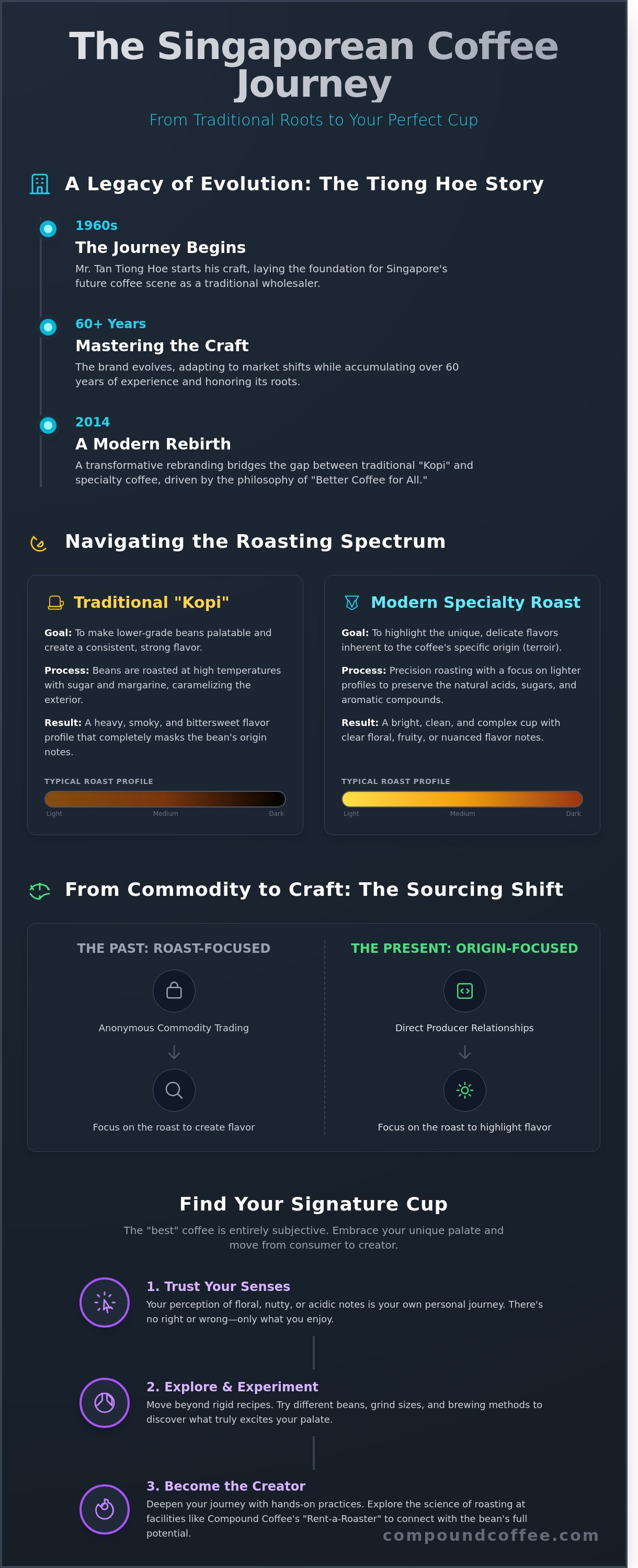
Tiong Hoe Coffee isn't just a roastery; it's a living archive of Singapore’s caffeine culture. Mr. Tan Tiong Hoe began his journey in the 1960s, long before the city-state became a global hub for refined palates. He didn't just roast beans; he studied the craft with a hunger that paved the way for future generations. This legacy provides a unique perspective on what is specialty coffee, blending old-school grit with new-age precision.
The Story Behind the Name
The name carries the weight of over 60 years of experience. Starting as a traditional wholesaler, the brand evolved as the local market's preferences shifted. Heritage brands often struggle to stay relevant, but tiong hoe coffee maintained its status by being a student of the bean first. They've shown that honoring your roots doesn't mean staying stuck in the past. Instead, they use their history as a platform to explore modern techniques. It's a reminder that while the industry changes, the human connection to a good cup remains constant. We believe that understanding where your coffee comes from is the first step in a lifelong journey of discovery.
Bridging the Gap Between Eras
In 2014, the brand underwent a transformative rebranding led by Jacob Tan and Juliana. This wasn't just a logo change; it was a strategic shift to bridge the gap between commercial "kopi" and high-scoring specialty origins. Their "Better Coffee for All" philosophy resonates with our mission at Compound Coffee to empower every drinker. We believe taste is entirely subjective. Your perception of a floral Ethiopian or a nutty Brazilian is yours alone, and there's no single "correct" way to enjoy a brew.
By introducing modern brewing technology and accessible formats like capsules, they've made premium flavors approachable for the everyday consumer. While they've embraced the third-wave movement, tiong hoe coffee remains a familiar, trusted face in a sea of new roasters. They offer a diverse range of roasted beans to suit different preferences. At Compound Coffee, we share this passion for quality, though we choose to focus on light and medium profiles and don't currently sell dark roast coffee. This variety in the Singaporean scene ensures that every individual can find a profile that speaks to their specific palate.
Navigating the Spectrum: Traditional vs. Specialty Roasts
Singapore's coffee landscape is a vibrant mosaic of old and new. You'll find everything from the smoky, caramelized notes of traditional Nanyang kopi to the bright, acidic profiles favored by modern specialty roasters like tiong hoe coffee. This diversity reflects the maturing Singaporean coffee market, where a 2021 industry report highlighted a significant surge in consumer interest for single-origin transparency. We see roasting as a bridge between the farm and your cup. Every roaster searches for a 'sweet spot' that highlights the bean's inherent character, though these spots vary based on the roaster's philosophy.
There are no rigid rules in this journey, only guidelines to help you explore. We believe that taste is deeply personal. Individuals perceive taste differently; what one person describes as 'vibrant acidity,' another might find 'sharp.' Our goal is to empower you to find what resonates with your own palate through experimentation and an open mind.
Heritage Roasts and Modern Palates
Traditional Singaporean 'Kopi' was born from a need to make lower-grade beans palatable. Roasting them with sugar and margarine created a heavy, comforting brew that remains a cultural staple. Today, we see a shift. Many cafes and roasters, including tiong hoe coffee, have moved toward lighter roast profiles. This style preserves the delicate floral and fruity notes that are often lost in longer roasts. At Compound Coffee, we don't sell Dark Roast Coffee. We prefer roast levels that balance extractability with the clear expression of a coffee's origin. It's about finding that middle ground where the bean's natural sweetness shines without being overshadowed by the roast itself.
The Evolution of Sourcing
Sourcing has evolved far beyond simple commodity trading. Modern roasting is now defined by intimate relationships with coffee producers. By working directly with small-holder families, roasters can ensure sustainability and fair compensation. This connection dictates the final flavor in your cup. When a roaster understands the specific terroir of a farm in Semendo or Ethiopia, they can tailor their roast to honor that environment. These sourcing philosophies transform coffee from a caffeine source into a shared experience between the farmer and the drinker. If you want to see how these different origins impact flavor, you might enjoy exploring our collection of roasted beans to start your own tasting journey.
Finding Your Signature Cup: A Guide to Subjective Taste
Coffee is a deeply personal journey. We believe there's no single "correct" way to enjoy a brew because your palate is unique. While exploring Tiong Hoe Specialty Coffee's legacy reveals how Singapore's scene has matured, the goal remains the same: finding what makes you smile. You might love a heavy, chocolatey body, while your friend prefers a bright, tea-like acidity. Both are valid. At Compound Coffee, we celebrate these differences by focusing exclusively on light and medium roast profiles. We don't offer dark roasts because we want the intrinsic characteristics of the bean to shine through without being masked by heavy carbonization.
Building a tasting vocabulary doesn't require a certificate. Start by identifying broad categories. Is the coffee sweet like brown sugar or tart like a green apple? Does it remind you of roasted peanuts or a floral jasmine tea? Don't worry about being "wrong." If you taste blueberries in your tiong hoe coffee, then those blueberries are real to you. This experimentation is how you move from a casual drinker to a confident enthusiast. We're here to provide the map, but you're the one driving the exploration.
Espresso vs. Filter: Which Suits Your Routine?
Your choice often depends on how you start your morning. If you love the velvety texture of a flat white or a latte, our espresso collection provides the structure needed to cut through milk. For those who crave clarity and nuance, the delicate world of filter coffee offers a clean window into the bean's origin. Try experimenting with your brewing ratios. A 1:15 ratio might feel too intense, while a 1:17 ratio brings out hidden floral notes. It's about finding your personal sweet spot through small, hands-on adjustments.
Single Origin or Blend?
Blends are the reliable anchors of a daily ritual. They're crafted for consistency, ensuring your 7:00 AM cup tastes exactly how you expect every single time. In contrast, single origins offer a "taste of place" that changes with the seasons. A coffee like the Semendo Honey (typically priced around S$22.00) provides a unique profile specific to its Indonesian soil and honey processing. Your preference might shift based on your mood. A balanced blend works for a busy Monday, but a vibrant single origin is perfect for a slow Sunday afternoon when you have time to savor every sip.
Deepening the Journey: From Coffee Drinker to Creator
Transitioning from someone who drinks coffee to someone who creates it is a deeply personal evolution. It's a shift from passive enjoyment to active exploration. While established names like tiong hoe coffee provide a fantastic benchmark for quality in Singapore, your own journey starts when you pick up the kettle yourself. This path isn't about reaching a single "perfect" destination; it's about discovering what tastes best to you through hands-on practice.
The process of becoming a coffee creator involves four intentional steps:
Master the basics: Spend time with your equipment daily. Repeatability is the foundation of experimentation.
Analyze the science: Learn how heat energy interacts with the cellular structure of the bean during the brewing process.
Micro-batch roasting: Use small amounts of beans to test how different roast durations impact the final flavor profile.
Gather feedback: Join a community of enthusiasts. Sharing a cup with others often reveals subtle notes you might've missed.
Hands-on Coffee Workshops
Confidence comes from doing. Reading about a V60 pour is one thing; feeling the resistance of the water as you pour is another. Taking a coffee class is often the most efficient way to bridge that gap. In a supportive, non-judgmental space, you can fail, adjust, and eventually succeed. Whether you're refining your latte art or perfecting a filter brew, sensory-based learning helps you trust your own tongue. Since everyone perceives flavors differently, we focus on giving you the tools to brew what you love rather than following a rigid set of rules.
In a city as multicultural as Singapore, many find that the passion for mastering a craft like coffee extends to other valuable skills, and for those looking to learn Mandarin, Chinese Edge offers a similar hands-on approach.
The Thrill of Roasting Your Own
Roasting at home demystifies the entire supply chain. While tiong hoe coffee might be your go-to for a reliable daily fix, roasting your own beans allows you to explore the raw potential of the coffee cherry. You can start with high-quality green coffee beans and a simple setup. It's a continuous experiment. We don't sell dark roast coffee at Compound Coffee Co. because we prefer the vibrant, complex notes found in lighter roasts, but we encourage you to find your own sweet spot. Treat every batch as a lesson. You can start your roasting journey in Singapore for under S$50 with basic home equipment and a curious mind.
Ready to start your roasting adventure? Explore our roasting guides to begin your journey.
Compound Coffee Co.: A Hub for the Local Community
At Compound Coffee Co., we see ourselves as more than just a roastery; we're a platform where discovery meets empowerment. We don't believe in being absolute authorities. Instead, we act as friendly guides on a shared journey. We know that taste is entirely subjective. Individuals perceive taste differently, and what one person loves, another might not. While established names like tiong hoe coffee have built a long-standing legacy in the Singapore scene, we focus on providing the tools for the next generation of enthusiasts to find their own voice. Our philosophy is that a rising tide lifts all boats. When we share knowledge and resources, the entire coffee community grows stronger together.
Our Co-Roasting Space
We've opened our facility to micro-roasters who have a clear vision but lack access to industrial machinery. Professional roasting equipment can cost upwards of S$20,000, which is a massive barrier for most people. Our co-roasting space changes that. You can check out our ultimate roasting intro to see how you can start using these professional tools yourself. By providing shared facilities, we've helped over 15 local micro-labels launch their own unique profiles since 2019. It's about creating a vibrant ecosystem where experimentation is encouraged and the barrier to entry is lowered for everyone in Singapore.
Empowering Your Coffee Passion
We're committed to supporting your specific goals, whether that's launching a private label or hosting a corporate team bonding session. Our lab is a space for constant research. We're always pushing boundaries to see what's possible with new processing methods and brewing techniques. We don't follow rigid rules; we offer guidelines to help you explore. It's also vital to mention that we don't sell dark roast coffee. We've found that lighter roast profiles better preserve the delicate, floral, and fruity notes that make specialty beans unique.
Whether you're a fan of the traditional profiles found at tiong hoe coffee or you're looking for something experimental and modern, we're here to help you learn. We invite you to visit our facility in person to see the craft in action. You can also explore our latest seasonal selections of roasted beans to start your own tasting journey at home. We're excited to see where your curiosity takes you.
Your Next Chapter in Singapore's Coffee Story
The journey from the traditional roots of tiong hoe coffee to the vibrant specialty scene we see today reflects a shared passion for the craft. You've seen how Singapore's landscape evolved through the dedication of pioneers like Tan Tiong Hoe since the 1960s. We believe that your personal taste is the only metric that truly matters. Whether you're brewing at home or exploring our facility, there's no single "right" way to enjoy your cup. We focus on lighter and medium profiles because we don't sell dark roast coffee; the final flavor is always up to your individual perception.
We're here to help you move from coffee drinker to creator through our passionate mentor-led workshops and direct-trade relationships with coffee producers. As Singapore's premier co-roasting facility, we provide the tools for you to experiment and grow. Explore our curated selection of roasted beans and start your discovery today.
It's time to trust your palate and enjoy every sip of this shared journey.
Frequently Asked Questions
Where is Tiong Hoe Specialty Coffee located in Singapore?
Tiong Hoe Specialty Coffee's flagship heritage store is located at 170 Stirling Road, #01-1133, Singapore 140170. This iconic location has been a staple in the Queenstown neighborhood since the 1960s. You can also visit their other coffee bars at VivoCity and Fusionopolis to enjoy their latest seasonal offerings.
Each location provides a unique atmosphere for exploring tiong hoe coffee and its rich history. Whether you're at the original Stirling Road shop or a modern mall outlet, the focus remains on a friendly, communal experience. Their team is always ready to share stories about the beans currently in their hoppers.
Is Tiong Hoe Coffee halal certified?
Tiong Hoe Specialty Coffee isn't currently MUIS halal certified. While their coffee beans and brewing processes don't involve alcohol or animal byproducts, they haven't applied for the official certification. We recommend checking their latest menu or speaking with the baristas if you have specific dietary requirements or preferences.
Because individuals perceive taste and ingredients differently, the staff is trained to be transparent about what goes into every cup. They're happy to act as your guide, helping you find a drink that fits your lifestyle. It's all about making sure you feel comfortable and empowered in your coffee journey.
What is the difference between traditional Kopi and Tiong Hoe's specialty coffee?
Traditional Kopi typically uses Robusta beans roasted at high temperatures with sugar and margarine to create a bold, charred flavor. Tiong Hoe focuses on specialty Arabica beans, which are roasted to highlight natural characteristics like fruitiness or floral notes. Neither style is objectively better; they simply offer different experiences for your palate.
Specialty coffee often involves a more transparent supply chain, focusing on the hard work of small farmers. When you drink tiong hoe coffee, you're tasting the specific terroir of the region where the beans grew. It's a great way to discover how varied coffee can taste when it's not masked by heavy roasting additives.
Can I buy Tiong Hoe coffee beans online for home brewing?
You can buy a wide variety of tiong hoe coffee beans through their official website or at any of their three physical stores. Prices generally start around S$18 for a 250g bag, featuring both signature blends and rotating single origins. They provide options for whole beans or specific grinds to suit your home setup.
We encourage you to experiment with different origins at home to see what resonates with you. Since taste is subjective, buying smaller bags is a fantastic way to explore without commitment. Don't be afraid to try a bean from a region you've never heard of before.
Does Compound Coffee sell dark roast coffee like traditional brands?
Compound Coffee doesn't sell dark roast coffee. We choose to focus on light and medium roasts because these profiles better preserve the delicate, intrinsic flavors of the coffee cherry. We believe this approach honors the farmers' efforts and provides a clearer window into the bean's true personality.
If you're used to very dark roasts, we invite you to explore our medium roast options. You might find that you enjoy the natural sweetness and vibrant acidity that's often lost in a darker roast. It's an invitation to discover a different side of the coffee spectrum at your own pace.
How can I learn to roast coffee like the professionals at Tiong Hoe or Compound?
Learning to roast is a hands-on process that starts with understanding how heat affects the cellular structure of a coffee bean. Compound Coffee offers roasting workshops where we share our techniques and help you develop your own roasting style. We don't teach a single "correct" way to roast because every bean and every palate is unique.
Our goal is to provide you with the knowledge and tools to experiment confidently. You'll learn about the drying phase, the first crack, and how to manage airflow to achieve your desired profile. It's a journey of discovery that turns a complete beginner into a confident enthusiast.
What are the best brewing methods for Tiong Hoe’s signature blends?
A V60 dripper or an AeroPress are excellent methods for brewing Tiong Hoe's blends if you want to highlight clarity and nuance. These manual methods allow you to control variables like water temperature and pour speed, which can drastically change the final cup. We often suggest a starting ratio of 1:15, or 15g of coffee to 225ml of water.
Remember that these ratios are just guidelines, not rigid rules. If you prefer a heavier body, you might try a French Press or a shorter brew time. The best method is the one that produces a cup you truly enjoy drinking every morning.
Does Tiong Hoe offer coffee workshops for beginners?
Tiong Hoe regularly hosts workshops that cover coffee appreciation, basic brewing, and even latte art for those starting their journey. These sessions are designed to be inclusive and non-intimidating, perfect for anyone curious about the world of specialty beans. They focus on practical skills you can actually use in your own kitchen.
Similarly, at Compound, we offer "GOATED" workshops that aim to empower you through hands-on experience. Whether you're learning at Tiong Hoe or with us, the focus is on community and shared learning. We want to help you find your own preferences rather than telling you what you should like.


Comments