

The Community Coffee: 5 Signs You Are Ready for a Speciality Workshop in 2026
Updated: Apr 3
What if the secret to a perfect morning cup isn't a S$3,000 espresso machine, but simply knowing how your own palate works? Around 70% of coffee lovers in Singapore spend over S$500 a year on premium beans only to end up with a bitter brew that tastes nothing like the notes on the bag. You might feel like an outsider when the community coffee scene seems more interested in technical jargon than actual enjoyment. We've all been there, standing in a cafe, staring at a wall of light and medium roasts, wondering why "stone fruit acidity" sounds more like a chemistry project than a drink.
You likely agree that coffee should be a source of joy, not a source of stress or expensive mistakes. We're here to help you move past the beginner label and find your own rhythm as a home brewer. This guide will show you how to identify the right moment to step into a hands-on learning environment without the snobbery. You'll discover five clear signs that you're ready to join a specialty workshop in 2026, where we'll explore subjective taste and help you gain the confidence to brew better coffee at home.
Key Takeaways
Understand how the community coffee concept in Singapore has evolved from simple transactions into a collaborative ecosystem that empowers everyone from small-scale farmers to home brewers.
Learn to identify the subtle signs—like noticing the distinct notes of Ethiopian versus Colombian beans—that suggest you are ready to join a hands-on specialty workshop.
Discover why we treat coffee brewing as a subjective journey of exploration rather than a set of rigid rules, helping you find the specific profiles that resonate with your unique palate.
Explore how intimate sourcing relationships and a focus on vibrant, lighter roast profiles create a more meaningful and transparent "farm-to-cup" experience.
Get a glimpse into the professional tools and platforms available in Singapore, including unique opportunities to roast your own signature coffee and launch your own label.
Table of Contents What Does 'The Community Coffee' Concept Mean in Singapore? The Art of Sourcing and Roasting for the Collective 5 Signs You Are Ready to Join a Coffee Workshop Finding Your Palate: A Guide to Subjective Flavour Join the Hub: How Compound Coffee Co. Empowers Your Discovery
What Does 'The Community Coffee' Concept Mean in Singapore?
In Singapore, the community coffee isn't just a caffeine fix; it's a living, breathing ecosystem. It connects the hands of smallholder farmers in regions like Sumatra to the home brewer in a Tampines HDB flat. This concept represents a shift from the transactional "buy and leave" cafe model of the early 2000s to the collaborative educational hubs we see today. We believe that a thriving coffee culture requires a humble and open approach. There isn't a single "best" way to brew a cup. Instead, we offer guidelines to help you find what resonates with your unique palate.
This shared ethos is what defines the community coffee in 2026. It's about moving away from gatekeeping and toward a "rising tide lifts all boats" philosophy. By focusing on transparency and accessibility, we ensure that every person in the chain feels empowered. Whether you're a roaster or a casual drinker, your contribution to the conversation matters.
The Evolution of Specialty Coffee in the Lion City
Singapore's relationship with beans has transformed since the first wave of specialty shops arrived around 2011. While traditional kopi remains a cultural staple, the growth of micro-roasters and shared roasting spaces has empowered a new generation of enthusiasts. The history of coffee culture shows that coffeehouses have always been centers for social exchange; Singapore is no different. By 2025, the local market saw a 15% increase in home brewing equipment sales, signaling a shift toward DIY mastery. This evolution is about empowerment. We provide the platform, but you bring the curiosity. At Compound Coffee Co., we don't sell dark roast coffee. We focus on lighter profiles to highlight the bean's natural character, encouraging a different kind of appreciation.
Why We View Coffee as a Shared Journey
We see the relationship between a roaster and a home brewer as a partnership. When you pick up a bag of filter coffee, you aren't just buying a product; you're joining a shared experiment. Since everyone perceives flavor differently, we don't issue commands. We share knowledge to elevate the experience for everyone. Sharing a V60 technique or discussing the nuances of our Semendo Honey helps us all grow. It's about empowering you to become a confident pro in your own kitchen. Your palate is your own. Science tells us genetic variations mean we all experience bitterness and acidity at different thresholds. We treat every cup as a conversation, not a lecture.
The Art of Sourcing and Roasting for the Collective
Coffee is more than a beverage; it's a bridge between the farmer and your morning cup. We believe that an intimate relationship with producers is the only way to ensure the quality of the community coffee remains high. When we pay fair prices or visit farms in regions like Sumatra, we're not just buying a commodity. We're investing in a philosophy where a rising tide lifts all boats. This approach means a farmer can afford better processing equipment, which leads to a more vibrant cup for you in Singapore. It's a cycle of empowerment that starts at the origin and ends in your mug.
Empowering Farmers Through Direct Relationships
Sourcing directly impacts the lives of small farmers and their families. By removing unnecessary middlemen, more of your S$6 or S$7 latte goes back to the source. Transparency in the supply chain strengthens the Singapore coffee community by building trust. It ensures that the community coffee we share is ethically produced and exceptionally flavorful. We encourage everyone to explore the unique story behind their roasted coffee beans. Whether it's a specific lot from a family-run estate or a cooperative effort, knowing the origin changes how you perceive the flavor. In 2026, as the local scene matures, drinkers are looking for this deeper connection to the land.
Roasting as a Guideline, Not a Rule
We see roasting as a way to unlock a bean's natural character, not to dictate what you should taste. Taste is inherently subjective. Individuals perceive taste differently, and what one person finds bright, another might find tart. We avoid dogmatic roasting styles to remain open to experimentation. Our focus remains on light and medium roasts to preserve the floral, fruity, or nutty notes inherent in the soil. You won't find dark roast coffee in our selection. We've found that heavy roasting often masks the very qualities we work so hard to source.
For those looking to deepen their technical understanding, the SCA Coffee Skills Program provides an excellent framework for these concepts. Different roast profiles suit specific methods; for instance, a vibrant light roast is often the perfect match for filter coffee. If you're curious about how these roast profiles change the way you brew at home, consider joining us for a hands-on workshop to explore your own palate.
5 Signs You Are Ready to Join a Coffee Workshop
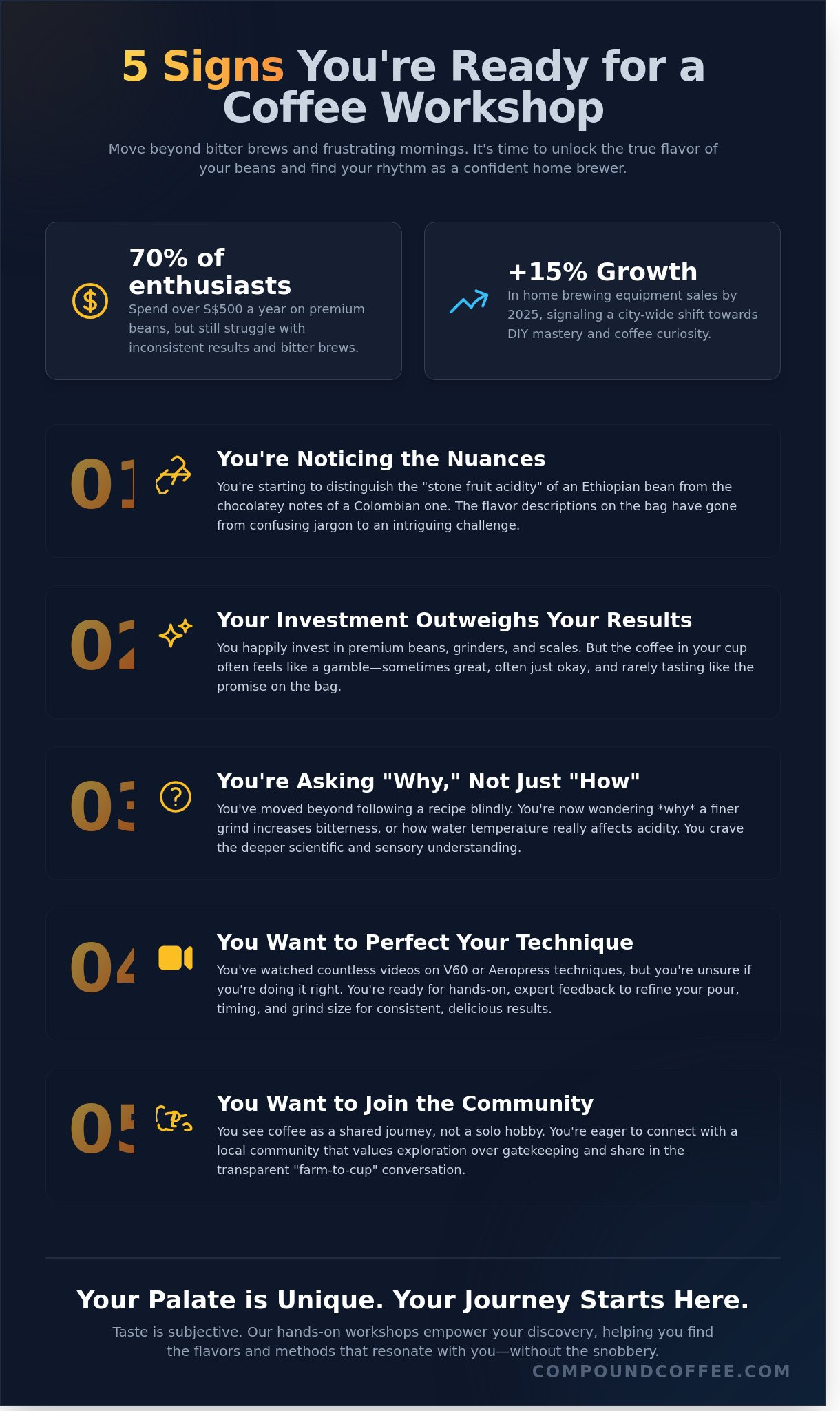
Your morning cup has shifted from a quick jolt of energy to a ritual you actually look forward to. Perhaps you've started picking up the floral notes of a washed Sidama or the nutty sweetness of a Huila; recognizing these subtle differences between origins like Ethiopia and Colombia is a major milestone. If you find yourself checking the roast date or wondering why your V60 brew tasted better at 92°C than 96°C, you're hitting the threshold of a deeper journey. It's about moving past just "making coffee" to understanding the variables that shape every sip. You're likely looking for the community coffee enthusiasts are building in Singapore, where shared discovery replaces solo experimentation.
You probably have an insatiable hunger to understand the "why" behind the grind. Instead of just following a static recipe from a website, you're ready to start experimenting with your own profiles to see how agitation or water chemistry changes the final cup. This level of curiosity is the clearest indicator that you've outgrown basic tutorials. You want to meet like-minded people who don't think talking about "extraction percentages" is overkill. Joining a session is the best way to find the community coffee lovers have created to support one another's growth.
Transitioning from Beginner to Confident Brewer
The fastest way to bridge the gap between "good enough" and "exceptional" is a hands-on coffee class. In these sessions, we strip away the intimidation. You'll learn in a space that values your personal palate because we know everyone perceives taste differently. Group settings are perfect for this; hearing a peer describe a "stone fruit" note while you taste "caramel" helps build a shared vocabulary. This environment is intentionally non-snobbish, focusing on empowering you to trust your own senses rather than following rigid rules.
What to Expect in a Modern Specialty Workshop
Expect to get your hands dirty with sensory analysis. You'll use tools like The Coffee Taster's Flavor Wheel to put names to the sensations on your tongue. Modern workshops focus on practical skills you can use on your own S$500 setup at home, not just industrial machines. You'll stop being a passive consumer and start acting as a coffee creator. Since we don't currently sell dark roast coffee, our workshops focus on preserving the unique terroir of the bean. You'll learn to adjust grind sizes by microns to highlight natural acidity and sweetness, making every bag of beans a fresh opportunity for discovery.
Finding Your Palate: A Guide to Subjective Flavour
You don't need a "golden tongue" to appreciate specialty coffee. At its heart, taste is entirely subjective. What one person describes as "bright citrus" might taste like "sharp lime" to you, and both are completely valid. Being part of the community coffee movement in Singapore means embracing the fact that your palate is unique. We don't believe in a single "correct" way to enjoy a brew. Instead, we focus on helping you find what makes your morning cup exciting.
To start identifying your preferences, look at three main pillars: acidity, sweetness, and body. Acidity isn't "sourness" in a bad way; it's the pleasant zing you find in a S$0.50 calamansi or a green apple. Sweetness is that smooth, lingering quality found in ripe fruit. Body is the weight of the coffee on your tongue, similar to the difference between drinking plain water and drinking full-cream milk. Experimentation beats perfection every time. Don't worry about hitting a "pro" standard immediately. Focus on changing one variable at a time to see how the flavour shifts.
Developing Your Personal Taste Profile
Keep a simple tasting journal at home. You don't need fancy jargon. Just record the bean name, the date, and whether you liked it on a scale of 1 to 10. Comparing two different beans side-by-side is the fastest way to learn. Try a floral Semendo Honey next to a nutty Brazilian variety. Your preferences will likely evolve as you explore. What tastes "too acidic" today might become your favourite profile by 2026.
The Role of Equipment in Your Flavour Journey
Your grinder is actually your most important tool. A consistent grind size ensures that every coffee particle extracts at the same rate, preventing a muddy or bitter cup. Different tools highlight different aspects of the bean. A V60 dripper often produces a light, tea-like clarity that emphasizes acidity. An Aeropress offers more body and sweetness. Use these tools as a way to discover new layers of the community coffee experience. Equipment shouldn't be a barrier to entry; it's just a lens to view the coffee through. Since we don't offer dark roast coffee, our equipment recommendations focus on highlighting the natural, vibrant characteristics of the bean.
As you explore equipment, you'll find that the global coffee community offers many excellent resources. For instance, roasters in the Middle East like Caffeine Lab are also go-to suppliers for high-performance grinders and gear, showing how interconnected the scene has become.
Ready to refine your palate with hands-on guidance? Book a specialty coffee workshop and start your discovery journey today.
Join the Hub: How Compound Coffee Co. Empowers Your Discovery
Compound Coffee Co. isn't just a place to grab a bag of beans; it's a platform designed to empower your specific coffee journey. Whether you're a curious beginner or a seasoned professional, we provide the tools and space to explore. We believe that the community coffee experience thrives on shared knowledge and the freedom to experiment without judgment. Since we began our mission, we've focused on being a hub where your personal taste is the only rule that matters. We don't believe in a "best" way to brew, only the way that tastes best to you.
Beyond the Bag: A Comprehensive Coffee Facility
Our space serves as a dedicated co-roasting facility in Singapore, supporting over 20 local micro-roasters who use our professional-grade equipment to bring their visions to life. If you've ever dreamed of moving from consumer to creator, our 'Rent a Roaster' programme offers a practical path forward. For those who want a guided start, we've designed an ultimate roasting intro to demystify the process. We don't sell dark roast coffee because we prefer to highlight the unique, inherent profiles of the beans, but we always respect that your palate is unique. Our goal is to be a one-stop hub where the Singapore coffee community can access the same revolutionary technologies used by the pros.
Your Invitation to the Shared Journey
Coffee is always better when it's shared. This is why we host corporate team bonding sessions that move past boring icebreakers and into hands-on sensory exploration. These sessions bring people together over a shared cup, fostering a deeper appreciation for the unsung heroes at the farm level. We invite you to visit our facility, ask the "silly" questions, and share in our passion for experimentation. Every individual perceives taste differently, and we're here to help you find your own signature brew style.
The heart of the community coffee scene is the people who drink it. We want to be the lab where your vision becomes reality. Whether you're looking to launch your own coffee label or just want to understand why your V60 tastes different every morning, our doors are open. Reach out to us with your questions or join a session to start your next chapter. Let's co-create something amazing together in 2026.
Take the Next Step in Your Flavor Discovery
You've seen that specialty coffee isn't about following a strict rulebook; it's about exploring your own palate. Since 2014, Compound Coffee Co. has spent over 10 years empowering the Singapore coffee scene through education and experimentation. We've cultivated direct relationships with small-batch farmers across the globe to bring diverse profiles to our hub, though we intentionally skip dark roasts to keep flavors bright and clear. This philosophy is the heartbeat of the community coffee movement, where we prioritize shared knowledge over gatekeeping.
Our mentors aren't here to lecture you. They're here to provide hands-on guidance as you navigate the subjective world of taste. Whether you're a total beginner or a seasoned home brewer, there's always a new technique to master or a unique origin to uncover. It's your journey, and we're just here to provide the tools and the space for you to thrive. Don't let 2026 pass you by without elevating your daily ritual.
For many in our community, elevating a daily ritual goes beyond just a morning brew. If you're exploring other wellness practices in Singapore to find a similar sense of mindful focus, Yoga with Adam offers a welcoming space to begin or deepen your journey.
We can't wait to see what unique profiles you'll discover at the brew bar.
Frequently Asked Questions
What is the best way to brew coffee at home?
The best way to brew coffee is the method that brings you the most joy, as taste is entirely personal and subjective. We suggest starting with a V60 or an Aeropress because these tools allow you to experiment with variables like water temperature and grind size. At Compound Coffee Co., we view brewing as a shared journey of discovery rather than a set of rigid rules. You might find that a 1:15 ratio works for your palate, while your friend prefers a 1:17 extraction.
Do you offer dark roast coffee for those who prefer a traditional taste?
We don't currently sell dark roast coffee because our passion lies in highlighting the unique, intrinsic flavors of each specific origin. By roasting at a lighter or medium profile, we preserve the delicate floral and citrus notes that define specialty beans. If you're used to traditional dark roasts, trying a medium-roast Colombian coffee can be a transformative experience. Our team is happy to help you find a profile that bridges the gap between traditional tastes and the vibrant world of the community coffee.
I'm a complete beginner; are the workshops suitable for me?
Our workshops are designed for everyone, whether you've never brewed a cup or you're a seasoned home barista. We've helped over 1,250 beginners since 2016 transition into confident pros through hands-on, practical learning. You don't need any prior knowledge or expensive gear to join us. We break down complex concepts like extraction science into simple, actionable steps that empower you to brew better at home immediately.
Why does the same coffee taste different to different people?
Individual perception varies because every person has a unique set of taste receptors and different past sensory experiences. Science shows that humans can have between 2,000 and 8,000 taste buds, which directly impacts how we perceive acidity or sweetness. Your environment and even your mood can influence your palate. This is why we celebrate different opinions in the community coffee circle; there are no wrong answers when it comes to what you taste.
What equipment do I need to start participating in the coffee community?
You only need a basic setup consisting of a burr grinder, a digital scale, and a manual brewer like a V60 to start your journey. Investing roughly S$150 to S$220 in quality entry-level gear can improve your cup quality by 60 percent compared to using pre-ground coffee. We provide all the professional-grade equipment during our workshops. This lets you test different tools before deciding which ones fit your home kitchen and budget.
Can I roast my own beans at your facility in Singapore?
You can definitely roast your own beans at our Singapore facility using our dedicated co-roasting platform. We provide access to commercial-grade Giesen roasters and professional software for enthusiasts looking to launch their own labels. Since 2017, we've supported dozens of local micro-roasters in bringing their unique visions to reality. It's a collaborative environment where you can learn the craft alongside mentors who are passionate about sharing their knowledge.
How often should I try new origins to develop my palate?
Trying a new coffee origin every 2 to 4 weeks is an excellent rhythm for developing your sensory palate. This frequency allows you to finish a 250g bag while the beans are at peak freshness, usually between day 7 and day 30 after the roast date. Rotating through different regions like Ethiopia, Kenya, or Indonesia helps you identify specific flavor profiles. You'll soon notice how volcanic soil or high altitudes change the character of the bean.
What makes Singapore's specialty coffee community unique?
Singapore's specialty coffee scene is unique due to its high density of over 400 independent cafes and a deeply collaborative spirit. This small geography fosters a tight-knit "rising tide lifts all boats" mentality where knowledge is shared freely among professionals and hobbyists. Our local community is also exceptionally tech-forward, often adopting revolutionary brewing technologies faster than other global hubs. It's a vibrant ecosystem where traditional coffee culture and modern specialty techniques exist side by side.


Comments