

Mastering the Bean: Essential Coffee Roasting Tips for Your Discovery Journey
- carmel.soon
- Mar 18
- 15 min read
Updated: Apr 4
You just invested S$34 in a premium bag of green beans from a small farm in Ethiopia, but the fear of turning them into charcoal keeps your roaster cold. It's a common hurdle for the 500 plus home roasters we've connected with in our Singapore community. We've all felt that sting of a batch that didn't quite hit the mark or tasted more like baked bread than vibrant fruit.
We believe that roasting shouldn't be a stressful exercise in avoiding mistakes; it's an invitation to experiment. These coffee roasting tips are designed as flexible guidelines to help you understand the "why" behind the heat. Since everyone perceives flavor differently, there's no single "correct" way to roast. We're here to help you find your personal sweet spot while avoiding the bitter results of an accidental over-roast. At Compound Coffee Co., we focus on highlighting the bean's natural character through light and medium profiles rather than hiding it behind a dark roast.
In this guide, we'll demystify technical jargon and show you how to navigate the roast stages through sight, smell, and sound. You'll gain the confidence to roast batches you're proud to drink and learn to trust your own palate above any digital graph.
Key Takeaways
Shift from being a passive consumer to an active creator by understanding roasting as the vital bridge between the farmer’s dedication and your unique morning ritual.
Gain confidence in your craft by learning how the three main phases of the roast cycle-Drying, Maillard, and Development-scientifically transform a green bean into a complex flavor experience.
Explore the vibrant acidity of Light roasts and the balanced sweetness of Medium roasts to discover which profiles best suit your personal palate and preference.
Start your journey on the right foot with essential coffee roasting tips that prioritize sourcing high-quality green beans and maintaining proper ventilation for a safe home setup.
Learn how to elevate your hobby with professional-grade equipment while remembering that taste is subjective and your personal discovery is the ultimate goal.
Table of Contents The Roasting Journey: Why Roasting Your Own Coffee Changes Everything Understanding the Roast Cycle: Science Meets Sensation Finding Your Profile: Light and Medium Roasts Explained Practical Coffee Roasting Tips for Your First Batch Elevating Your Craft: From Home Kitchen to Professional Roastery
The Roasting Journey: Why Roasting Your Own Coffee Changes Everything
Imagine a coffee farmer in Huila, Colombia, spending 9 months tending to a single harvest. They carefully monitor soil health, hand-pick cherries at peak ripeness, and manage complex fermentation cycles. When those green beans arrive at your home in Singapore, you become the final custodian of all that hard work. Roasting serves as the vital bridge between the farmer's labor and your morning ritual. It's the moment you stop being a passive consumer and transform into an active creator of flavor. You're no longer just buying a product; you're finishing a story that began thousands of miles away.
Taking control of your own roast empowers you to understand the intricate physics hidden inside every bean. You'll begin to notice how density and moisture content dictate how much heat a coffee can handle. By observing the coffee-roasting process firsthand, you witness the magical transition from raw, grassy seeds to aromatic, browned beans. This hands-on experience demystifies the specialty coffee world. At Compound Coffee Co., we view roasting as a shared exploration. We aren't here to give you a secret formula; we're here to explore the endless possibilities of the bean alongside you.
Embracing Subjectivity: Your Palate is the Ultimate Judge
There's no such thing as a single "best" way to roast a specific coffee. Human biology plays a massive role in how we experience a cup. Research indicates that roughly 25% of the population are "supertasters" who perceive bitterness and acidity much more intensely than others. Because our sensory receptors vary so widely, a roast profile that one person calls "vibrant" might taste "sour" to someone else. We want you to trust your own tongue over any chart or graph. We highly recommend starting a roasting journal for every S$20 or S$30 bag of green beans you buy. Track your charge temperatures and development times, then correlate them with your tasting notes. This personal data is far more valuable than any generic advice because it's calibrated to your unique palate.
The "Discovery" Mindset vs. Rigid Rules
Think of professional coffee roasting tips as flexible guidelines rather than strict laws. Many new roasters feel stressed about "failing" a batch, but we encourage a "fail forward" philosophy. If you accidentally stall a roast or drop the beans too early, you haven't wasted money; you've purchased a lesson in flavor chemistry. Experimentation is where the real joy lives. You might find that a shorter development time on a Kenyan coffee reveals a surprising note of tomato jam or blackcurrant that a standard profile would have hidden.
Our approach at Compound Coffee Co. focuses on light and medium-light profiles because we want to celebrate the bean's natural sweetness and origin character. We don't sell or roast dark coffee, as heavy roasting often masks the very traits the farmers worked so hard to produce. When you apply these coffee roasting tips with a sense of curiosity, you'll eventually find a signature profile that exceeds your own expectations. It's about the thrill of the "aha!" moment when a batch finally clicks. This mindset turns a kitchen chore into a rewarding craft that evolves with every single gram you roast.
Understanding the Roast Cycle: Science Meets Sensation
Roasting is a beautiful, sensory-led dialogue between you and the green bean. It’s a process of unlocking potential rather than forcing a specific outcome. While we provide these coffee roasting tips to help you find your way, remember that your palate is the ultimate judge. Individuals perceive taste differently, and there is no single "correct" profile that fits every person in Singapore. We view these stages as a map, but you are the one choosing which path to explore.
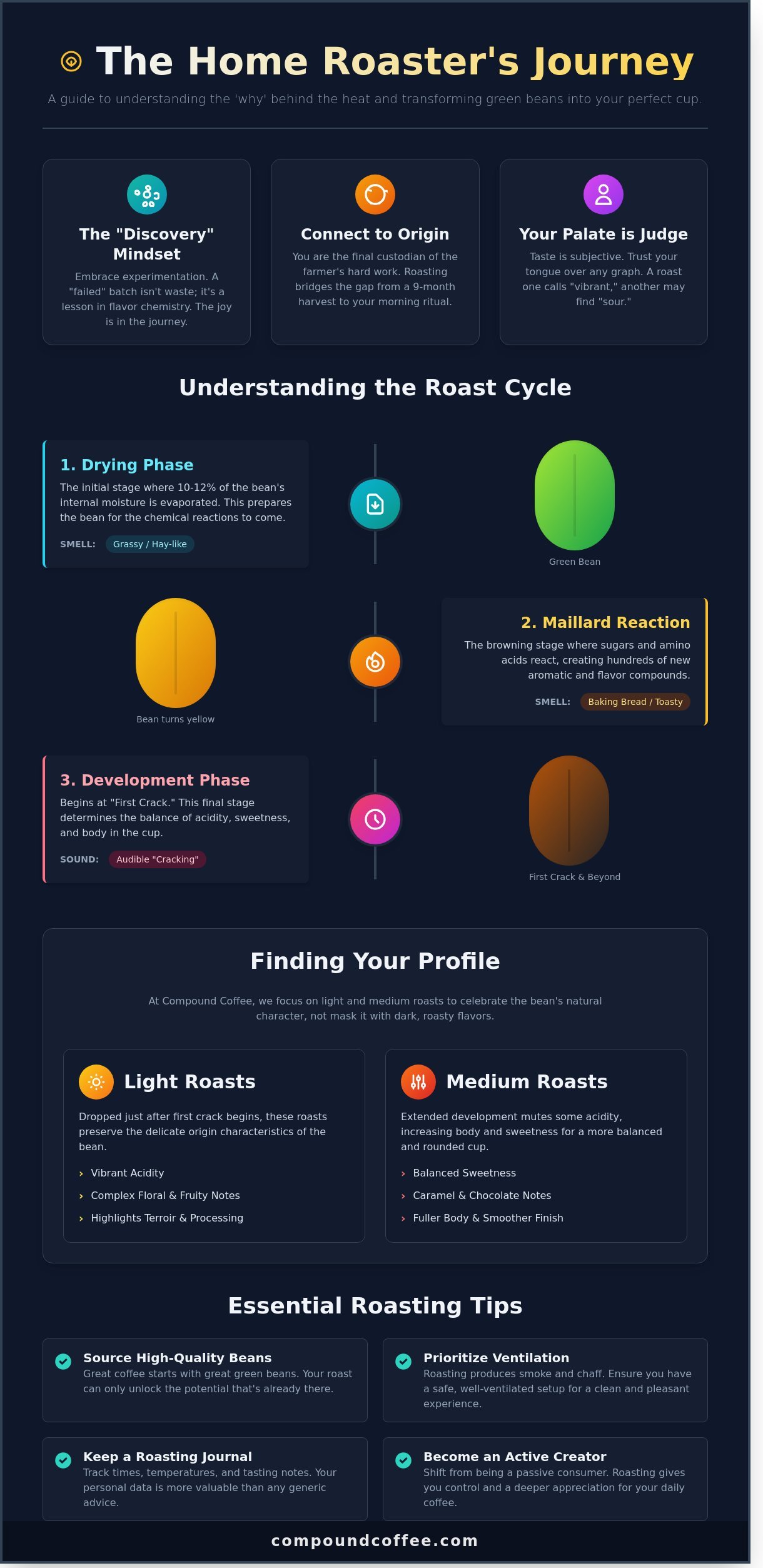
To master the craft, you need to understand the three distinct stages of the roast cycle. The first is the Drying Phase, where you remove the 10% to 12% moisture content present in raw green coffee. This is followed by the Maillard Reaction, where the aromatic complexity begins to take shape. Finally, the Development Phase occurs after the first crack, determining the final balance of the cup. Understanding the specific techniques, temperatures, and methods helps you manipulate how these phases interact to create a profile you truly love.
The Drying Phase and Maillard Reaction
The Maillard reaction is where the magic happens. Browning indicates the complex chemical changes occurring as sugars and amino acids react under heat to create hundreds of aromatic compounds. You’ll see the beans shift from a grassy green to a pale yellow and eventually a light tan. This transition is your cue that sweetness is being built. In our experience, rushing this stage often leads to uneven development, while dragging it out too long can result in a flat, "baked" cup. Watch for the "yellowing" point around 160°C as a key indicator that the chemical transformation is accelerating.
First Crack and Development Time
First crack is the most exhilarating moment for any roaster. It occurs when steam pressure builds up inside the bean, causing the cellular structure to break down and expand. It sounds like soft pops of popcorn. Managing your heat application immediately after this point is critical. If the temperature stalls, you risk "baking" the coffee, which robs it of its vibrant character and leaves it tasting like bread or paper.
We focus heavily on this development time because it dictates the balance between sparkling acidity and a syrupy body. Since we don't offer dark roasts, our goal is usually to find the "sweet spot" where the bean's origin remains clear and bright. A shorter development might highlight floral notes in an Ethiopian heirloom, while a slightly longer one might bring out the chocolatey richness of a Brazilian pulp natural. For those eager to experiment with these variables in a hands-on environment, our specialty coffee workshops offer a space to learn and discover your own preferences without the pressure of being "perfect."
The roast cycle is not just a series of numbers on a screen; it is a physical transformation you can see, smell, and hear. By staying curious and paying attention to these sensory cues, you'll go from a beginner to a confident roaster who understands the "why" behind every delicious cup. Whether you prefer a bright, acidic brew or something with more weight, the journey of discovery is yours to enjoy.
Finding Your Profile: Light and Medium Roasts Explained
Every coffee bean tells a story of its origin, and the roast profile is the lens through which we choose to read it. At Compound Coffee Co., we view roasting as a collaborative effort between the farmer's hard work and our experimental approach in the lab. Because individuals perceive taste differently, there's no objective "best" roast level. Instead, we offer guidelines to help you discover what resonates with your own palate. One of the most effective coffee roasting tips we share with our community is to think of the roast as a volume knob for the bean's natural characteristics. Turning it up or down changes the intensity of specific flavors, but the goal is always to keep the bean's soul intact.
The Case for Lighter Roasts
Light roasts are about transparency and clarity. We aim to preserve the "terroir," which is the unique combination of soil, altitude, and climate that defines a farm's output. When we roast lightly, usually dropping the beans shortly after the first crack, we highlight the natural fruitiness and vibrant acidity inherent in the seed. You'll often find delicate floral notes like jasmine or the crisp snap of green apple in these profiles. Since our journey began in 2014, we've found that these roasts excel when brewed with precision. If you enjoy a clean, tea-like consistency that showcases the farmer's craft, explore our range of Filter Coffee roasted beans to see these profiles in action. We don't want to mask the bean; we want to celebrate it.
Achieving Balance with Medium Roasts
Medium roasts represent a beautiful sweet spot where origin character meets the chemistry of the roasting process. As the beans spend a little more time in the drum, the Maillard reaction and sugar browning create a profile defined by balance, sweetness, and caramelization. Approximately 65% of our community members prefer this level for their daily brew because it offers a rounded mouthfeel without losing the bean's identity. These roasts often lean into flavors of milk chocolate, toasted nuts, and brown sugar. Because of their increased solubility and structural integrity, medium roasts are often preferred for espresso-based drinks where they can cut through milk while remaining sweet. Check out our Espresso roast selection for inspiration on how balance can elevate your morning latte.
You might notice that you won't find Dark Roasts on our shelves. This is a deliberate choice based on our passion for coffee research. When beans are roasted to a dark, oily stage, the unique flavors of the farm are often replaced by generic carbon and smoky notes. We believe in empowering our customers to taste the difference between a high-altitude Ethiopian heirloom and a rich Brazilian pulp-natural; something that becomes difficult when the roast dominates the bean. By sticking to light and medium profiles, we ensure the "unsung heroes" at the farm level are truly heard.
Matching your roast level to your brewing method is a great way to start your exploration. For those using a V60 or Chemex in their Singapore home kitchen, a lighter roast provides a refreshing and complex experience. If you're pulling shots on a home espresso machine, a medium roast offers the body and sweetness required for a balanced extraction. These aren't rigid rules, just starting points for your own journey. We encourage you to experiment with different temperatures and ratios, as your personal preference is the only metric that truly matters in the end.
Practical Coffee Roasting Tips for Your First Batch
Your first roast is a rite of passage. It is the moment where theory transforms into a tactile experience of heat, sound, and aroma. To set yourself up for a rewarding journey, these coffee roasting tips focus on preparation and control rather than rigid perfection. We believe that roasting is an act of discovery, and while we provide the framework, your own palate is the ultimate guide. After all, individuals perceive taste differently, and what one person loves, another might find too bright or too heavy.
Start with high-quality specialty coffee. It's a mistake to think that low-grade "commercial" beans are good for practice. Roasting beans with high defect counts often results in sour or woody flavors that no amount of heat can fix. Since we don't offer dark roast profiles at Compound Coffee Co., we find that starting with premium green coffee allows the natural terroir to shine without needing to hide flaws behind carbonization. You'll find it much easier to learn when the beans actually reward your efforts with sweetness and clarity.
Safety and environment are vital in a home setting. If you're roasting in a typical Singapore HDB kitchen, even a small 200g batch can generate enough smoke to linger for hours or trigger a sensitive alarm. Ensure your kitchen has a high-CFM exhaust fan or position your roaster near a balcony with a portable fan to push smoke outdoors. Maintaining a clear environment also helps you accurately smell the aromatic transitions from "grassy" to "baked bread" to "caramel."
Consistency relies on data. Use a digital scale with 0.1g precision and a dedicated timer. Track your "charge temperature" and the time it takes to reach "first crack," which usually occurs between 8 and 12 minutes depending on your heat source. Just as a pitmaster masters their flame, a coffee roaster must master their heat source; you can even learn more about Charcoal Kings to see how deep the art of fuel management goes. If you don't measure these variables, you won't be able to replicate a successful roast or troubleshoot a failed one. Finally, you must cool your beans fast. Once you hit your target color, drop the beans into a cooling tray immediately. Beans can stay above 150°C for several minutes if left in a heap; this continues the cooking process and can mute the delicate acidity you've worked hard to preserve. Aim to get them to room temperature in under 240 seconds.
Sourcing Your Green Beans
Understanding bean density and moisture content helps you predict how coffee reacts to heat. Denser beans, often grown at higher altitudes, require more initial energy to penetrate the cellular structure. For your first attempt, we recommend starting with honey-processed or natural processed beans. These often have higher sugar content and a more visible color change, making it easier to track the progression of the roast. You might try roasting the Semendo Green Beans Honey for a rewarding first experience. It offers a forgiving profile that highlights the sweetness of the honey process, providing a clear benchmark for your developing skills.
The Post-Roast Window: Cooling and Degassing
Resist the urge to brew your coffee immediately. Freshly roasted beans need to "rest" for 5 to 7 days to reach their peak flavor profile. During this window, a process called degassing occurs. The beans release CO2 that was trapped during the roast; if you brew too early, this gas interferes with water contact, leading to uneven extraction and a metallic or "fizzy" taste. In Singapore's 80% average humidity, proper storage is essential. Use an airtight container with a one-way valve and keep it in a cool, dark cupboard. This protects the beans from oxidation and moisture, keeping your hard-earned roast vibrant for weeks. To begin your own exploration of flavor, explore our curated green coffee collection and find the profile that speaks to you.
Elevating Your Craft: From Home Kitchen to Professional Roastery
Most of us started our journey in a small Singapore kitchen with a stovetop pan or a modified popcorn popper. It is a fantastic rite of passage. These methods teach you the core sensory milestones of roasting, like the sound of the first crack or the changing aroma of the beans. However, there usually comes a point where you want more than just a drinkable cup. You want consistency. Moving beyond basic home tools allows you to control variables that a stovetop simply cannot manage. Professional equipment offers precise airflow control and drum speed adjustments, which are essential for those who want to replicate a specific flavor profile time and again.
Transitioning to professional-grade gear isn't about following a set of rigid rules. It's about gaining the tools to explore your own preferences. In Singapore, the specialty coffee community has grown by approximately 35% in the last three years, creating a vibrant network of enthusiasts. Joining this community and seeking mentorship can shave years off your learning curve. Instead of struggling through 50 bad batches, a mentor helps you understand why a certain heat application resulted in a specific taste. This shared journey of discovery is what makes the craft so rewarding. You'll find that these coffee roasting tips become much more effective when you have the right environment to test them.
Hands-On Learning and Workshops
Structured learning is often the fastest way to bridge the gap between a hobbyist and a pro. Enrolling in a coffee roasting course in Singapore moves you from "guessing" to "knowing." You learn to interpret data and react to the beans in real-time. Our "GOATED" workshop experience is designed for passionate individuals who want to dive deep into the science without losing the soul of the process. We don't believe in a single "best" way to roast. Since individuals perceive taste differently, our workshops focus on empowering you to find the profiles that resonate with your palate. It's about giving you the confidence to trust your own senses while using technical data as a helpful guide.
Accessing Professional Facilities
Investing in a commercial roaster can cost anywhere from S$15,000 to over S$40,000. For many micro-roasters in Singapore, renting a professional facility is a more accessible game-changer. It allows you to use high-end machinery without the massive overhead. You can explore our Ultimate Roasting Intro to see how you can gain access to our facilities. This is where many home roasters transition into building a private label. It turns a weekend hobby into a business reality. You get to experiment with revolutionary technologies and high-quality green beans in a space designed for innovation.
As you refine your skills, remember that we focus on highlighting the natural, complex sugars of the coffee cherry. Because of this, we don't sell dark roast coffee. We find that lighter roasts allow the unique characteristics of each farm to shine through. Whether you're roasting for your family or starting your own brand, these coffee roasting tips are meant to be your compass, not a map. The real joy lies in the experimentation and the community you build along the way. Your vision of the perfect cup is entirely your own, and we're just here to help you find the tools to create it.
Take Your Next Step in Coffee Discovery
Mastering the roast cycle is just the beginning of your sensory adventure. You've seen how heat transforms green beans and why light or medium profiles highlight the farmer's labor across high-altitude regions. These coffee roasting tips aren't strict laws. They're tools to help you explore. Since individuals perceive taste differently, your goal is to find the flavors that resonate with you. We don't offer dark roasts because we love the vibrant floral notes found in lighter profiles, but the final choice is always yours.
If you're ready to elevate your craft, visit us at our 1,500 square foot facility, Singapore’s hub for specialty coffee education. Since our founding in 2014, we've provided access to professional Lighttells equipment and a community of over 1,200 passionate roasters. It's a space designed for experimentation and shared knowledge where your vision becomes reality.
Your perfect cup is waiting to be found, and we're excited to be part of your roasting story.
Frequently Asked Questions
Is coffee roasting at home messy or smoky?
Roasting at home produces both smoke and chaff, so good ventilation is essential in your Singapore kitchen. Every coffee bean has a silver skin that turns into papery chaff during the roast; this makes up about 1% of the total weight. If you roast 250g of beans, expect a small handful of messy flakes to clean up. We suggest roasting under a powerful kitchen hood or near a balcony to manage the 100% inevitable smoke.
How long does it take to roast coffee beans?
A typical home roast takes between 8 and 15 minutes depending on your equipment. Most of our community members find that a 12 minute profile provides a lovely balance between sweetness and acidity. You'll likely hear the first crack around the 9 minute mark. Experimenting with these timings is part of the fun, as every person perceives the resulting flavors differently in their own cup.
Can I roast coffee in a regular oven or air fryer?
You can certainly use a convection oven or an air fryer, though these methods offer less precision than dedicated roasters. In a standard 230°C oven, beans often roast unevenly because they aren't being agitated. If you use an air fryer, try a 200g batch with a rotisserie basket to keep the beans moving. These coffee roasting tips are just a starting point for your own kitchen experiments.
What is the best type of green bean for a beginner to roast?
We recommend starting with a processed Brazilian or Colombian bean because they are famously forgiving. A Brazil Santos with a 17/18 screen size is consistent in density, which helps the heat penetrate the bean evenly. These beans often have a wider sweet spot during the roast. This makes it easier for you to find a flavor profile you enjoy without the beans becoming temperamental.
How do I know when the coffee is finished roasting?
You'll know the roast is finishing when you hear the first crack, which sounds like snapping wood or popcorn. This usually happens when the internal bean temperature reaches approximately 196°C. Since we don't sell or advocate for dark roasts at Compound Coffee, we suggest ending your roast shortly after this stage. Watching the color change from yellow to a light cinnamon brown is a great visual guide.
Why does my home-roasted coffee taste sour or grassy?
Sour or grassy flavors usually mean the beans are underdeveloped and didn't receive enough heat. If the roast ends too quickly, perhaps under 8 minutes, the internal sugars don't fully caramelize. These coffee roasting tips help you avoid baked flavors by ensuring the bean reaches at least 190°C. Remember that taste is subjective; some enjoy a brighter acidity while others prefer more development.
How long should I wait to drink my coffee after roasting?
You should wait at least 3 to 7 days for the beans to degas before brewing. Freshly roasted coffee releases a high volume of carbon dioxide, with 50% of it escaping in the first 48 hours. If you brew too early, these gases can block water from extracting the flavor. Many in our community find that filter roasts peak in clarity around day 10 or 12.
Does roasting coffee at home actually save money?
Roasting at home can save you roughly 40% on your monthly coffee expenses in Singapore. While specialty roasted beans often cost S$55 to S$70 per kilogram, high quality green beans are available for S$18 to S$28 per kilogram. Even after accounting for the 15% weight loss during roasting, the savings are clear. It's a rewarding way to empower your own coffee journey while managing your budget.


Comments