

How to Make Better Coffee at Home: A 5-Step Guide to Cafe-Quality Brews
Updated: Feb 26
Is there anything more frustrating than a morning coffee that just doesn't hit the spot? You’re trying to figure out how to make better coffee at home, but every cup is a gamble-sometimes bitter, sometimes weak, and rarely as good as the one from your favourite local cafe. If you’re tired of the disappointment and overwhelmed by all the complex advice out there, you’re in the right place. We believe the joy of a truly exceptional coffee experience shouldn't be a mystery locked behind a barista counter.
This appreciation for handcrafted quality can extend beyond coffee. For those in Singapore looking to explore other premium, ready-to-enjoy delicacies as part of their daily wellness or indulgence, the freshly brewed desserts from Royal Bird's Nest offer another way to experience exceptional local craft.
Here at Compound Coffee Co., our passion is to empower our community with the knowledge to unlock incredible flavour. This guide is your hands-on roadmap. We're demystifying the process and breaking it down into five fundamental, easy-to-follow steps that will completely transform your brewing. Forget the confusion and inconsistency. Get ready to develop a simple, repeatable routine that delivers delicious, cafe-quality coffee every single time, right from your own kitchen. Let's start brewing.
Key Takeaways
Your coffee journey begins with the bean; discover why fresh, specialty-grade coffee is the non-negotiable first step to a better cup.
Elevate your brew by understanding why a quality grinder, not the brewer, is the single most impactful equipment investment you can make.
The secret on how to make better coffee at home lies in mastering three core variables: your water, your coffee-to-water ratio, and your brew time.
Find your perfect brewing ritual by exploring different brewing methods, each offering a unique experience and flavour profile to match your taste.
Table of Contents Step 1: The Foundation - Start with Better Coffee Beans Step 2: The Game-Changer - Invest in a Quality Grinder Step 3: Master the Brew Variables - Water, Ratio, and Time Step 4: Choose Your Method - Find the Right Brewer for You Step 5: Refine Your Technique - Simple Habits for Great Coffee
Step 1: The Foundation - Start with Better Coffee Beans
If you're truly passionate about learning how to make better coffee at home, the single most impactful change you can make has nothing to do with a fancy S$1,000 espresso machine. It all starts, and ends, with the beans. Think of them as the soul of your cup; you simply cannot brew an exceptional coffee from stale, low-quality beans. Before diving into grinders or water temperature, mastering this first step in the fundamentals of coffee preparation will elevate your daily coffee experience more than anything else.
Freshness is Everything: Whole Bean vs. Pre-Ground
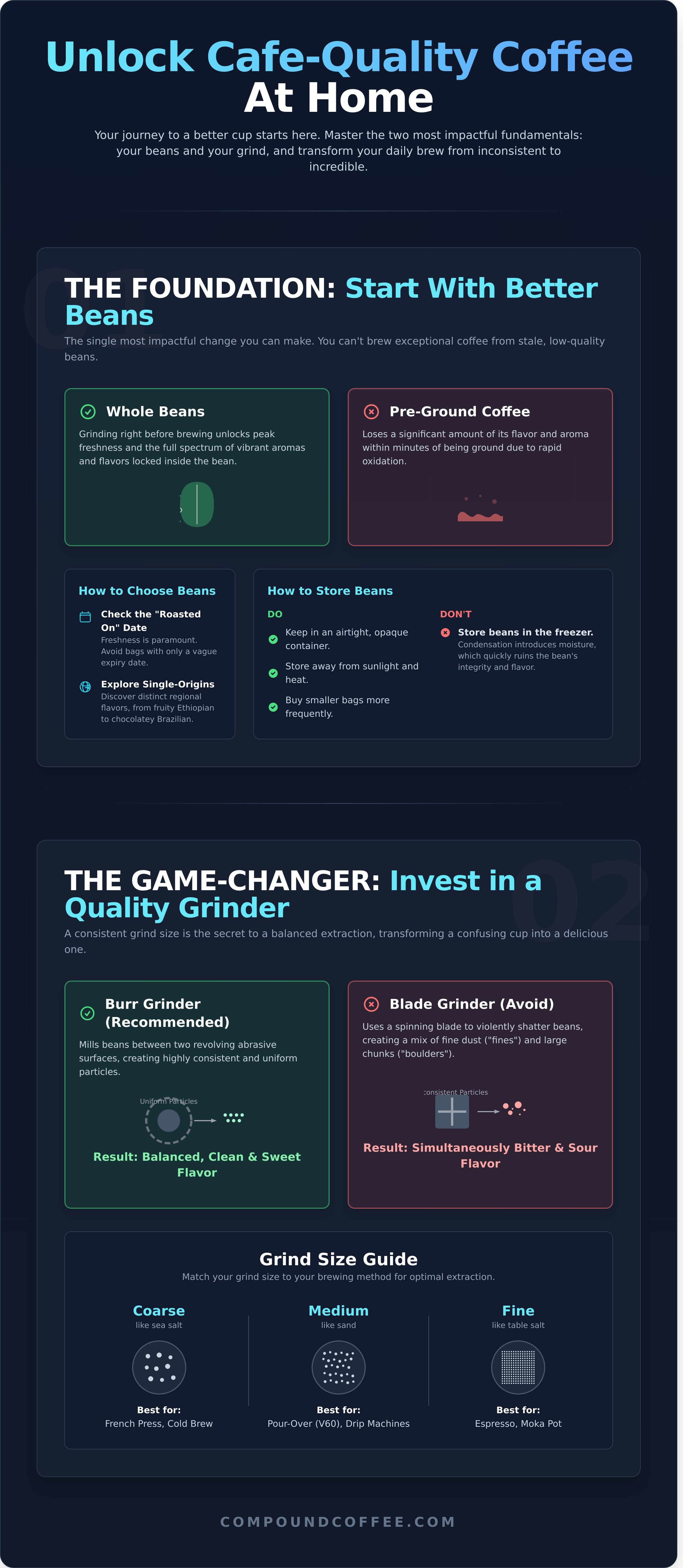
Coffee is a fresh agricultural product, not a pantry staple with an infinite shelf life. Once roasted, coffee beans begin to release aromatic oils and compounds. Grinding accelerates this process exponentially, exposing more surface area to oxygen. Pre-ground coffee loses a significant amount of its vibrant aroma and flavour within minutes of being ground. Choosing whole beans empowers you to unlock that peak freshness and aromatic explosion the moment before you brew.
How to Choose Your First Bag of Quality Beans
Stepping into the world of specialty coffee can feel overwhelming, but finding a great bag is simple. First, always look for a ‘roasted on’ date on the bag, not a vague expiry date. Fresh is best! We recommend starting your journey with single-origin beans, which showcase distinct flavour profiles from a specific region. This is the fastest way to discover what you truly enjoy, whether it’s the fruity notes of an Ethiopian Yirgacheffe or the chocolatey body of a Brazilian Santos. Explore different roasted coffee beans and let your palate be your guide.
Storing Your Beans for Maximum Flavor
You’ve invested in amazing beans; now it's time to protect them! Proper storage is crucial for preserving their delicate flavours, especially in Singapore's humid climate. Follow these simple rules:
Keep it Airtight & Dark: Store your beans in an opaque, airtight container away from direct sunlight. The original bag with a one-way valve is often a great choice.
Avoid the Freezer: The freezer is not your friend. Condensation from temperature changes can introduce moisture and ruin the integrity and flavour of your beans.
Buy Fresh, Buy Often: Instead of buying a giant bag, purchase smaller quantities more frequently. This ensures you’re always brewing with beans at their absolute peak freshness.
Step 2: The Game-Changer - Invest in a Quality Grinder
If there's one piece of equipment that will fundamentally transform your coffee experience, it's not the brewer or the fancy kettle-it's the grinder. Freshly ground coffee is non-negotiable, but the quality of that grind is what separates a good cup from a truly exceptional one. This is the single biggest secret for how to make better coffee at home.
The goal of brewing is balanced extraction, where water pulls the perfect amount of soluble flavour from the coffee grounds. When grounds are inconsistent in size, extraction becomes a chaotic mess. The tiny particles (fines) over-extract quickly, releasing bitter flavours, while the large chunks (boulders) under-extract, contributing sour, underdeveloped notes. The result? A confusing cup that's simultaneously bitter and sour.
Burr Grinders vs. Blade Grinders: No Contest
Blade grinders, often found for under S$50 in Singapore, use a spinning blade to violently smash beans into random-sized pieces. It’s more shattering than grinding. A burr grinder, on the other hand, uses two revolving abrasive surfaces (burrs) to mill the coffee beans into a uniform size. This consistency is the key to a clean, even extraction and unlocking the true potential of your coffee beans. A quality entry-level burr grinder is a worthy investment, starting around S$100-S$150.
Matching Your Grind Size to Your Brewing Method
Your grinder empowers you to "dial in" the perfect settings for any brewer. Grind size directly controls how long water is in contact with the coffee. A finer grind creates more resistance, slowing water down for a longer extraction, while a coarser grind lets it flow through quickly. Here’s a simple hands-on guide to get you started:
Coarse Grind (like sea salt): Ideal for immersion methods like French Press and Cold Brew.
Medium Grind (like sand): The sweet spot for most pour-over brewers (like the V60) and automatic drip machines.
Fine Grind (like table salt): Necessary for methods that use pressure, like Espresso and Moka Pots.
Experimenting with your grind setting is a core part of the passion and knowledge behind brewing. Don't be afraid to make small adjustments to discover what tastes best to you. This control is fundamental to learning how to make better coffee at home, tailored perfectly to your palate.
Step 3: Master the Brew Variables - Water, Ratio, and Time
You've got great beans and the right grind. Now, we dive into the heart of the brewing process itself. This is where you transform from a coffee drinker into a coffee brewer. Controlling just three core elements-water, ratio, and time-is the most impactful step in learning how to make better coffee at home. It’s less about secret recipes and more about repeatable science. Let's demystify it.
The 98% Rule: Why Water Matters
Your finished cup of coffee is over 98% water, so its quality is non-negotiable. While Singapore's tap water is safe, its mineral content can sometimes interfere with delicate flavour notes. On the other end, distilled water is too pure and lacks the minerals needed for proper extraction. The solution? A simple countertop water filter. This ensures you’re starting with a clean, neutral base that lets your coffee’s true character shine through. For temperature, aim for 90-96°C (195-205°F). An easy trick is to let a fully boiled kettle rest for about a minute before you pour.
The Golden Ratio: Using a Scale for Consistency
Ditch the scoops and embrace the scale. The single best tool for consistency is a simple digital kitchen scale, available online for as little as S$15. We recommend starting with the "golden ratio," a widely accepted range of 1:15 to 1:18. This simply means for every 1 gram of coffee, you use 15 to 18 grams (or millilitres) of water. Using grams instead of scoops removes all guesswork, ensuring your brew is delicious and repeatable, every single time.
Troubleshooting Taste: Under- and Over-Extraction
This simple diagnostic tool will empower you to fix your own brew. Think of extraction as the process of water dissolving flavours from the coffee grounds. Getting it right is crucial, and your taste buds are the best guide.
Is your coffee sour or thin? That's a classic sign of under-extraction. The water didn't have enough time to pull out the sweet flavours. To fix it, try grinding your beans finer or increasing your brew time.
Is your coffee bitter or harsh? You're tasting over-extraction. The water pulled out too many undesirable compounds. The fix is the opposite: grind coarser or shorten your brew time.
By understanding this balance, you gain complete control over your coffee experience.
Step 4: Choose Your Method - Find the Right Brewer for You
Once you have great beans and a quality grinder, the next step is choosing your tool. Thinking about how to make better coffee at home isn't about finding the "best" brewer-it's about finding the right brewing experience for you. Each method is a different conversation with your coffee, highlighting unique characteristics and creating a distinct style in the cup. The key is to experiment and discover the ritual you enjoy most.
Here’s a look at three popular methods, perfect for starting your journey:
Full-Bodied and Forgiving: The French Press
If you love a rich, heavy-bodied coffee with a bold texture, the French Press is your perfect starting point. It uses a full immersion method, where coarse coffee grounds steep directly in hot water for around four minutes. This process is incredibly straightforward and forgiving, making it one of the easiest ways to get a consistently satisfying cup. Cleanup is simple, though you'll get some fine sediment at the bottom of your mug, which adds to its characteristic mouthfeel.
Clean and Nuanced: The Pour-Over (V60, Kalita)
For those who want to taste the delicate, vibrant notes in their coffee-the bright citrus, the floral hints, the sweet berry flavours-the pour-over is unparalleled. This method requires more technique and attention to detail, as you control the flow and distribution of water over the coffee bed. The reward is a stunningly clean and bright cup that truly expresses the bean's origin. Mastering it is a passion project, and a hands-on coffee workshop is the fastest way to build your confidence and perfect your technique.
Versatile and Fast: The AeroPress
The AeroPress is the coffee community's beloved multi-tool. It’s a flexible, durable, and incredibly fast brewer that’s perfect for the home and for travel. By changing your grind size and brew time, you can create anything from a concentrated, espresso-style shot to a clean, filter-style cup. Renowned for producing a smooth, low-acidity coffee, its quick plunge-through extraction makes it a fantastic choice for a delicious brew in under two minutes.
Ultimately, the secret to making better coffee is finding a ritual you love. Explore the methods that excite your curiosity and fit your lifestyle. Your perfect cup awaits.
Step 5: Refine Your Technique - Simple Habits for Great Coffee
You've got the right beans, the perfect grind, quality water, and your ideal ratio. Now comes the final, transformative step: refining your technique. This is where the magic happens, turning a good cup into a truly memorable coffee experience. Brewing is a process of mindful repetition, and these small, consistent habits are what separate the amateur from the pro. This is the final key to understanding how to make better coffee at home.
Pre-heating and Rinsing: The Foundation of Consistency
Temperature stability is one of the most overlooked aspects of brewing. A cold brewer or mug can instantly drop your water temperature, leading to under-extraction and a sour-tasting cup. A simple pre-heating ritual solves this.
Pre-heat Your Brewer: Before adding your coffee grounds, pour hot water through your V60, AeroPress, or French Press to warm it up. Discard this water.
Warm Your Mug: Fill your drinking mug with hot water while you brew. A warm mug keeps your coffee at its optimal drinking temperature for longer.
Rinse Paper Filters: This quick step removes any residual papery taste and helps the filter sit snugly in your dripper.
The 'Bloom': Unlocking Your Coffee's True Potential
If you're using freshly roasted beans, you'll notice they bubble vigorously when you first add water. This is the "bloom"-the rapid release of trapped carbon dioxide (CO2). Skipping this step can lead to an uneven extraction. To unlock your coffee's full flavour, start every pour-over with a bloom. Simply pour just enough hot water (about double the weight of your coffee grounds) to saturate all the grounds, then wait 30-45 seconds for the CO2 to escape before continuing with your main pour.
Ready for the Next Level? From Brewer to Roaster
Once you've mastered these brewing habits, your passion for coffee will inevitably lead you to wonder: where does the flavour truly come from? The next step in your journey is understanding the roast. The roast profile has a monumental impact on the final taste, transforming a green bean's potential into the sweet, complex, or fruity notes you love. To dive deeper into this craft, explore our introduction to coffee roasting. At Compound Coffee, we believe in empowering the curious, and this is just the beginning of your coffee adventure.
Empower Your Morning Brew
You now hold the blueprint for cafe-quality coffee, right in your own kitchen. The journey from a good cup to a truly great one isn’t about magic; it’s about intentional choices. By focusing on the fundamentals-starting with exceptional, freshly roasted beans and mastering variables like your grind and brew ratio-you unlock a new world of flavour. This is the core of how to make better coffee at home, transforming a simple routine into a moment of pure craft.
At Compound Coffee, this passion is what drives us. We're more than just a roaster; we're a community hub for coffee lovers and experimenters right here in Singapore. We believe in empowerment, which is why we source our beans directly from the best small farms and producers, ensuring their hard work shines through. It's a philosophy we share in everything we do, from our beans to our hands-on coffee workshops designed to elevate your skills.
Ready to put your knowledge into practice? Start your journey with our curated selection of freshly roasted beans. Embrace the process, keep experimenting, and discover the perfect cup that's waiting for you.
Frequently Asked Questions About Making Better Coffee
Do I really need a scale to make good coffee?
Yes, we believe a scale is a game-changer. It removes all the guesswork from your brewing process, allowing you to use a precise coffee-to-water ratio every single time. This consistency is the secret to replicating that perfect cup. A simple digital kitchen scale, often available for under S$25 in Singapore, empowers you to experiment with confidence and truly understand how small changes affect your final brew. It's the fastest way to elevate your coffee experience.
How long do roasted coffee beans stay fresh?
For the most vibrant and flavourful experience, coffee beans are best used within two to three weeks of their roast date. After this period, they begin to lose their complex aromatic compounds due to oxidation. We always recommend buying smaller bags more often and storing them in a cool, dark, airtight container. Always look for the “roasted on” date on the bag-it’s a true mark of a roaster who cares about freshness and quality.
What's the difference between single-origin and blended coffee?
Single-origin coffee comes from one specific farm or region, highlighting the unique flavour profile and character-the terroir-of that particular place. Think of it as a solo performance. A blend, on the other hand, combines beans from different origins to create a balanced, consistent, and often more rounded flavour profile, like a well-rehearsed orchestra. Neither is superior; it’s all about discovering the taste experience you personally enjoy the most. We encourage you to experiment with both!
Is an expensive espresso machine necessary for good coffee at home?
Absolutely not! While a high-end machine is a fantastic tool, it is not the only path to an incredible cup. The secret to how to make better coffee at home lies in fresh beans, a quality grinder, and solid technique. Brewing devices like a V60, AeroPress, or French Press can produce world-class coffee for a fraction of the cost, empowering you to explore a huge range of flavours without a massive investment.
Why does my coffee taste weak or watery?
A weak or watery taste is almost always a sign of under-extraction. This typically happens for two reasons: your coffee grind is too coarse, or your coffee-to-water ratio is off (not enough coffee grounds). Water passes through coarse grounds too quickly to extract enough flavour. Try making your grind finer or increasing your dose of coffee. Using a scale to maintain a consistent ratio, like 1 part coffee to 16 parts water, will help you diagnose the issue.
Can I use boiling water to brew coffee?
We strongly recommend against it. Water at a rolling boil (100°C) is too hot and will scorch the delicate coffee grounds, resulting in a bitter and astringent taste. The ideal temperature for brewing is just off the boil, between 92°C and 96°C. A simple, hands-on trick is to bring your kettle to a boil, then let it rest for 30-60 seconds before you begin pouring. This small pause makes a massive difference in flavour.


Comments