
How to Cup Coffee at Home: A Guide to Sensory Discovery
- carmel.soon
- Apr 16
- 12 min read
What if the secret to unlocking your sensory potential isn't a professional certification, but a simple spoon and 15 minutes at your dining table? Learning how to cup coffee at home is the fastest way to bridge the gap between being a casual drinker and a confident enthusiast. You've likely stared at a bag of specialty beans and felt a bit lost when reading tasting notes like "bergamot" or "toasted almond." It's a common hurdle for the 55% of Singaporeans who drink coffee daily, according to a 2022 Rakuten Insight survey. You might feel like you lack the "right" palate or get frustrated by rigid brewing rules that feel more like a science experiment than a morning ritual.
At Compound Coffee Co., we believe that taste is entirely subjective because every individual perceives flavor differently. We're here to guide you through a simple, non-prescriptive practice that removes the pressure of being an expert. This guide will empower you to identify which coffee origins you truly enjoy and help you develop a more nuanced palate without any snobbery. We'll walk you through a hands-on setup to turn your kitchen into a hub of discovery, focusing on the vibrant clarity of light and medium roasts since we don't carry dark roast coffee.
Key Takeaways
Learn why coffee cupping is a simple, accessible immersion method that allows you to explore pure flavours without the need for complex professional equipment.
Understand the science of subjectivity and why your personal palate is the ultimate authority in your coffee journey.
Master how to cup coffee at home using just a few basic kitchen supplies and filtered water to create a clean canvas for your sensory discovery.
Discover the step-by-step techniques for evaluating fragrance and aroma, including the critical sensory peak of "breaking the crust."
See how home cupping insights can empower your everyday brewing choices and connect you with Singapore’s vibrant specialty coffee community.
Table of Contents Demystifying Coffee Cupping: Why It’s Not Just for Professionals The Sensory Science of Subjectivity: Why Your Palate Is Always Right Essential Tools for Your Home Cupping Lab (No Lab Required) A Step-by-Step Guideline to Cupping Coffee at Home Beyond the Bowl: Elevating Your Coffee Experience in Singapore
Demystifying Coffee Cupping: Why It’s Not Just for Professionals
Cupping is the most raw, stripped-back way to taste coffee. It is essentially a simplified immersion brewing method where coffee grounds sit directly in hot water, allowing you to evaluate the bean's quality without the influence of paper filters or complex pouring techniques. While professional Q-graders use this process to score beans on a 100-point scale, learning how to cup coffee at home is about something much more personal: sensory discovery. It is a shared journey that connects the hard work of farmers in regions like Sumatra with your own kitchen table. Coffee cupping serves as the global industry standard for quality control, but for us, it is a tool to help you find what you truly love.
At Compound Coffee Co., we believe there is no "correct" way to perceive a flavour. If you taste a hint of local jackfruit while a roaster's note suggests peach, your experience is entirely valid. Taste is subjective, and individuals perceive flavours differently based on their own memories and palates. This process isn't about passing a test; it's about empowering you to trust your own senses and enjoy the diverse profiles found in specialty coffee.
Cupping vs. Brewing: What’s the Difference?
When you prepare a V60 or pull an espresso shot, you're managing dozens of variables like flow rate, pressure, and agitation. A 1-degree change in water temperature or a 5-second difference in pour time can significantly shift the final cup. Cupping removes these hurdles. By using total immersion, the coffee's inherent terroir and roast profile take center stage. It is the most honest way to see a bean's potential because there is nowhere for flaws or highlights to hide. Since we focus exclusively on light and medium roasts and do not sell Dark Roast Coffee, this method is perfect for tasting the vibrant acidity and floral notes in our filter coffee selection. It allows the farmer's meticulous work to shine through without the noise of brewing equipment.
Breaking the 'Expert' Barrier
You don't need a certified palate or a chemistry degree to start. Many people feel intimidated by professional tasting notes, but those are just guidelines, not rigid rules. If a coffee reminds you of a specific fruit from the Tekka Market or a childhood snack, use that vocabulary. Your personal associations make the experience more meaningful and help you build a "flavour library" in your mind. Cupping is an accessible bridge between the roaster's lab and the home kitchen. It helps you understand how to cup coffee at home so you can make better buying decisions and appreciate the nuances of every 250g bag you open. By stripping away the ego and the gear, you're left with the most important part of the experience: the coffee and your own unique perspective.
The Sensory Science of Subjectivity: Why Your Palate Is Always Right
Your palate is a product of your genetics and your history. Science shows that humans possess varying numbers of taste buds, meaning some of us are "supertasters" while others are less sensitive to certain compounds. When you're learning how to cup coffee at home, it's vital to remember that individuals perceive taste differently. A memory of a specific fruit from a local Singapore wet market might trigger a flavor association for you that a taster in Europe would never recognize. At Compound Coffee Co., we believe we provide the guidelines, but you provide the experience. We aren't here to tell you what's "correct." We're here to help you unlock your own sensory potential.
While the industry often relies on SCA cupping standards to create a shared language among professionals, your individual sensory response is the final authority. We focus our energy on light to medium-light roasts because these profiles preserve the unique characteristics of the coffee's origin. Dark roasts often introduce heavy carbon and smoke flavors that mask the delicate acidity and floral notes cupping is designed to uncover. Because we want to empower you to find these hidden nuances, we don't sell dark roasts. Our goal is to highlight the hard work of the farmers, not the flavor of the roasting machine.
Understanding Tasting Notes
Tasting notes like "jasmine," "stone fruit," or "chocolate" are descriptors, not added ingredients. These labels represent chemical compounds that the coffee bean shares with those other foods. If you're just starting out, don't feel pressured to find specific fruits immediately. Start with broad categories. Is the coffee fruity, nutty, or floral? If a bag label says "pear" but you taste "green apple," you aren't wrong. Both fruits share similar malic acid profiles. Trust your gut and your tongue. If you're ready to test your skills, you can explore our range of light-roasted filter coffees to see which notes resonate with you.
The Role of Temperature in Flavour
Coffee is a dynamic liquid. Its flavor profile isn't a static point but a moving target that evolves as it cools. Professional cuppers typically taste at three distinct stages. The first taste happens when the coffee is hot, around 71°C, where you mostly perceive body and basic sweetness. As the temperature drops to a warm room temperature, the acidity becomes more defined. Finally, as it reaches a cool state, the full clarity of the origin reveals itself. You'll likely notice that acidity and sweetness become much more prominent at these lower temperatures. This evolution is a core part of how to cup coffee at home effectively. Don't rush the process. Let the cup sit and tell its story over 15 to 20 minutes.
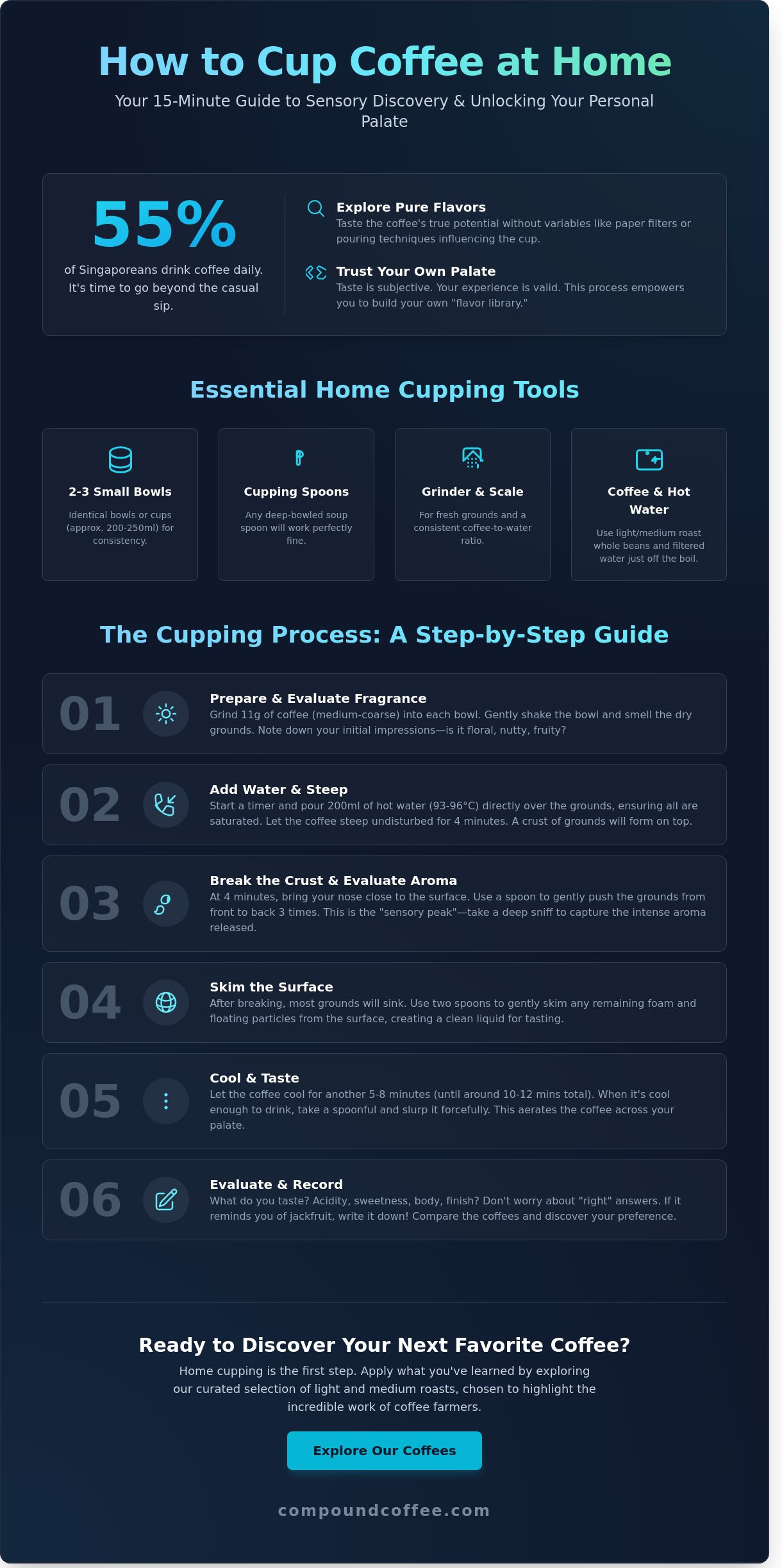
Essential Tools for Your Home Cupping Lab (No Lab Required)
Learning how to cup coffee at home shouldn't feel like a high-stakes chemistry exam. You don't need a temperature-controlled laboratory to uncover the hidden notes in your morning brew. The most vital tool you'll bring to the table is a curious and open mind. Since taste is deeply subjective and individuals perceive flavours differently, your unique perspective is what makes the experience valuable. We view these steps as guidelines rather than rigid rules, helping you find your own preferences on this shared journey.
To get started, gather these basic supplies from your kitchen:
3 to 4 identical bowls or ceramic mugs: Aim for a capacity of approximately 200ml to 260ml.
Two deep spoons: Standard soup spoons are perfect for the job.
A digital scale: Precision is helpful for consistency, ideally measuring to 0.1g.
A timer: Your smartphone clock works just fine.
Filtered water: This acts as your clean canvas.
In Singapore, our tap water is high quality, but using a basic carbon filter is recommended. It helps remove residual chlorine that might otherwise mask the delicate floral or tea-like notes in a light roast. We suggest setting up 3 or 4 different coffees at once. This side-by-side comparison makes the subtle differences in body, sweetness, and acidity much more apparent, even if you're just starting out.
The Home Kitchen Setup
You don't need to invest in professional SCA-certified cupping bowls to see great results. Standard ceramic mugs work perfectly as long as they are the same shape and size to ensure the coffee cools at the same rate. For the "slurp" technique, deep soup spoons, like the ones used for laksa or ramen, are excellent. They hold enough liquid to allow for a vigorous spray across your palate, which is essential for hitting all your taste buds. To keep your space organized, place a "rinse cup" of hot water between each coffee station. This simple step prevents cross-contamination of grounds and ensures each sample stays pure. If you want to dive deeper into the technical standards used by pros, A Guide to Coffee Cupping provides a solid foundation to supplement your home practice.
Selecting Your Coffee Beans
To truly appreciate the diversity of coffee, try pairing a natural process coffee with a washed process one. Natural coffees often lean towards heavy fruit and intense sweetness, while washed coffees tend to offer more clarity and sparkling acidity. You can browse our current selection of roasted coffee beans to build your own tasting flight. For a unique regional experience, we recommend trying the Semendo Honey from Indonesia. It's a fantastic example of how honey processing can create a profile that is both sweet and clean. It's helpful to remember that we don't sell dark roast coffee, as we prefer to highlight the intrinsic flavours developed at the farm level. Mastering how to cup coffee at home is about empowering yourself to discover what you enjoy most in every sip.
A Step-by-Step Guideline to Cupping Coffee at Home
Learning how to cup coffee at home is about opening your senses to the incredible diversity of the bean. It's a journey of discovery that we're all taking together. Follow these steps to begin your sensory exploration.
Step 1: Fragrance and Aroma. Start by smelling the dry grounds immediately after grinding. This is the fragrance. Once you add hot water, wait for a crust of grounds to form on top. Lean in and smell this "wet" aroma. It's often where you'll find the first hints of sweetness or floral notes.
Step 2: Breaking the Crust. At exactly the four-minute mark, use a spoon to gently push the floating grounds toward the back of the cup. Do this three times. This action releases a concentrated burst of aromatics. It's the sensory peak of the process, so keep your nose close to the surface.
Step 3: Cleaning the Surface. Use two spoons to skim off the remaining foam, oils, and floating particles. This is a vital step because it stops the extraction process and ensures a clean, clear taste. Since we don't sell dark roast coffee, you'll notice that the liquid remains vibrant and translucent rather than murky.
Step 4: The Slurp. Once the coffee has cooled to a comfortable temperature, take a spoonful and slurp it vigorously. This is a core part of how to cup coffee at home because it helps you perceive the full range of flavors.
Step 5: Reflection. After you've tasted the samples, take a moment to think. What surprised you? Which cup felt the most balanced? There are no wrong answers here.
The Art of the Slurp
The slurp might feel silly at first, but it's backed by simple physics. By slurping forcefully, you aerate the liquid and turn it into a fine mist. This allows volatile aromatics to travel from the back of your mouth to your nose via the retro-nasal passage. It's how your brain identifies complex notes like stone fruit or jasmine. Be loud and proud with your slurp to get the full effect. If it feels uncomfortable, taking small, mindful sips also works well. Every palate is different, and we respect how you choose to experience your brew.
Taking Notes Without Stress
You don't need a degree in sensory science to enjoy this. Start with a simple "Like" or "Dislike" scale. If a coffee reminds you of a specific memory, like a summer afternoon or a certain fruit, write that down. Use "vibe" words or even draw shapes to represent the texture. If technical terms feel restrictive, ignore them. The goal is to find what you enjoy. To dive deeper into your own preferences, consider joining a hands-on coffee workshop where we can explore these flavors together in a relaxed environment.
Ready to start your journey? Explore our seasonal range of freshly roasted filter coffees to find your next favorite profile.
Beyond the Bowl: Elevating Your Coffee Experience in Singapore
Learning how to cup coffee at home is just the beginning of a much larger sensory journey. It's a gateway that changes how you approach your morning routine. Once you've slurped your way through a few bowls, you'll notice your daily V60 or Aeropress brewing starts to shift. You aren't just following a recipe anymore; you're adjusting variables based on the specific sweetness or clarity you identified on the cupping table.


Comments