

Green Coffee Beans: The Ultimate Guide to Sourcing, Roasting, and Discovery in 2026
What if the most transformative moment in your coffee journey happens before the roaster even turns on? You've likely felt the frustration of staring at a bag of green coffee beans and feeling overwhelmed by technical specs like 11% moisture content or high-density grading. It's intimidating to invest S$35 in a premium micro-lot only to worry about scorching it in your home setup. We know that every individual perceives taste differently, so we view roasting as a shared experiment rather than a set of rigid rules.
This guide will demystify those technical hurdles and empower you to source with confidence, whether you're roasting in a pan or a specialized machine. You'll learn to identify quality indicators that actually matter to your unique flavor preferences. We're going to walk through the bean's journey from farm to Singapore; we'll provide the tools to find your perfect cup and a community of passionate learners to experiment with as you discover the vibrant profiles that exist before any dark roasting occurs.
Key Takeaways
Understand the anatomy of the coffee cherry and how green coffee beans transform from a humble seed into a complex foundation for your daily brew.
Learn to use terroir and processing methods as helpful guidelines for sourcing, while embracing the idea that taste is personal and subjective.
Explore the transition from home roasting to professional equipment and how to experiment with the Maillard reaction to co-create your signature profile.
Get practical tips on navigating Singapore’s high humidity and customs regulations to ensure your beans remain stable and vibrant in our local climate.
Discover why we focus exclusively on Light and Medium roasts to empower your journey of finding the natural, unique character in every cup.
Table of Contents What Are Green Coffee Beans? Understanding the Seed of the Fruit Evaluating Quality: A Guideline for Your Sourcing Journey From Kitchen to Lab: Options for Roasting Your Green Beans Buying and Storing Green Coffee in Singapore Empowering Your Coffee Journey with Compound Coffee Co.
What Are Green Coffee Beans? Understanding the Seed of the Fruit
Your journey into the heart of coffee starts long before the first crack of a roast. It begins with a seed. When we talk about green coffee beans, we're referring to the unroasted mature or immature coffee beans extracted from the fruit of the Coffea plant. These seeds are the raw potential of everything you'll eventually taste in your cup. While many people only see the dark brown finished product, the green stage is where the coffee's chemical blueprint is locked away. Since Compound Coffee focuses on highlighting natural characteristics, we don't sell Dark Roast Coffee. We believe the most vibrant stories are told through lighter profiles that respect the bean's origin and inherent sugars.
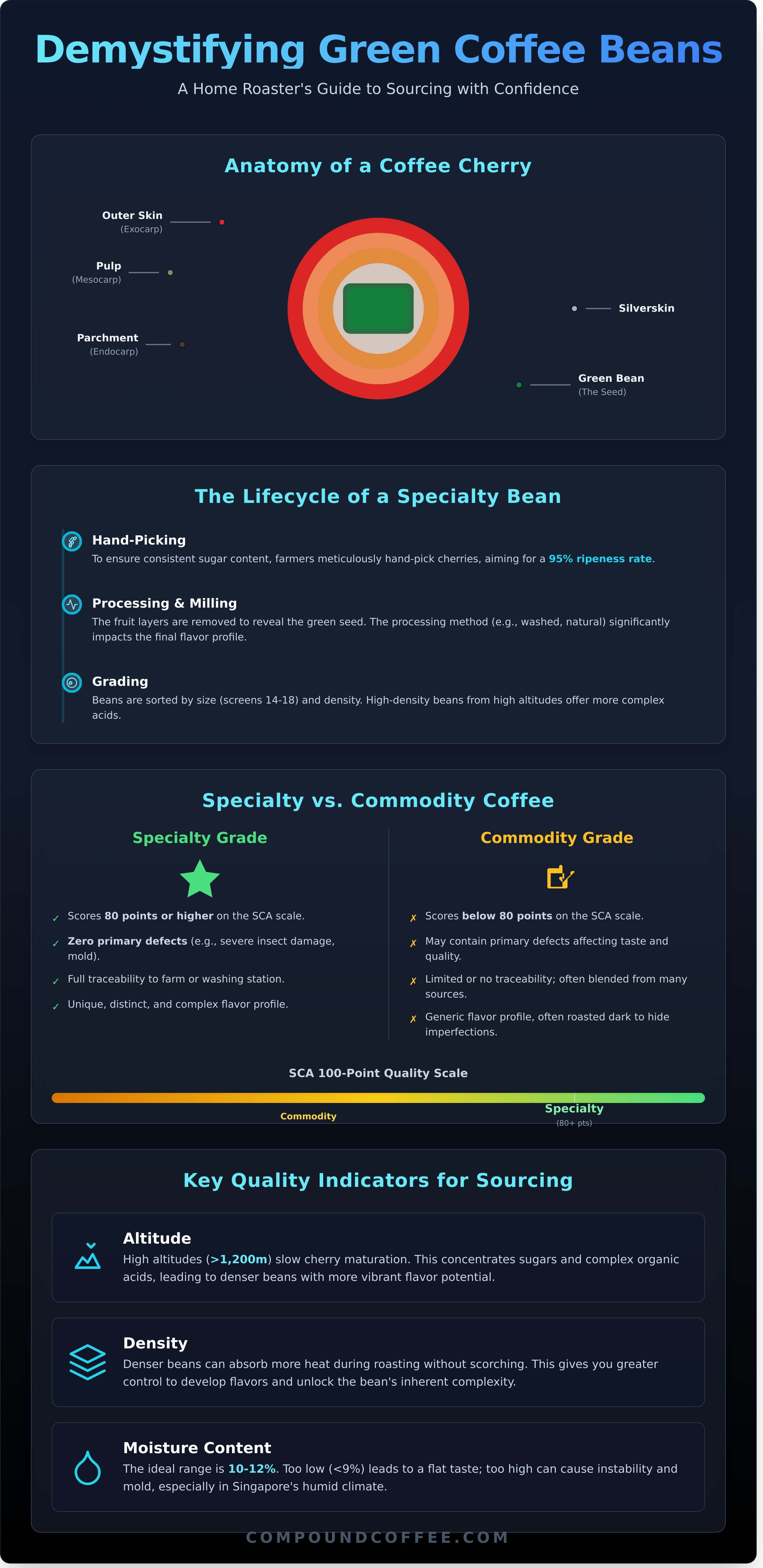
Think of a coffee cherry like a stone fruit. You have the outer skin (exocarp), the sweet pulp (mesocarp), and a protective layer called parchment (endocarp). Inside that parchment sits the seed, often wrapped in a thin, papery layer known as the silverskin. Every step taken to remove these layers affects the final flavor. If the pulp stays on longer, you might get fruitier notes; if it's washed away quickly, the profile often turns out cleaner. Because taste is subjective and individuals perceive flavor differently, exploring these processing styles is a personal adventure rather than a set of rules. We're here to provide the guidelines, but your palate is the final judge.
The Lifecycle of a Specialty Bean
Specialty coffee starts with a choice in the field. Farmers often aim for a 95% ripeness rate during hand-picking to ensure consistent sugar content. Once harvested, the beans undergo milling to strip away the parchment and reveal the green seed. Grading then happens, where beans are sorted by size, often using screens from size 14 to 18, and density. High-density beans typically grown at altitudes above 1,200 meters offer more complex acids. This provides a fascinating canvas for you to experiment with during your roast.
Specialty vs. Commodity Green Coffee
The distinction between commodity and specialty is measured on a 100-point scale established by the Specialty Coffee Association (SCA). For a lot to earn the 'specialty' title, it must score 80 points or higher. This isn't just a number; it represents a commitment to quality and traceability that allows you to know exactly which farm or washing station produced your coffee. Knowing the specific lot matters because it connects you to the producer's hard work. Specialty green coffee is a seed with zero primary defects and a unique flavor profile.
In Singapore, the home roasting community has grown by approximately 20% since 2020. Whether you're roasting in a small home machine in a HDB flat or a professional drum roaster, starting with specialty grade ensures your raw material hasn't been compromised by mold or insect damage. We see ourselves as guides helping you discover which of these unique profiles resonates with your own palate. Buying specialty means you're investing in a product that has been scrutinized for quality at every stage of its agricultural life. It's the difference between a mass-produced commodity and a carefully curated ingredient that's ready for your creative touch.
Evaluating Quality: A Guideline for Your Sourcing Journey
Your roasting journey starts with the seed. It's the raw potential of every cup you'll eventually brew. When you hold green coffee beans in your hand, you're touching the culmination of years of labor and specific environmental conditions. We view the sourcing process as a collaborative exploration between you and the producer. There's no single 'best' bean, only the one that speaks to your specific palate at this moment. Embracing this variety is what makes home roasting so rewarding.
Terroir is the silent architect of flavor. It encompasses the altitude, soil composition, and local climate of the farm. High-altitude environments, typically those above 1,500 meters, produce denser seeds. The cooler temperatures at these heights slow down the maturation of the coffee cherry. This slower growth allows the plant to concentrate more sugars and organic acids into the seed. This density is the foundation of a high-quality, standard cup of coffee. Denser beans can absorb more thermal energy during the roast without scorching, giving you more control over the final profile. Lower altitude beans are often softer and require a gentler heat application to avoid bitter flavors.
Every home roaster should track two vital statistics: density and moisture. Most specialty-grade coffee arrives with a moisture content between 10% and 12%. If the moisture drops below 9%, the bean may lose its vibrant acidity and taste 'baggy' or aged. If it exceeds 12.5%, the risk of microbial growth increases significantly. You can measure density simply by weighing a fixed volume of beans. A higher weight per liter generally indicates a more complex flavor potential. These numbers aren't rigid rules; they're data points to help you understand how your beans will behave once the heat is on.
The precision needed for coffee is a great example of why accurate measurement is critical in any quality-focused process. For those interested in industrial-grade weighing solutions and calibration services, you can visit Independent Scale Service to see how these principles apply in other fields.
Processing Methods and Visual Cues
The way a farmer processes the fruit significantly alters how the raw seed looks. Washed process beans are the most common. They typically show a clean, bluish-green hue and a very consistent shape. The mechanical removal of the fruit before drying results in a very tidy appearance. Natural process beans are different. Because they dry inside the whole cherry, they often have a yellowish or tan tint. You'll notice more silver skin tucked into the center crack. Experimental ferments, like 72-hour anaerobic maceration, can produce beans that look mottled or even slightly purple. These visual variations are clues to the wild, fruity, or boozy flavors waiting inside.
The Subjective Nature of Taste
We believe that your personal perception is the ultimate judge of quality. Everyone's sensory hardware is unique. You might perceive acidity as a bright, pleasant spark, while someone else might find it sharp or overwhelming. This is why we treat cupping notes as a compass rather than a destination. If a label mentions 'red currant and dark chocolate,' it's a suggestion of what the producer found. It's not a test you have to pass. We encourage you to maintain a discovery mindset. In Singapore, you can explore diverse origins like Ethiopia for floral elegance or Colombia for balanced sweetness. Prices for these specialty lots usually range from S$28 to S$45 per kilogram. Experimenting with different origins is the fastest way to develop your own preferences. If you're looking for a place to start, our curated green coffee selection offers a wide variety of profiles to explore.
From Kitchen to Lab: Options for Roasting Your Green Beans
Roasting your own green coffee beans is a rite of passage for any enthusiast looking to deepen their connection with the craft. The journey often begins in the heart of the home. Not long ago, enthusiasts in Singapore relied on cast-iron pans or modified popcorn poppers to transform raw seeds into aromatic coffee. These methods are tactile and exciting, yet they often lack the thermal stability needed for repeatable results. Modern home air roasters have changed the game. These devices use convection to keep the beans suspended in a stream of hot air, which minimizes the risk of scorching and provides a much more even heat distribution than a stovetop pan ever could.
The transition from a simple kitchen setup to a "lab" mindset happens when you start prioritizing control over the Maillard reaction. This critical chemical phase is where sugars and amino acids react to develop the complex flavors we enjoy. Professional-grade equipment allows you to manipulate variables like drum speed and airflow with high precision. Since taste is deeply subjective and individuals perceive flavor differently, having this level of control is empowering. It lets you tailor the roast to your specific palate. For those who want to dive into the physics of heat transfer and airflow, our Ultimate Roasting Intro Page offers a wealth of technical guidance to get you started.
Home Roasting vs. Professional Co-Roasting
Home setups are wonderfully accessible. You can pick up a basic manual roaster for under S$100 or invest in a sophisticated digital home unit for roughly S$800 to S$1,500. These tools are perfect for small batches, but they can struggle with consistency due to ambient temperature changes in a typical Singaporean kitchen. Co-roasting spaces offer a unique middle ground. By renting time on industrial machines like a Giesen or Stronghold, you access technology worth over S$25,000 without the massive upfront cost. These environments often include professional sensors like Lighttells, which measure the roast degree of your green coffee beans with scientific accuracy. You get the precision of a commercial roaster while benefiting from a community of fellow makers who can offer immediate feedback on your results.
Discovery Through Experimentation
We encourage you to treat your first twenty batches as a series of lab sessions rather than a grocery task. Every roast is an opportunity to learn how different origins react to heat. Logging your data is the most important habit you can develop. Record your charge temperature, the time it takes to reach "yellowing," and the exact duration of the development phase after the first crack. This data allows you to replicate your successes and understand your misses. At Compound Coffee, our passion lies in the lighter end of the spectrum to highlight unique farm characteristics. We don't sell or roast dark roast coffee, as we find the delicate nuances of the bean are often lost in those higher temperatures. If you're looking for a mentor to help you navigate these variables, our Coffee Classes provide a hands-on environment where you can experiment under expert guidance. It's the fastest way to turn your curiosity into confidence.
Buying and Storing Green Coffee in Singapore
Singapore's tropical climate presents a unique set of hurdles for any home roaster. With average relative humidity levels often hovering around 84%, your green coffee beans are constantly at risk of absorbing moisture from the air. This moisture gain can lead to mold or, more commonly, a rapid degradation of the bean's organic compounds. While unroasted beans are far more stable than their roasted counterparts, they aren't invincible. You'll find that raw beans typically maintain their peak flavor profile for 6 to 12 months, whereas roasted coffee often begins to lose its vibrance after just 30 days.
If you're thinking about importing your own stash, the Singapore Food Agency (SFA) generally allows small quantities for personal use without a permit. However, if you're looking to bring in more than 5kg of raw coffee, you'll need to look into commercial import requirements and potential GST payments. Most local enthusiasts find that sourcing through established channels is much simpler. It saves you the headache of customs paperwork and ensures the beans have been transported in climate controlled environments. Since we don't sell dark roast coffee at Compound Coffee, we focus on preserving the delicate, bright notes that only stay intact with proper handling.
Optimal Storage Guidelines for the Tropics
Keeping your beans in a cool, dark, and dry spot is the gold standard for preservation. In our heat, a kitchen cabinet away from the stove or windows is usually the best bet. Airtight containers are essential to block out Singapore's moisture. For those who want to go the extra mile, vacuum sealing is a fantastic way to pause the clock on oxidation. Many professional importers use GrainPro bags; these are high barrier liners that keep humidity out and preserve the bean's internal moisture at a steady 10% to 12%.
You can tell your green coffee beans are aging if they lose their vibrant green or bluish hue and turn a pale, yellowish white. This is often called fading. If you smell something akin to old books or wet cardboard, the beans have become baggy. While you can still roast these, the resulting cup might lack the crisp acidity found in fresh harvests. We believe taste is subjective, so while faded beans might not be ideal for everyone, you might find they offer a different character that suits your personal preference.
Sourcing Locally in Singapore
Buying from local specialty roasters is often the most rewarding path for beginners and pros alike. You get access to beans that have already been cupped and vetted for quality by experienced palates. It's a great way to skip the international shipping fees and the uncertainty of long transit times. Many local enthusiasts also join community buy groups to split larger bags of rare microlots. This collaborative approach makes high end coffee more accessible and builds a shared knowledge base within the local scene.
Before you start roasting your own, it's helpful to know what a perfectly executed roast tastes like. Browsing the Roasted Beans section allows you to see the flavor profiles we aim for, providing a benchmark for your own roasting experiments. We encourage you to use these profiles as a guide rather than a rigid rulebook. Everyone perceives flavor differently, and the joy of the journey is finding the specific notes that resonate with you.
Ready to start your own roasting experiments with expert guidance? Explore our coffee roasting workshops to connect with fellow explorers and refine your craft in a hands-on environment.
Empowering Your Coffee Journey with Compound Coffee Co.
Compound Coffee Co. isn't just a supplier of high-quality seeds. We view ourselves as a platform for discovery where every bag of coffee is an invitation to learn. Since we started in 2016, our mission has been to empower the coffee community in Singapore by sharing knowledge and fostering a spirit of curiosity. We've built an ecosystem where pushing boundaries is the daily mantra. This isn't about following a set of rigid rules; it's about giving you the tools to explore your own palate. We believe that you're the best judge of what tastes good in your cup.
Our philosophy centers on the idea of being a partner in your exploration. We focus exclusively on Light and Medium roasts to highlight the inherent character of the green coffee beans we source. Every seed has a unique story told through its soil, altitude, and processing method. By avoiding heavy char and oily surfaces, we let those natural notes of jasmine, stone fruit, or cocoa shine through. We've found that this approach respects the hard work of the farmers who nurtured the crop for months before it reached our shores.
Our co-roasting space in Singapore serves as a vital hub for the next generation of roasters. We currently provide the infrastructure for over 25 independent coffee labels to develop their own signature profiles using our professional Giesen equipment. We've always believed that a rising tide lifts all boats. By providing a low-barrier entry point for passionate individuals, we help diversify the local coffee scene. It's a place where "passionate experimenters" come together to share ideas and refine their craft.
The Compound Experience
Our relationship with coffee starts at the source. We take regular farm trips to build intimate connections with producers, ensuring we understand the challenges and triumphs of each harvest. We choose not to offer Dark Roasts because we want to respect the unique sugars found within the green seed. High temperatures can destroy the delicate organic acids that provide brightness and complexity. Our foundational workshops, which start at S$180, are designed to demystify the science of the seed. These hands-on sessions help you understand how heat interacts with organic compounds. We recognize that individuals perceive taste differently, so our workshops focus on helping you find your own preferences rather than dictating a single "correct" way to brew.
Start Your Discovery Today
The world of specialty coffee is vast and waiting for your input. You might want to try roasting your own green coffee beans at home using a small-batch roaster or simply explore our curated roasted selections. We invite you to join our community of experimenters who aren't afraid to try new brewing ratios or water temperatures. Taste is a journey, not a destination, and we're here to be your guide as you navigate the different origins and processing methods available. Whether you're a complete beginner or a seasoned professional, there's always something new to learn in the lab. We'll provide the data and the tools, but your curiosity is what will drive the discovery.
Taste is a personal journey, and we're here to be your guide as you explore new flavors. Explore our Espresso selection to see how we translate green potential into cup reality.
Start Your Personal Roasting Discovery Today
Your path to a better cup starts with understanding the raw potential within green coffee beans. We've explored how sourcing through direct relationships with small-holder farmers ensures both quality and ethical impact. You've seen that roasting at home isn't about following rigid rules. It's about finding what tastes right to you. Since we started in 2014, we've learned that everyone perceives flavor differently; your palate is the ultimate authority. We don't roast dark coffee here because we believe in highlighting the natural vibrance of the seed. As Singapore’s leading co-roasting facility, we provide the professional tools you need to experiment safely. You'll be joining a passionate community of 500+ home roasters who are already redefining their morning ritual. We're here to act as your guide, sharing the technical knowledge we've gathered from years of hands-on experimentation. Let's co-create a profile that suits your specific preferences.
We're excited to see what unique flavors you'll discover on this shared journey of exploration.
Frequently Asked Questions
How long do green coffee beans last before they go bad?
Green coffee beans generally stay fresh for 6 to 12 months when you store them in a cool, dark place. After 365 days, they often lose their vibrant acidity and start tasting like paper or hay. You'll notice the color fade from a deep jade to a pale yellow over time. Since Singapore's humidity stays around 80 percent, we recommend using airtight containers to prevent mold and keep your beans stable.
Can I roast green coffee beans in a regular oven or popcorn maker?
You can definitely start your journey using a standard kitchen oven or a hot air popcorn maker. An oven set to 230 degrees Celsius works, though it's harder to get an even roast compared to dedicated machines. A popcorn maker is a popular entry point because it moves the beans with air. Just remember that these methods are experimental guidelines. Since we don't sell dark roast coffee, we suggest aiming for lighter profiles to taste the bean's unique origin.
Are green coffee beans healthier than roasted coffee beans?
Green coffee beans contain higher levels of chlorogenic acids, which are 50 percent more concentrated than in roasted beans. These antioxidants often decrease during the roasting process as heat changes the chemical structure. While some studies suggest benefits for blood pressure, the taste of a green bean infusion is very different from traditional coffee. It's an earthy, tea like experience that depends entirely on your personal palate and health goals.
Is it cheaper to buy green coffee beans and roast them myself?
Buying green coffee beans can save you roughly 30 to 50 percent on the raw material cost compared to pre-roasted specialty bags. In Singapore, a 1kg bag of high quality green beans might cost S$25; the roasted version could be S$45 or more. You have to account for the 15 to 20 percent weight loss that happens during roasting. It's a cost effective way to experiment with different origins while building your skills as a home roaster.
What is the difference between green coffee and raw coffee?
There's no functional difference because these terms both refer to the dried seeds of the coffee cherry before roasting. In the industry, we usually say "green" to describe the color and "raw" to highlight that they haven't been heat treated yet. These seeds have a moisture content between 10 and 12 percent. They're the blank canvas you'll use to co-create your own signature flavor profiles at home as you learn the craft.
How do I know if my green coffee beans are specialty grade?
Specialty grade beans must have zero Category 1 primary defects and fewer than 5 secondary defects in a 350 gram sample. They also need a cupping score of 80 points or higher on a 100 point scale according to SCA standards. You can check the bag for specific lot numbers or certifications. We believe these numbers are helpful benchmarks, but your own taste buds are the final judge of what makes a coffee special to you.
Why does my home-roasted coffee taste different from a cafe's brew?
Professional cafes often use commercial roasters costing over S$15,000 that provide precise control over airflow and drum speed. Your home environment and equipment create a different heat transfer rate, which changes how sugars caramelize. Because taste is subjective, your roast might actually be more enjoyable to you than a cafe's brew. Experimenting with your technique is the fastest way to bridge that gap and find your own favorite cup.


Comments