

Green Coffee Beans: A Guide to Sourcing and Roasting at Home (2026)
- carmel.soon
- Mar 30
- 13 min read
Updated: Apr 3
What if the most important part of your coffee journey hasn't actually happened yet? Many of us in Singapore are used to buying pre-roasted bags, but there's a hidden world of flavor locked inside the raw green bean that stays tucked away until you take control of the heat. It is easy to feel overwhelmed by technical jargon or worry about accidentally buying a bag of culinary legumes instead of specialty coffee seeds. We have all been there, wondering if a specific processing method is worth the S$25 price tag or if we will just end up with a ruined batch.
You are right to be cautious, because your hard-earned money should lead to a brew you actually enjoy. This guide will help you understand coffee grading and sourcing so you can buy with total confidence. We will show you how to evaluate raw quality and how different processing styles change what you taste in the cup. Since everyone perceives flavor differently, we aren't here to give you rigid rules. Instead, we'll provide the knowledge you need to start experimenting at home. We will look at everything from moisture content to how light and medium roast profiles bring out a seed's unique personality, though you won't find any dark roast tips here.
Key Takeaways
Understand the raw potential of the coffee seed and why its shelf-stability makes it the perfect starting point for your personal roasting journey.
Learn to visually evaluate each green bean for uniformity and moisture to ensure your roast develops the vibrant flavors unique to specialty coffee.
Discover how processing methods like the washed process influence the farm’s terroir, helping you choose the right profile for your subjective taste.
Master the basics of sourcing small batches from transparent suppliers, allowing you to experiment with different origins at your own pace.
Explore how to scale your passion from home experiments to professional-grade equipment using community-focused co-roasting spaces in Singapore.
Table of Contents What are Green Coffee Beans? (The Raw Canvas of Specialty Coffee) Evaluating Quality: What to Look for in Specialty Green Beans Processing Methods: How They Shape the Raw Flavour Potential How to Source and Store Green Beans for Home Roasting Join the Roasting Journey with Compound Coffee Co.
What are Green Coffee Beans? (The Raw Canvas of Specialty Coffee)
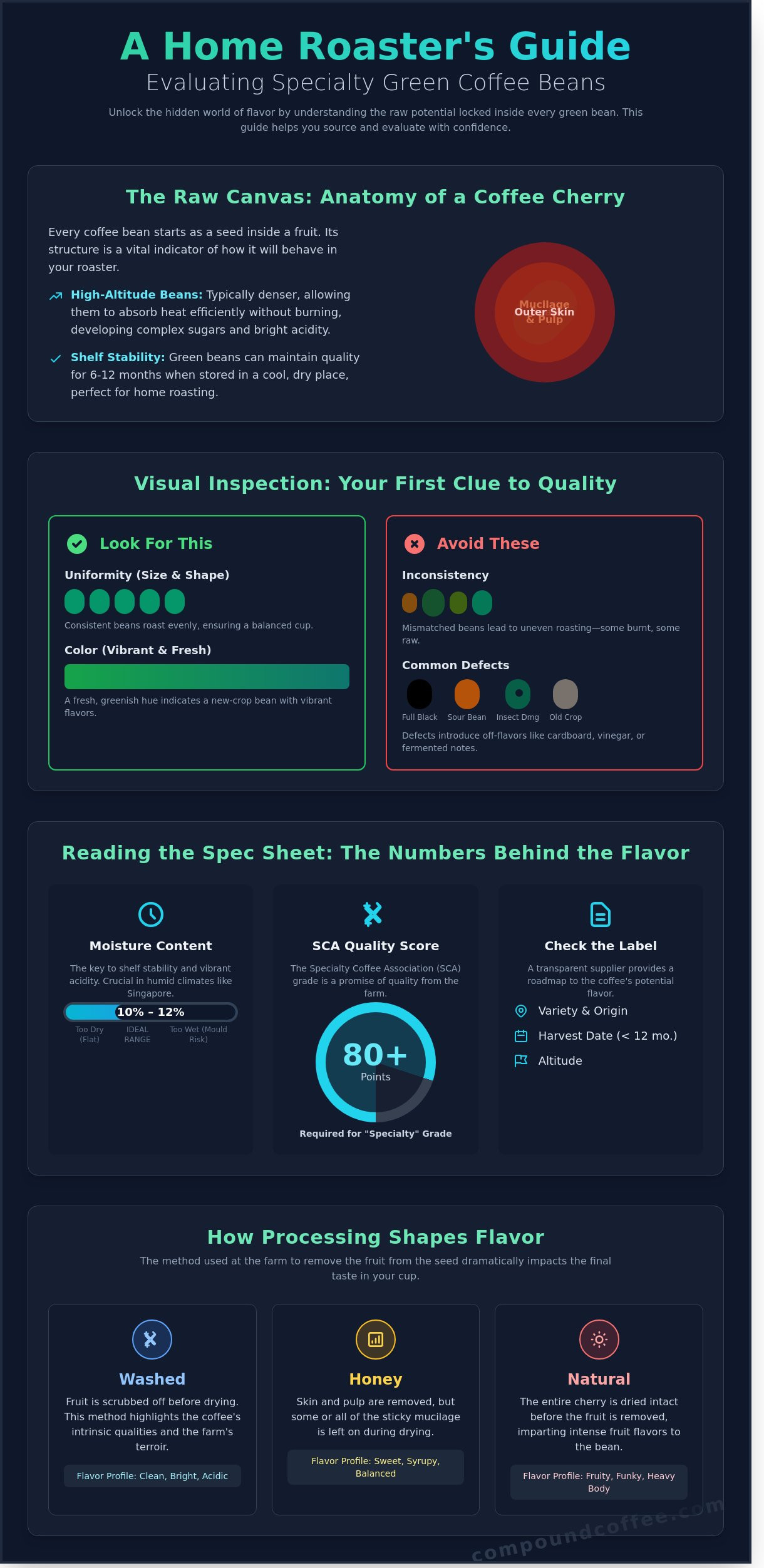
Every cup of coffee begins its life as a seed inside a vibrant fruit called a coffee cherry. We refer to these seeds as green coffee beans because they remain in their raw, unroasted state. Unlike roasted coffee, which begins to lose its aromatic complexity within weeks, a green bean is remarkably shelf-stable. When stored in a cool, dry place in Singapore's humid climate, these beans can maintain their quality for 6 to 12 months, making them the perfect starting point for your home roasting journey.
The difference between commercial and specialty beans lies in the dedication of the producer. While commercial coffee often prioritizes mass production and price, specialty coffee is about an intimate relationship with the land. Producers, the unsung heroes of the industry, carefully sort and process the beans to ensure they're free from defects. This meticulous care allows us to experience the true potential of the origin. If you want to start exploring these raw materials, you can find options like our Semendo Honey green beans to begin your own experimentation.
The Anatomy of a Coffee Cherry
Understanding the layers of the fruit helps you master the roast. The cherry consists of the outer skin, the sweet pulp, and a sticky layer called mucilage. Once these are removed, we're left with the bean itself. Its physical structure is a vital indicator of how it'll behave in your roaster. High-altitude beans are typically denser; this density is a key indicator of potential flavor because it allows the bean to absorb heat more efficiently without burning the exterior. This structural integrity is what enables the development of complex sugars and bright acidity during the roasting process.
Why Roast at Home? The Joy of Discovery
Roasting at home offers a level of freshness that's hard to match. By roasting small batches of 100g or 250g as needed, you ensure every brew is at its peak. It also gives you total control over the flavor profile. While we don't sell dark roast coffee because it often hides the unique character of the farm, we encourage you to find the balance that suits your palate. Taste is deeply subjective. One person might love a light, tea-like Kenyan, while another prefers a chocolatey Brazilian. We're here to provide the guidelines and knowledge, but your own sensory experience is the ultimate authority on what makes a perfect cup.
This passion for understanding and shaping a natural product's potential is a rewarding journey. If the process of unlocking flavor in coffee beans excites you, you may find a similar craft in the world of premium cacao. For those ready to explore another complex bean, you can discover Sacred Bean and their specialty Criollo Fino de Aroma products.
Evaluating Quality: What to Look for in Specialty Green Beans
When you first open a bag of green bean samples, your senses provide the first clues about the potential in the cup. Visual inspection is your starting point. You're looking for uniformity in size, shape, and colour. If the beans look like a mismatched collection of different sizes, they'll roast unevenly; the small ones might char while the large ones remain underdeveloped. Consistency is a hallmark of careful processing at the farm level.
Moisture content is a technical but vital metric for home roasters in Singapore's humid climate. Most specialty lots arrive with a moisture level between 10% and 12%. If the moisture is too high, you risk mould growth during storage; if it's too low, the coffee often loses its vibrant acidity and tastes "flat." We often find that understanding these numbers helps you predict how the coffee will react to heat. Reading a spec sheet gives you the roadmap. You'll want to check the variety, harvest date, and altitude. Freshness matters, so look for beans harvested within the last 12 months to ensure the best flavour clarity.
The Specialty Coffee Association (SCA) sets the gold standard here. For a coffee to earn the "Specialty" label, it must score 80 points or above on a 100-point scale. This isn't just a number; it's a promise of quality that reflects the hard work of the farmers. While these standards provide a great baseline, remember that taste is subjective. What one person perceives as a bright citrus note, another might find too sharp. We encourage you to use these grades as a guide while you discover what truly excites your palate.
Common Defects and How to Spot Them
Identifying defects is a skill that grows with practice. Specialty coffee standards allow for zero primary defects in a 350g sample. Primary defects include full black beans or sour beans, which can introduce fermented or vinegary flavours that ruin a brew. Secondary defects like slight insect damage or broken beans are limited to five or fewer. You'll also notice a difference between old-crop and new-crop beans. Old-crop coffee often loses its green lustre and can taste "baggy" or like cardboard. If you want to see how high-quality processing looks in practice, you can explore our Semendo Honey green beans to see a clean, well-sorted lot.
Density and Altitude: The High-Grown Advantage
Altitude plays a massive role in how a green bean develops its character. Higher elevations usually mean cooler nights, which slows down the maturation of the coffee cherry. This slow growth allows more complex sugars to develop, resulting in a denser bean. Strictly Hard Bean (SHB) is a classification for coffee grown above 1,350 metres. These dense beans can generally withstand higher initial heat during the roasting process. If you're roasting a "Soft Bean" from a lower altitude, you'll need a gentler touch to avoid scorching the exterior. Learning to adjust your strategy based on density is a fantastic way to experiment with your roasts. If you're ready to dive deeper into these variables, our roasting guide offers a helpful framework for your journey.
Processing Methods: How They Shape the Raw Flavour Potential
Processing is far more than a logistical necessity; it's a vital extension of the farm's terroir. While soil chemistry and altitude provide the foundation, the way a producer handles the fruit after harvest dictates which flavours will be unlocked during your roast. Every green bean carries a blueprint of its environment, but the processing method acts as the lens through which we view it. It's the stage where the raw potential of the seed is either clarified or transformed through fermentation.
Washed (Wet) Process: By removing all fruit layers before drying, this method produces a "clean" cup. Expect bright acidity, floral aromas, and distinct clarity.
Natural (Dry) Process: Drying the seeds inside the full cherry allows for natural fermentation. This often leads to heavy bodies, lower acidity, and intense fruit notes like blueberry or strawberry.
Experimental Processes: Techniques like anaerobic fermentation or carbonic maceration are the new frontiers. These methods use controlled environments to create wild, wine-like profiles that challenge our traditional understanding of coffee flavour.
Washed vs. Natural: Which Suits Your Palate?
We believe there's no single "correct" way to enjoy coffee because individuals perceive taste differently. A Washed coffee might offer a crisp, lemony finish that refreshes the palate, while a Natural process provides a creamy, dessert-like experience. Because we don't sell Dark Roast coffee, these processing nuances remain front and center in every cup. We suggest roasting a small 100g batch of each process side-by-side. It's a fantastic way to discover whether you lean towards the sparkling acidity of the Washed process or the jammy sweetness of a Natural.
Spotlight on Honey Processing
Honey processing sits in the sweet spot between Washed and Natural methods. Farmers remove the skin but leave a specific percentage of the sticky mucilage on the bean during drying. This "honey" layer ferments slightly, imparting a syrupy mouthfeel and a refined, integrated sweetness. It's a technical process that requires constant monitoring to prevent spoilage, especially in humid climates, but the results are often remarkably balanced.
For those eager to explore this profile, our Semendo Green Beans Honey serves as a fantastic starting point. It captures the essence of Indonesian coffee craft, offering a clean yet deeply sweet profile that's approachable for any home roaster. Experimenting with a green bean like this allows you to see how mucilage retention translates into that sought-after honey-like texture in your final brew.
How to Source and Store Green Beans for Home Roasting
Finding the right green bean is the first step in your roasting journey. We suggest starting with small quantities, usually between 250g and 500g. This volume is perfect for home roasters because it gives you enough room to fail, learn, and eventually succeed without much waste. You can typically test three or four different roast profiles with a single 500g bag. In Singapore, these specialty packs usually cost between S$15 and S$30 depending on the farm's reputation and the processing method used.
Sourcing with Purpose: Ethical Considerations
Your choice of coffee impacts lives thousands of miles away. We look for transparency in every transaction to ensure the supply chain is healthy. At Compound Coffee Co., we maintain intimate relationships with producers to ensure the "unsung heroes" of the industry receive fair compensation. Choosing specialty beans isn't just about flavor; it's about empowering small farmers and their families through direct trade models.
When you buy beans with a clear trail back to the specific washing station or farm, you're supporting a sustainable ecosystem. We believe taste is entirely subjective, so we provide these transparent options to help you find what you personally enjoy. Individuals perceive acidity and sweetness differently, and our goal is to guide you toward your own preferences. Please note that we focus on highlighting the bean's natural vibrance, so we don't offer dark roast options in our selection.
Storing Your Green Bean Stash
Don't put your beans in the freezer. While it's a common myth that cold preserves them, freezing can introduce moisture through condensation, which damages the cellular structure of the green bean. Keep your stash at room temperature, ideally between 20°C and 25°C, in a dry spot away from direct Singapore sunlight.
Breathable Bags: Use GrainPro or similar multi-layer liners to keep moisture levels stable at the industry standard of 10% to 12%.
Airtight Containers: These work well for short-term storage, but you'll want to keep them in a dark cupboard to prevent light degradation.
The Roasting Window: Most green coffee stays at its peak for 6 to 12 months. After 18 months, beans often taste "baggy" or like old cardboard.
If you notice a flat, woody flavor in your brewed cup, your beans might be past their prime. Since everyone's palate is unique, you might find you enjoy a bean even as it ages, while others prefer the vibrance of a fresh crop. Trust your own senses as you experiment with your stash.
Ready to start your first batch? Explore our
to experience a unique honey process coffee from Sumatra.
Join the Roasting Journey with Compound Coffee Co.
Starting your own roasting project is a leap into a wider world of flavor. We've built our Ultimate Roasting Intro Page to act as a roadmap for your first steps into this craft. At Compound Coffee Co., we believe there's no single "correct" way to enjoy a cup. Taste is entirely subjective. Your palate might pick up delicate floral notes where someone else perceives bright stone fruit. We focus exclusively on light to medium roasts because these profiles let the green bean’s inherent character shine. You won't find dark roasts in our selection; we prefer to highlight the vibrant, acidic, and sweet complexities that different terroirs offer without masking them with smoke or char.
The Compound Co-Roasting Experience
Home roasting often starts with small 100g batches in a pan or a desktop machine. When you're ready to scale your experiments, our co-roasting space in Singapore provides access to professional-grade equipment. It's a dedicated hub where your vision becomes reality. You can rent high-end roasters to refine your technique alongside a community of experimental coffee lovers. If you want to sharpen your skills before diving in, our Coffee Classes offer hands-on training to help you understand the science behind the heat. We've helped over 500 local enthusiasts move from curious beginners to confident roasters since we launched our training programs.
From Green to Roasted: Finding Your Style
Finding your signature style takes time and plenty of trial and error. It helps to have a benchmark for your progress. Try comparing your home creations with our Specialty Roasted Beans to see how different heat applications change the final cup. Exploring diverse origins is the best way to learn what you love. Whether it's the citrus-forward acidity of an Ethiopian heirloom or the earthy sweetness of an Indonesian green bean, every origin tells a unique story. We invite you to join us in this constant state of learning and discovery. Explore our green and roasted bean selection today and start co-creating your perfect coffee profile.
Your Journey into Specialty Roasting Starts Here
Mastering the green bean is an evolving craft that celebrates your unique palate. You've explored how processing methods like honey or washed treatments shape raw flavor potential. You've also learned that sourcing depends on building transparent links with small-scale farmers. At our Singapore-based co-roasting facility, we've spent the last 10 years mentoring enthusiasts to find their own signature profiles. We don't sell dark roast coffee because we believe in preserving the vibrant, complex notes inherent in the seeds. Since everyone perceives taste differently, these guidelines serve as your starting point for endless experimentation.
Our community hub provides the tools and expertise to move you from a beginner to a confident home roaster. We source our lots through direct relationships, often paying 30% above market rates to support the unsung heroes at origin. Whether you're roasting your first batch or your hundredth, you're part of a movement that values education and empowerment. It's time to fire up your roaster and discover which flavors resonate with you. Start your roasting journey with our specialty green beans and join a community that's just as passionate about the process as you are.
Frequently Asked Questions
Is a green bean a vegetable or coffee?
In the context of your morning brew, a green bean is the raw, unroasted seed of a coffee cherry rather than a garden vegetable. These seeds come from the Coffea plant and only transform into the aromatic brown beans we recognize after they encounter heat. While they share a name with common legumes, their chemical makeup is entirely different. We find that the raw scent often reminds people of fresh grass or peas, but remember that individuals perceive taste differently based on their own experiences.
Are green coffee beans cheaper than roasted beans?
You'll typically find that green coffee beans cost 30% to 50% less than roasted ones because you aren't paying for the roaster's labor, energy, or packaging. In Singapore, a 500g bag of high-quality specialty green coffee might cost between S$15 and S$28, while the roasted version of that same coffee often exceeds S$45. You're also accounting for the weight loss that happens during roasting. It's an affordable way to explore premium origins while taking a hands-on role in your coffee journey.
How long do green coffee beans last before they go bad?
Green coffee beans generally stay fresh for 6 to 12 months if you store them in a cool, dry place away from the Singapore sun. They don't spoil like fresh produce, but they do lose moisture and organic compounds over time, which can lead to a flat or woody flavor. We recommend roasting your supply within 180 days to enjoy the most vibrant profile. Since taste is subjective, you might find you enjoy the mellowed character of an older bean, so don't be afraid to experiment.
Can I roast green coffee beans in a regular oven or pan?
You can certainly roast a green bean in a heavy cast iron pan or a kitchen oven, though these methods require a bit of practice to get right. A pan needs constant stirring for 10 to 15 minutes to prevent scorching, while an oven often lacks the airflow needed to blow away the chaff. Many members of our community start with these home tools before moving to dedicated roasters. There isn't one best way to roast; it's all about finding the process that makes you feel most connected to your cup.
Do green coffee beans have more caffeine than roasted ones?
Green coffee beans contain almost exactly the same amount of caffeine as roasted ones, as caffeine is quite stable even at high temperatures. During a typical roast, a bean might lose less than 1% of its caffeine content. However, because beans lose about 18% of their weight in water during the process, roasted coffee is actually more concentrated by weight. If you measure your coffee with a scale, a 20g dose of roasted beans technically contains slightly more caffeine than 20g of green beans.
Does Compound Coffee sell dark roast green beans?
Compound Coffee doesn't sell dark roast coffee in any form, as our passion lies in highlighting the natural, transparent flavors of the farm. When you purchase green beans from us, you're getting raw seeds that haven't been touched by heat yet. This gives you the freedom to explore any roast level you prefer at home. While our own roasting philosophy avoids dark profiles to preserve acidity and floral notes, we empower you to follow your own palate and discover what you enjoy most.
What is the best way to start roasting coffee at home in Singapore?
The easiest way to start is by using a simple manual ceramic roaster or a repurposed popcorn maker, which you can often find for under S$50. Since Singapore's humidity stays around 80%, it's vital to keep your green bean supply in airtight containers to prevent them from absorbing moisture. We suggest starting with small 50g batches so you can observe how the colors and smells change every minute. Treat these first few roasts as a fun experiment rather than a quest for perfection.
How much weight does coffee lose during the roasting process?
Coffee beans typically lose between 12% and 22% of their total weight during the roasting process. This loss is mostly water vapor escaping the bean, along with some carbon dioxide and silver skin chaff. If you start with a 500g bag of green coffee, you'll likely end up with roughly 400g to 425g of roasted coffee depending on how long you apply heat. Understanding this 15% to 20% average shrinkage helps you calculate exactly how much raw coffee you need to buy for your weekly consumption.


Comments