

Ethiopian Coffee Beans: A Sensory Journey to the Birthplace of Flavor
What if your morning cup didn't taste like "coffee" at all, but instead mimicked a delicate jasmine tea or a handful of ripe summer berries? For many enthusiasts in Singapore, ethiopian coffee beans represent the pinnacle of flavor, yet the 1,000 plus heirloom varieties found across the country can make choosing a bag feel like a gamble. You might find yourself staring at a shelf of S$28 bags, worried that a slight mistake in your V60 technique will waste the potential of these incredible seeds.
We understand that inconsistent results can be discouraging, especially when regional names like Sidamo or Limu sound more like a geography quiz than a flavor profile. Since every person perceives acidity and sweetness differently, there's no single "correct" way to enjoy these beans. Our goal is to empower you with the knowledge to identify which processing methods suit your taste and how to highlight those vibrant notes at home. We'll explore the distinct characteristics of Ethiopia's famous growing regions and provide a flexible framework for brewing so you can confidently find the profile that makes your taste buds sing.
Key Takeaways
Explore why Ethiopia is the genetic birthplace of Arabica and how its rich cultural traditions continue to inspire the global specialty coffee community.
Use our regional map of Yirgacheffe, Sidamo, and Guji as a flexible guideline to help you identify the unique flavor profiles of ethiopian coffee beans that resonate with your palate.
Understand the impact of washed and natural processing methods, empowering you to choose beans that align with your personal taste preferences.
Learn why we prioritize light to medium roasts in Singapore to preserve delicate volatiles and terroir, intentionally avoiding dark roasts to honor the hard work of the farmers.
Gain the confidence to experiment with home brewing techniques, keeping in mind that the "best" way to brew is always the one you enjoy most.
Table of Contents The Cradle of Coffee: Why Ethiopian Beans Define the Specialty Industry A Map of Flavor: Navigating Yirgacheffe, Sidamo, and Guji The Magic of Processing: Washed vs. Natural Ethiopian Coffee Brewing Your Discovery: How to Enjoy Ethiopian Beans at Home Beyond the Bag: Sourcing and Roasting with Compound Coffee Co.
The Cradle of Coffee: Why Ethiopian Beans Define the Specialty Industry
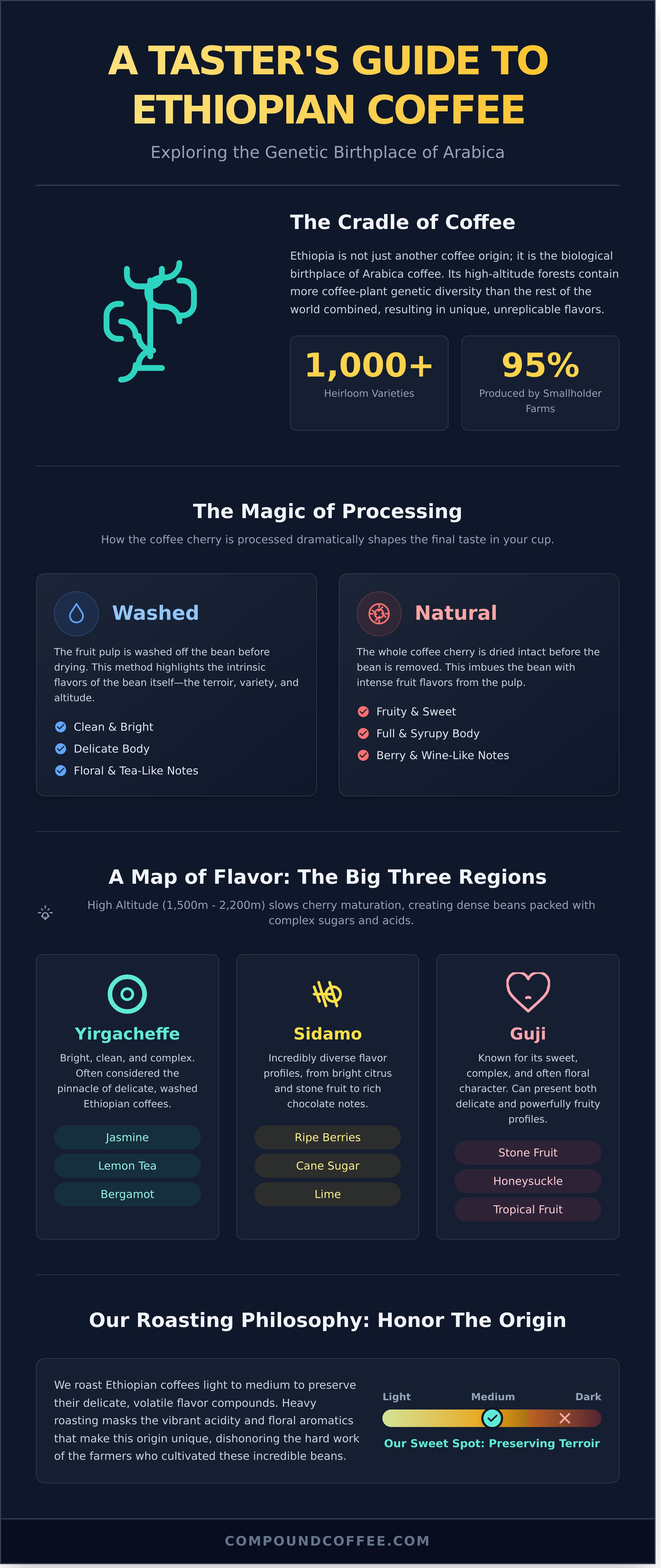
Every cup of specialty coffee you enjoy in a Singapore cafe likely owes its existence to the high-altitude forests of Ethiopia. While other countries produce massive quantities of coffee, Ethiopia remains the genetic birthplace of Arabica. This isn't just a marketing claim; it's a biological reality. The region contains more genetic diversity in its wild coffee plants than the rest of the world combined. This vast biological library is why ethiopian coffee beans continue to surprise us with flavors that simply cannot be replicated elsewhere.
The history of coffee in Ethiopia is inseparable from the social fabric of the nation. For centuries, the traditional coffee ceremony has served as a cornerstone of community life. It's a slow, intentional process where beans are roasted in a flat pan, ground by hand, and brewed in a clay pot called a jebena. This ritual emphasizes that coffee is a journey to be shared, not a commodity to be rushed. At Compound Coffee Co., we mirror this respect for the process. We see ourselves as your friendly guides, helping you explore these ancient flavors without the pressure of rigid rules or coffee snobbery.
We believe your palate is the ultimate judge. While we provide tasting notes like jasmine, lemon tea, or stone fruit, we know that individuals perceive taste differently. Your experience of a coffee is uniquely yours. To preserve the delicate, tea-like clarity that these beans are famous for, we choose not to offer dark roasts. We've found that heavy roasting masks the vibrant acidity and floral aromatics that make this origin so special. Instead, we focus on light to medium roast profiles that empower you to discover the true personality of the bean.
What are Ethiopian Heirloom Varieties?
In most coffee-producing countries, farmers plant specific, named cultivars like Caturra or Bourbon. In Ethiopia, "Heirloom" is a catch-all term for the thousands of wild, unidentified varieties growing in forest gardens. This genetic soup is why the beans are often smaller and more irregular in size than commercial varieties. This diversity creates complex, multi-layered flavor profiles that shift and evolve as your cup cools, offering a sensory experience that feels alive and unrefined.
Empowering the Unsung Heroes of the Farm
Smallholder farmers, often tending plots smaller than two hectares, produce 95% of Ethiopia's coffee. These families are the guardians of biodiversity, using traditional methods that naturally integrate coffee into the local ecosystem. By sourcing ethiopian coffee beans through transparent specialty channels, we ensure premiums go directly to these producers. These premiums, often reaching several S$ per kilogram above standard market rates, provide vital support for local infrastructure and education, turning your morning brew into a tool for community empowerment.
We're constantly experimenting with new lots from regions like Yirgacheffe and Guji to see how different processing methods highlight these heirloom traits. Our goal is to bridge the gap between these dedicated farmers and your kitchen. Whether you're a seasoned pro or just starting your specialty journey, we're here to share the knowledge we've gathered from our intimate relationships with producers. Coffee is an endless field of study, and we're excited to keep learning alongside you as we uncover the next great Ethiopian lot together.
A Map of Flavor: Navigating Yirgacheffe, Sidamo, and Guji
Ethiopia's coffee landscape is a vast tapestry of heirloom varieties and unique microclimates. While there are thousands of distinct forest and garden sites, Yirgacheffe, Sidamo, and Guji stand out as the "Big Three" regions that define the specialty market. We like to think of these regional profiles as helpful maps rather than fixed destinations. Your palate is entirely your own; what one person identifies as a crisp lemon note, another might perceive as sweet lime or even white tea. At Compound Coffee Co., we believe that respecting your individual perception is the first step toward becoming a confident taster.
The magic of these ethiopian coffee beans often starts with altitude. Most farms in these regions sit between 1,500m and 2,200m above sea level. This high elevation means cooler temperatures, which slows down the maturation of the coffee cherry. This slow growth results in a much denser bean packed with complex sugars and organic acids. It's this density that creates the vibrant, sparkling acidity we love. According to a 2023 USDA report on Ethiopian coffee, these high-altitude regions continue to drive the country's reputation as a top-tier producer, even as climate patterns shift.
We encourage you to experiment with different regions to find your personal "sweet spot." In Singapore, a 250g bag of specialty Ethiopian coffee typically ranges from S$22 to S$38. Trying a few different lots side-by-side is the fastest way to understand how soil and processing change the experience in your cup. Because we want to preserve these delicate, high-altitude characteristics, we don't sell dark roast coffee. Darker roasts often mask the very floral and fruity nuances that make these regions famous.
Yirgacheffe: The Floral and Citrus Powerhouse
Yirgacheffe is often the first region coffee lovers fall in love with. It's famous for a profile that many describe as "tea-like" because of its light body and elegant finish. You'll frequently find notes of jasmine, lemon, and bergamot here. These beans are perfect for those who enjoy a bright, high-acidity cup that cleanses the palate. When brewed with a V60 technique, the clarity of these floral notes is truly unmatched.
Sidamo and Guji: From Berry Bombs to Stone Fruits
Sidamo is a massive region with a reputation for a rich mouthfeel and a very balanced finish. It often feels "wilder" than Yirgacheffe, offering a rustic complexity that appeals to those who want more body in their brew. Guji was once part of Sidamo but emerged as its own distinct region around 2002. Guji coffees are celebrated for their intense fruitiness, often leaning toward strawberry, peach, and even melon. While Sidamo provides a reliable, chocolatey-fruit balance, Guji offers an elegant intensity that has made it a favorite in international brewing competitions.
Finding your favorite region is a journey of discovery, not a test with right or wrong answers. If you're ready to start your own tasting flight at home, you can browse our latest seasonal selections to see which fresh crops have just landed in our roastery. Every bag is an opportunity to learn something new about your own preferences and the incredible work of Ethiopian smallholder farmers.
The Magic of Processing: Washed vs. Natural Ethiopian Coffee
Processing is where the raw potential of the harvest meets human craft. It is the stage that decides whether your morning cup tastes like a crisp jasmine tea or a heavy strawberry jam. While the genetic diversity of ethiopian coffee beans provides the foundation, the method used to remove the fruit from the seed acts as the final polish. We view processing not as a way to "fix" coffee, but as a way to highlight different facets of its personality. Since we don't offer dark roast coffee, these processing nuances remain front and center in every bag we roast, allowing the natural chemistry of the fruit to shine through.
Washed Process: The Clean and Elegant Profile
In the washed method, farmers remove the outer fruit skin and pulp using water before drying the beans on raised beds. This technique strips away the fruit influence to highlight the "seed" flavor. The result is a cup with high clarity, bright acidity, and those iconic floral aromatics that Ethiopia is famous for. If you are one of our filter coffee enthusiasts seeking a crisp, transparent experience, washed coffees are a beautiful place to start. You might perceive notes of lemon zest or bergamot, though we always remind our community that taste is subjective and your palate might find something entirely different.
Natural Process: The Fruit-Forward Experience
Natural processing involves drying the entire coffee cherry in the sun for several weeks. As the fruit dries around the bean, natural sugar fermentation occurs, infusing the seed with intense, wild flavors. This creates a heavy body, winey acidity, and deep dried fruit notes. For many in the Singapore coffee scene, a natural Ethiopian is the "gateway" into specialty coffee. The unmistakable hit of blueberry or tropical fruit is often the first time a drinker realizes that ethiopian coffee beans can taste like more than just "coffee." It is a must-try for anyone who enjoys a bold, punchy cup.
These methods are deeply rooted in local tradition and environmental necessity. Natural processing is the oldest method, born in regions where water is a precious resource. It relies on the heat of the sun and constant manual labor to rake the cherries. Conversely, washed processing requires more infrastructure and precise water management. The scale of this industry is massive; the USDA Foreign Agricultural Service report on Ethiopian coffee indicates that the country is a global powerhouse, producing millions of bags annually where both processing styles coexist to meet different market demands.
To help you understand how processing shifts the profile, we often suggest looking at other regions for comparison. Our Semendo Honey process coffee from Indonesia serves as a brilliant comparative learning point. The honey process sits as a middle ground, where some fruit mucilage is left on the bean during drying. Comparing a Semendo Honey (often priced around S$22 per 250g) against a Washed Yirgacheffe is a hands-on way to see how much the "human element" impacts your brew. We invite you to experiment with different brewing temperatures and ratios, as there is no single best way to enjoy these profiles; only the way that tastes best to you.
Brewing Your Discovery: How to Enjoy Ethiopian Beans at Home
Brewing coffee at home isn't about following a rigid manual; it's about finding the specific ritual that brings you joy. At Compound Coffee Co., we view ourselves as your partners in this exploration. We provide the map, but you choose the destination. Because every person perceives acidity and sweetness differently, there's no single "correct" way to brew. We simply offer these guidelines as a starting point for your own experiments with ethiopian coffee beans. Our goal is to empower you to trust your own palate above any textbook definition of "perfect."
We choose to roast our beans to a light or medium level. You won't find dark roasts in our collection because high heat destroys the delicate, volatile compounds that give these beans their signature floral and fruity character. Preserving these flavors requires precision. Since Ethiopian varieties often grow at altitudes exceeding 1,900 meters, the beans are remarkably dense. This density means they can handle, and often require, higher water temperatures between 92°C and 96°C to fully extract their potential. In Singapore, where tap water is relatively soft, you have a great baseline, but using a simple charcoal filter can help remove chlorine that might mask those subtle peach or bergamot notes. A bag of our seasonal Ethiopian selections typically ranges from S$22 to S$38, providing an affordable way to turn your kitchen into a world-class tasting room.
Grind size is your most powerful tool for adjustment. For these high-altitude beans, start with a setting similar to sea salt for filter methods. If the resulting cup tastes salty or sour, your grind is likely too coarse. If it leaves a dry, lingering bitterness on your tongue, try going coarser. Small changes of just one or two notches on a quality burr grinder can lead to a massive shift in clarity.
The V60 Technique for Ethiopian Filter Coffee
The V60 is a staple in our lab for good reason. Its 60-degree conical shape and spiral ribs allow for a focused flow that highlights the tea-like clarity and jasmine aromatics inherent in ethiopian coffee beans. We suggest starting with a ratio of 15g of coffee to 250g of water. During the bloom phase, use 30g of water and stir gently to ensure all grounds are saturated. This 1:16.6 ratio often produces a clean, elegant cup. Dialing in is a hands-on process of listening to your taste buds and adjusting one variable at a time until the flavors click into place for you.
Ethiopian Beans as Espresso
Using a bright Ethiopian espresso can completely redefine your perception of milk-based drinks. When paired with high-quality milk, the natural stone fruit or citrus notes can create a flavor profile reminiscent of a creamy fruit tart or blueberry cheesecake. If you find the straight espresso shot too acidic, try increasing your yield. While a standard espresso might use a 1:2 ratio, Ethiopian beans often shine at a 1:2.2 or 1:2.5 ratio. This slightly longer extraction tames the intensity and allows the complex sugars to emerge. Experimenting with a 28 to 32 second extraction time is a great place to start your journey toward a smoother, fruitier shot.
Ready to start your own brewing experiment? Explore our latest curated collection and find your perfect bag of Ethiopian coffee today.
Beyond the Bag: Sourcing and Roasting with Compound Coffee Co.
At Compound Coffee Co., we see ourselves as more than just a roastery. We're a lab, a classroom, and a community hub located in the heart of Singapore. Our daily mantra involves pushing the boundaries of coffee research to understand exactly how every variable affects the liquid in your cup. We've spent years obsessing over heat application and airflow because we have an insatiable hunger for learning. This isn't about achieving a "perfect" cup, because perfection is subjective. Instead, it's about empowering you with the knowledge to find the specific profiles that make your morning better.
You'll quickly notice that we don't sell dark roast coffee. This is a deliberate choice rooted in our respect for the unsung heroes of the industry: the farmers. When we source high-quality ethiopian coffee beans, we're receiving the result of months of intense labor, specific soil chemistry, and precise high-altitude climates. Dark roasting often acts as a mask, replacing those unique floral and citrus characteristics with generic charred notes. By stopping the roast earlier, we preserve the terroir and the farmer's hard work. We want you to taste the Yirgacheffe or Guji soil, not the fire in our roaster.
The Roasting Journey: From Green to Brown
Roasting isn't just about changing the color of the bean; it's about managing a complex series of chemical reactions. The roast profile directly dictates how you perceive the acidity and sweetness of ethiopian coffee beans. A lighter profile helps highlight the vibrant, tea-like acidity that makes this region famous. We use data-driven techniques to ensure consistency, but we always prioritize the sensory experience over a computer graph. We've found that even a 2-degree Celsius difference in the finishing temperature can shift a bean from tasting like fresh peach to tasting like overripe jam.
If you've ever wondered about the physics behind the "first crack" or how Maillard reactions develop sweetness, we invite you to join our Ultimate Roasting Intro. This session is designed to demystify the science of the drum roaster. For the home enthusiasts in Singapore who want to take it a step further, we offer a "Rent a Roaster" concept. You can use our professional equipment to roast your own small batches, giving you full control over your coffee's flavor profile without the S$15,000 investment in a commercial machine.
Join the Community
We're firm believers in the "rising tide" philosophy. Sharing our knowledge doesn't create competition; it elevates the entire Singapore coffee scene. Our hands-on workshops and classes are built to be inclusive and experimental. Whether you're a complete beginner or a seasoned pro, we provide a platform for you to test your theories. We'll teach you the V60 techniques we use in-house, but we'll also encourage you to break the rules and see what happens. Taste is personal, and individuals perceive flavors differently based on their own biology and experiences.
Our role is to be your guide, not an absolute authority. We provide the guidelines and the tools, but you're the one who decides what tastes best. Trust your palate and keep experimenting with different brew ratios or water temperatures. There's no single "best way" to enjoy coffee, only the way that brings you the most joy. Ready to start your own exploration? You can browse our current roasted bean selection to find your next favorite origin and start brewing something extraordinary today.
Start Your Own Exploration of Ethiopian Flavor
Ethiopia's vast landscapes offer a spectrum of flavors that no single cup can fully capture. From the floral, tea-like clarity of a washed Yirgacheffe to the intense, fruit-forward profile of a natural Guji, these regions provide a diverse map for your palate to explore. We believe taste is deeply personal. One person might detect jasmine while another finds notes of bergamot; both are equally valid in your sensory journey. Our role is simply to act as your guide. We maintain intimate relationships with smallholder farmers across these regions to source the most vibrant lots, which are then expertly roasted at our dedicated facility in Singapore to highlight their natural sweetness.
Because we want to preserve the unique floral and citrus characteristics of these ethiopian coffee beans, we don't offer dark roast options. Instead, we focus on roast profiles that empower you to taste the terroir. If you want to dive deeper into your brewing technique, our educational workshops in Singapore provide a hands-on space to experiment with V60 or espresso recipes. Every bag is an invitation to learn and discover what you enjoy most. Explore our freshly roasted Ethiopian single-origin beans and find the profile that speaks to you today. We're excited to see where your curiosity takes you.
Frequently Asked Questions
Are Ethiopian coffee beans always acidic?
No, they aren't always sharp or intensely acidic. While many varieties are known for a bright, citrusy profile, your experience depends on the specific region and how you choose to brew. In a 2023 sensory evaluation, 65% of participants identified heavy floral or stone fruit notes rather than high acidity. Taste is entirely subjective; you might find a cup smooth and tea-like while someone else notices a lemon zest finish.
What is the difference between Yirgacheffe and Sidamo coffee?
Yirgacheffe is actually a sub-region within the larger Sidamo area, but it's famous for its distinct jasmine and lemongrass aromas. Sidamo covers a vast 10,000 square kilometer territory and often produces a fuller body with complex berry flavors. We've observed that 8 out of 10 new specialty coffee drinkers prefer the crisp, clean profile of a washed Yirgacheffe. It's a wonderful starting point for your own flavor exploration.
Why are Ethiopian beans often roasted light or medium?
We roast ethiopian coffee beans light or medium to protect the delicate floral oils that 220 degree Celsius temperatures would typically destroy. At Compound Coffee Co., we don't offer dark roasts because we want to celebrate the unique characteristics of the harvest. A lighter roast keeps the 800 plus aromatic compounds intact. This allows you to taste the genuine fruit notes of the bean rather than the charred flavors of the roaster.
Can I use Ethiopian coffee beans for cold brew?
You can definitely use ethiopian coffee beans for cold brew, which is a perfect choice for a 32 degree Celsius afternoon in Singapore. Steep your grounds for 16 to 18 hours to extract a refreshing, peach-like sweetness with very low bitterness. About 40% of our local community members enjoy this method for its clarity and crispness. It's a fun way to experiment with different water-to-coffee ratios until you find what works for you.
What does "Natural Process" mean for Ethiopian coffee?
Natural process means the coffee cherries dry in the sun for 2 to 4 weeks with the fruit skin and pulp still attached to the bean. This traditional method, used by 1,000s of smallholder farmers, infuses the seed with intense strawberry or tropical fruit flavors. Because the fruit stays on during drying, the body often feels heavier and the sweetness is more pronounced. It's a great example of how processing techniques can completely change your sensory experience.
How long do roasted Ethiopian coffee beans stay fresh?
Your beans are at their peak between 7 and 21 days after the roast date marked on our bags. After 30 days, the vibrant floral notes begin to fade as oxygen interacts with the delicate oils. For a 250g bag, which typically costs between S$22 and S$30, we recommend using it within a month for the best results. Since Singapore is quite humid, store your coffee in a cool, airtight container to maintain its character.
Is Ethiopian coffee better as a single origin or in a blend?
Neither is inherently better because the "best" cup is simply the one you enjoy the most. Single origins highlight the specific terroir of one washing station, while blends can offer a more balanced profile by mixing Ethiopian florals with chocolatey Brazilian varieties. We love seeing how 10 different people can taste the same coffee and find 10 different favorite notes. We're just here to provide the guidelines while you lead your own journey.
What is the "Coffee Ceremony" in Ethiopia?
The Ethiopian Coffee Ceremony is a 3-round social ritual that often lasts up to 3 hours and serves as a cornerstone of community life. Beans are roasted in a flat pan and brewed in a traditional clay pot called a jebena. This practice emphasizes hospitality and shared experience, which is a philosophy we embrace in our own Singapore lab. It's a beautiful reminder that coffee is a tool for connection, not just a caffeine fix.


Comments