
Common Home Brewing Mistakes to Avoid: A Guide to Coffee Discovery
You just spent S$28 on a beautiful bag of light roast Ethiopian beans, but your first cup tastes more like salted cardboard than jasmine and peach. It's a common frustration for many home brewers in Singapore who find their morning results vary wildly from day to day. Identifying common home brewing mistakes to avoid is the first step toward transforming your kitchen into a personal coffee lab where discovery replaces disappointment.
We agree that specialty coffee can feel intimidating when you're faced with technical terms like extraction or grind distribution. It's easy to feel like you're wasting premium beans on bad batches while trying to decode a process that should be joyful. We want to share our passion for experimentation to help you build a repeatable process that yields delicious results every time you brew.
This guide will show you how to troubleshoot your coffee by adjusting variables based on your unique palate. Since everyone perceives taste differently, we'll provide guidelines rather than rigid rules to help you find your own preferences. We'll explore how to master your technique and gain the confidence to experiment with new origins.
Key Takeaways
Embrace coffee brewing as an exciting journey of discovery where you learn to tweak variables to suit your own unique palate.
Identify how the "Big Three" foundations-water quality, freshness, and high-quality roasted coffee beans-impact your final cup before you even start brewing.
Master the use of grind size and agitation as your primary tools to troubleshoot common home brewing mistakes to avoid for a more consistent experience.
Learn a simple sensory framework to diagnose your brew, helping you distinguish between under-extraction and over-extraction based on how you perceive flavor.
Move beyond rigid recipes to understand the "why" behind each step, empowering you to transition from a curious beginner to a confident home pro.
Table of Contents Why Your Home Brew Tastes Different: Embracing the Journey of Discovery The 'Big Three' Foundations: Beans, Water, and Freshness Technique Pitfalls: Grind Size and Agitation Errors Sensory Troubleshooting: Adjusting Based on Your Palate Elevating Your Craft: From Beginner to Confident Pro
Why Your Home Brew Tastes Different: Embracing the Journey of Discovery
You've likely felt the sting of disappointment when your home brew doesn't match the vibrant cup you enjoyed at a cafe. You spent S$30 on a bag of fresh beans, followed the instructions, yet the result feels flat or uninspiring. It's a common hurdle, but we see these moments as invitations to learn rather than failures. Brewing isn't a chore; it's a hands-on experiment where you're the lead researcher. By understanding coffee preparation, you realize that every cup is simply a result of extraction variables you can control.
One of the common home brewing mistakes to avoid is believing there's a single "best" way to brew. Extraction is a science, but taste is entirely personal. What a professional roaster describes as "bright and acidic," you might perceive as "sour." Neither of you is wrong. At Compound Coffee Co., we believe in empowering you to trust your own palate. We don't sell dark roast coffee because we're passionate about highlighting the unique, inherent flavors of each origin, but how you extract those flavors is a journey only you can lead.
The Myth of the 'Perfect Recipe'
A recipe developed by a roaster in a climate-controlled lab often behaves differently in a typical Singapore kitchen. Our local ambient temperatures frequently hit 30°C, which subtly influences how quickly your brewing water loses heat or how your beans degas. Treat every recipe as a flexible guideline rather than an absolute law. If a 1:16 ratio feels too heavy for your morning, don't hesitate to stretch it to 1:17. Your environment is unique, so your approach should be too.
Empowering Your Palate
Your ultimate goal isn't to meet a rigid technical standard; it's to find a cup that brings you genuine joy. It's easy to get lost in the gear, but that's another of the common home brewing mistakes to avoid. Focus instead on the sensory experience. We recommend keeping a simple brew log to track your experiments with grind size and temperature. This practice turns every bag of beans into a lesson. If you're ready to dive deeper into what you're tasting, explore our Specialty Coffee Beginner Guide for sensory basics. Every sip is an opportunity to refine your preference and celebrate the incredible work of the farmers who grew the coffee.
The 'Big Three' Foundations: Beans, Water, and Freshness
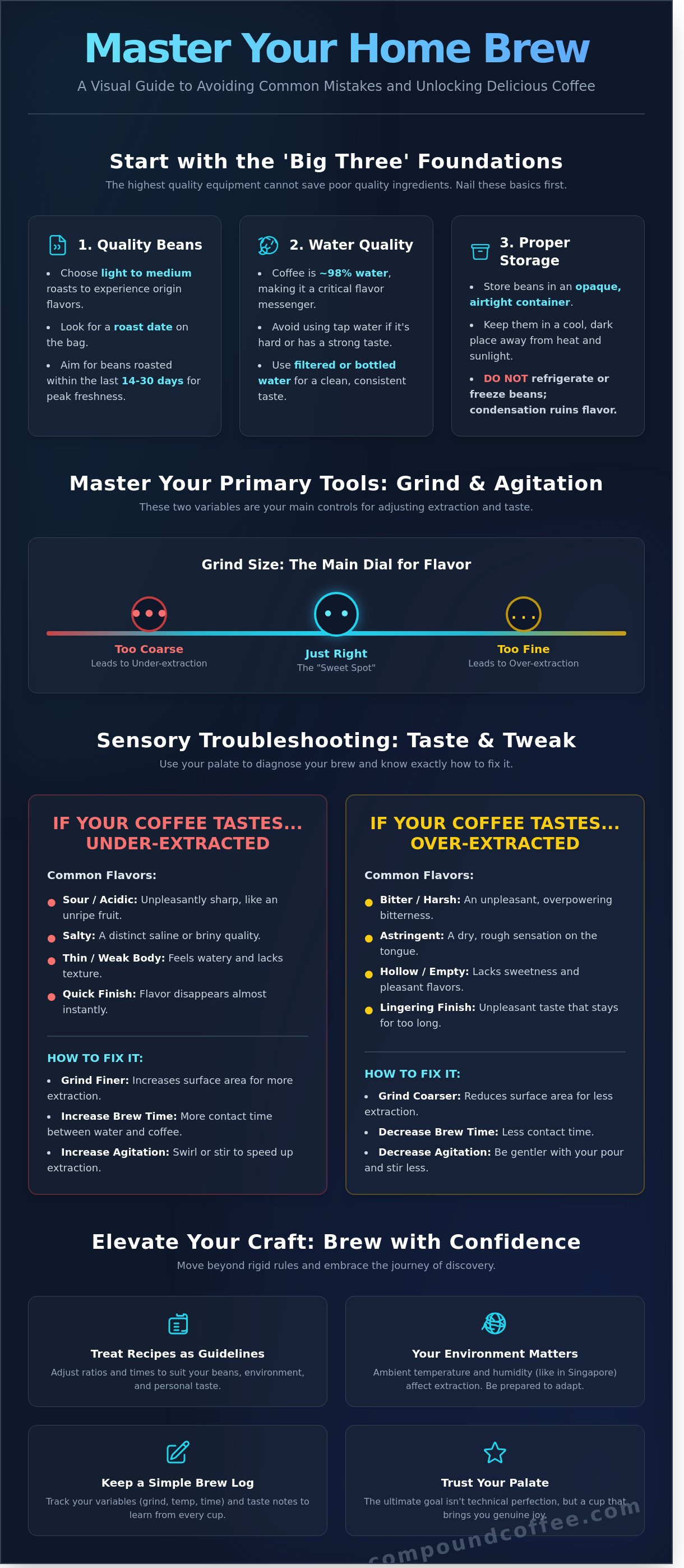
Great coffee starts long before you press a button or pour water from a kettle. It begins with the raw materials. One of the most common home brewing mistakes to avoid is treating coffee and water as secondary to the equipment you use. Even the most expensive brewer cannot fix poor ingredients. We believe that understanding the synergy between your roasted coffee beans and the water you use is the fastest way to elevate your morning ritual.
At Compound Coffee Co., we view ourselves as guides on your flavor journey. We don't believe in rigid rules because we know that individuals perceive taste differently. What tastes vibrant to one person might feel sharp to another. However, we've found that focusing on these three foundational pillars creates a consistent canvas for you to discover what you truly enjoy.
Sourcing and Storing Your Beans
Many coffee drinkers choose bags based on "Dark Roast" labels, seeking boldness. We don't currently sell Dark Roast Coffee because we prefer Light to Medium profiles that preserve the clarity of the bean's origin. If you usually reach for dark roasts, we encourage you to explore these lighter profiles to see if you can spot the fruity or floral notes hidden inside. Always look for a roast date on the bag. Coffee is a fresh agricultural product; aiming for beans roasted within the last 14 to 30 days usually ensures peak aromatics.
Storing your beans correctly is vital in Singapore. With our local humidity often exceeding 80%, leaving a bag open is a recipe for stale coffee. Don't put your beans in the fridge. The constant temperature changes when you take them out create condensation, which damages the delicate oils. Instead, use an opaque, airtight container kept in a cool, shaded corner of your kitchen.
The Water Quality Factor
Since coffee is roughly 98% water, the liquid you use acts as the messenger for flavor. Poor water quality, heavy with minerals or chlorine, acts like a filter that masks the delicate notes of high-quality filter coffee. While Singapore's tap water is safe and generally soft, using a basic carbon filter can remove residual chlorine tastes that interfere with your perception of sweetness.
Temperature is another area where many go wrong. Using boiling water at 100°C directly from the kettle can lead to over-extraction, which often results in a bitter, hollow cup. We suggest a target range of 90°C to 96°C. If you don't have a temperature-controlled kettle, simply let your boiling water rest for about 60 to 90 seconds. This small pause prevents scorching the grounds and allows the more nuanced flavors to shine through. You can experiment with different temperatures to see how they change the body and acidity of your brew; it's all part of the learning process.
Ready to start your journey? You can
to find a profile that speaks to your palate.
Technique Pitfalls: Grind Size and Agitation Errors
Your technique is the bridge between a bag of specialty beans and a cup that truly sings. One of the most common home brewing mistakes to avoid is treating your recipe like a static, unchanging document. At our Singapore lab, we often see enthusiasts find a grind setting they like and stick to it for every bag they buy. However, coffee is an agricultural product. A washed Ethiopian heirloom will behave differently than a honey-processed bean from Indonesia. Because we focus exclusively on light to medium roasts rather than dark roasts, these nuances are even more pronounced. Grind size is your most powerful lever for controlling flavor. If your coffee tastes sharp or sour, it's likely under-extracted and needs a finer touch. If it's bitter or drying, you've probably gone too fine.
Consistency starts with your brew ratio. While your personal palate is the ultimate authority, a ratio of 60g of coffee per liter of water (roughly 1:16) serves as a reliable compass for most filter methods. Precision matters in the specialty world. Even a 2g deviation in water can shift the clarity of those delicate floral notes. We recommend using a digital scale to ensure your variables stay the same every morning, allowing you to make intentional adjustments based on how the coffee tastes to you.
Matching Grind to Method
Think of your grind size as a texture guide tailored to your equipment. For a French Press, aim for a coarse texture similar to sea salt. For espresso, you'll need a fine powder resembling table salt. If you notice a "muddy" or slushy surface on your coffee bed after brewing, your grinder might be producing too many "fines," which are tiny dust particles. This often leads to a clogged filter and a bitter, hollow cup. Understanding this relationship is why many pros suggest that your coffee grinder is your most important tool in the pursuit of better flavor.
The Art of the Pour
Pouring technique often separates a good brew from a great one. A frequent error in V60 brewing is pouring too fast or hitting the paper filter directly with the water stream. This causes water to bypass the coffee grounds entirely, a phenomenon known as "channeling." You'll end up with a watery, uneven brew that lacks depth. Don't skip the "bloom" phase. Pouring about 30g to 40g of water and waiting 30 seconds allows trapped CO2 to escape. Without this step, those gases push water away, preventing full flavor extraction.
Agitation, such as a gentle stir or a swirl of the brewer, can help even out the extraction by ensuring all grounds are wet. It can be a double-edged sword, though. Too much movement can over-extract the coffee and lead to bitterness, while too little can leave flavor on the table. We encourage you to experiment with one small change at a time. Coffee is a journey of discovery, and your preference is the only metric that truly counts.
Sensory Troubleshooting: Adjusting Based on Your Palate
You've weighed your beans and timed your pour, but the coffee in your cup doesn't quite match the vibrant notes on the bag. This is a normal part of the process. One of the most common home brewing mistakes to avoid is treating a recipe like an unbreakable law. At Compound Coffee Co., we see every brew as a collaborative experiment between you and the bean. Because everyone perceives flavor differently, your palate is the only critic that truly matters. One person's "zesty" acidity is another person's "sharp" sourness.
To improve your results, adopt a scientist's mindset. Change only one variable at a time. If you adjust your grind size, keep your water temperature and brew time exactly the same. If you change three things at once, you'll never know which one actually fixed the flavor. This "one-variable" rule is the fastest way to go from a beginner to a confident brewer who understands how to manipulate extraction.
If it Tastes Too Sour or Weak
When a cup tastes unpleasantly tart, thin, or even salty, you're likely dealing with under-extraction. This happens when the water hasn't had enough opportunity to pull the sweetness and complexity out of the grounds. The salty sensation is a tell-tale sign of a very under-extracted brew because acids and salts are the first compounds to dissolve. To fix this, you need to increase the energy of your brew. Try using a finer grind setting to increase the surface area of the coffee. You can also increase your water temperature to a range of 93°C to 96°C. If your technique feels solid, simply try increasing your total brew time by 20 to 30 seconds to allow those heavier sugars more time to dissolve and balance the acidity.
If it Tastes Too Bitter or Dry
Bitterness and a "dry" mouthfeel usually point toward over-extraction. It's important to distinguish between the two. Bitterness is a flavor felt at the back of the tongue, while astringency is a physical drying sensation, much like drinking a tea that has steeped for ten minutes. If your cup feels harsh, try using a coarser grind or dropping your water temperature to around 90°C. Our Semendo Honey is an excellent bean for practicing these subtle adjustments. Because it's a honey-processed coffee, it has a clear, accessible sweetness that makes it very obvious when you've hit the "sweet spot" versus when you've pushed it too far into bitterness. Since we don't roast dark, you'll find that these adjustments allow the natural fruit and honey notes to shine without being masked by char.
Ready to put your palate to the test? Explore our latest seasonal releases in our
and start your next brewing experiment.
Elevating Your Craft: From Beginner to Confident Pro
Mastering your morning cup isn't about reaching a final destination; it's about embracing the journey. At Compound Coffee Co., we thrive on an insatiable hunger for learning and experimenting. By identifying common home brewing mistakes to avoid, you've already taken the first step toward better flavor. Now, it's time to move beyond simply following a recipe card. True confidence comes from understanding the "why" behind every variable. When you know how temperature affects acidity or why grind size alters body, you gain the power to manipulate any bean to suit your specific palate.
Every individual perceives taste differently. What tastes like bright citrus to one person might feel like sharp acidity to another. We don't believe in rigid rules or dogmatic methods. Instead, we view brewing as a series of guidelines that help you find what you personally enjoy. Our role is to act as your friendly guide, helping you demystify the science so you can focus on the joy of discovery. If you're ready to fast-track your progress, we invite you to join a hands-on workshop at our facility. It's the most effective way to calibrate your palate alongside experts who share your passion.
The Power of Community and Shared Learning
Coffee shouldn't be a solitary pursuit. Sharing your brews with others is one of the fastest ways to refine your sensory vocabulary. When you describe a flavor and hear how others perceive it, you start to build a more nuanced map of taste. This is the heart of the Compound Coffee hub. We operate on the philosophy that a rising tide lifts all boats. By sharing knowledge and experiences, we empower everyone in the community to brew better coffee. Professional guidance during a workshop can help you spot subtle common home brewing mistakes to avoid that you might not notice on your own. It's about building a collective expertise that benefits every coffee lover in Singapore.
Your Next Step in the Coffee Journey
Growth happens when you step outside your comfort zone. If you usually reach for washed process coffees, try a honey processed lot like our Semendo Honey. The difference in sweetness and mouthfeel will give you a new perspective on how processing shapes the final cup. You can even visit our Techlink facility to see our coffee roaster in action. Watching the transformation from green seeds to aromatic beans helps connect the dots between the farm and your kitchen.
We don't sell dark roast coffee because we want to highlight the vibrant, diverse profiles that light and medium roasts offer. This focus allows you to taste the hard work of the small farmers we partner with. Ready to start your next experiment? Browse our current seasonal roasts to find your next favorite origin. Remember, the best cup of coffee isn't the one with the highest score or the most complex technique. It's the one you enjoy the most.
Master Your Own Coffee Craft
Perfecting your morning cup isn't about following a rigid manual; it's about developing your own sensory toolkit. By focusing on the "Big Three" of fresh beans, water quality, and grind precision, you've already started to demystify why your brew might taste different each day. Understanding these common home brewing mistakes to avoid helps you move beyond frustration and into a space of genuine experimentation. At Compound Coffee Co., we believe taste is entirely subjective, so we provide the guidelines while you decide what's delicious. We don't believe in a single right way to brew, but we do believe in the power of discovery.
Our passionate mentors at our Red Dot-level facility in Singapore are here to support your growth through hands-on workshops designed for every skill level. We source all our beans through direct relationships with small farmers, ensuring that every light or medium roast you try supports a sustainable global community. Whether you're troubleshooting a V60 technique or exploring new flavor profiles, remember that the best way to brew is the way that makes you happy. Explore our seasonal roasted beans and start your discovery journey today!
There are no wrong answers in coffee discovery, only new things to learn. Grab your kettle, trust your palate, and keep pushing the boundaries of what your home setup can do.
Frequently Asked Questions
Why does my coffee taste sour even though I followed the recipe exactly?
Sourness usually indicates under-extraction, where the water hasn't pulled enough sugars from the beans to balance the acids. Since individuals perceive taste differently, your "perfect" recipe might need a slight tweak, such as using a finer grind or water that's 2 or 3 degrees hotter. Experimenting with these variables helps you move past common home brewing mistakes to avoid and find a profile that fits your unique palate.
Is tap water okay for brewing coffee at home in Singapore?
Singapore tap water is safe for brewing and meets all WHO drinking water standards, but its specific mineral content can sometimes mask delicate flavor notes. Using a basic carbon filter or a dedicated water pitcher reduces chlorine levels, which typically improves the clarity and sweetness of your cup. We recommend trying both tap and filtered water to see which version highlights the floral or fruity characteristics you enjoy most.
How often should I clean my coffee equipment to avoid off-flavors?
You should rinse your brewing equipment with hot water after every single use to prevent coffee oils from turning rancid. For a deeper clean, use a dedicated coffee equipment cleaner every 14 to 30 days depending on how many cups you brew daily. Residual oils can create a papery or metallic taste that ruins even the best beans, so keeping your gear pristine is a simple way to ensure a clean experience.
Can I use the same grind size for Aeropress and French Press?
Most brewers prefer a medium-fine grind for the Aeropress and a much coarser, sea-salt texture for the French Press. Using a French Press grind in an Aeropress might result in a weak, watery cup because the immersion time is much shorter. We view these settings as helpful guidelines rather than rules, so feel free to adjust your grinder by 2 or 3 clicks to see how it changes the body of your coffee.
Does the roast date really matter for home brewing?
Freshness is vital because coffee beans lose their aromatic compounds and CO2 gas within 30 to 60 days of roasting. We find that most beans hit their "sweet spot" for flavor between 7 and 21 days after the roast date. While you can certainly brew older beans, you'll likely notice a lack of complexity and a flatter profile compared to a bag that was roasted more recently.
What is the best coffee-to-water ratio for a beginner?
A ratio of 6 grams of coffee for every 100ml of water is a fantastic starting point for any beginner looking to improve their brew. This "1 to 16" ratio provides a balanced strength that isn't too overwhelming or too thin. Because taste is subjective, you might eventually prefer a 1 to 15 ratio for a heavier mouthfeel or a 1 to 17 ratio for something more tea-like and delicate.
Why don't you sell Dark Roast coffee at Compound Coffee Co.?
We don't sell Dark Roast coffee because our passion lies in highlighting the unique, natural flavors of each specific farm and origin. Dark roasting often masks these characteristics with smoky or charred notes, which goes against our mission to empower farmers by showcasing their hard work. Instead, we focus on light to medium roasts that celebrate the inherent sweetness and vibrant acidity of the coffee cherry.
How do I know if my coffee is over-extracted or just naturally bitter?
Over-extraction typically presents as a harsh, lingering bitterness that leaves your tongue feeling dry, whereas natural bitterness is often balanced by a pleasant sweetness. One of the most common home brewing mistakes to avoid is confusing the "dark chocolate" bitterness of certain origins with the "burnt rubber" taste of over-extracted grounds. If your coffee feels hollow or astringent, try coarsening your grind or lowering your water temperature to see if the flavor improves.


Comments