

Coffee Origins: A Journey from Ancient Legends to Your Morning Cup
- carmel.soon
- Mar 22
- 15 min read
Updated: Apr 3
What if the secret to your favorite S$6.50 morning brew isn't the expensive espresso machine, but a 9th-century Ethiopian goat herder named Kaldi? It's completely normal to feel a bit overwhelmed when you're staring at a shelf of specialty bags covered in labels like "washed process" or "single origin." You shouldn't have to guess whether a bag will match your morning mood. By understanding the basics of coffee origins, you'll learn how specific regions and high altitudes influence the 800 plus aromatic compounds in your beans. This makes it much easier to find a profile you'll genuinely enjoy. Since taste is deeply personal and everyone perceives flavors differently, our goal is to offer guidelines rather than rigid rules. Because we don't sell dark roast coffee, we focus entirely on how these unique environments create natural sweetness and acidity. We are going on a journey from the ancient forests of Africa to the volcanic slopes of Central America to see how terroir shapes every sip you take.
Key Takeaways
Understand how a bean's geographic "fingerprint" shapes its character, from the specific soil composition to the unique climate of the farm.
Explore the science of terroir and why high-altitude environments often result in the more complex and dense flavor profiles that specialty lovers crave.
Learn how different coffee origins across the globe influence acidity and body, providing a helpful guideline to help you narrow down your personal preferences.
Discover how to decode "Single Origin" labels to find a pure expression of a region's environment and the hard work of its dedicated farmers.
See why we focus on Light and Medium roasts to let the bean's natural voice shine, intentionally avoiding dark roasts that can mask these unique origin characteristics.
Table of Contents What is Coffee Origin and Why Does It Matter? Terroir: The Science Behind the Flavour Comparing Regional Flavour Profiles How to Choose Your Perfect Origin Empowering the Journey: The Compound Coffee Approach
What is Coffee Origin and Why Does It Matter?
When we talk about coffee origin, we're identifying the specific geographic location where a coffee cherry was grown and harvested. It's the birth certificate of your morning brew. For many, coffee is just a generic brown liquid, but we view it as a seasonal agricultural product. Just like a fine wine reflects its vineyard, coffee carries the distinct characteristics of its environment. At Compound Coffee Co., we believe that understanding coffee origins is the first step in moving from a casual drinker to a confident explorer of flavor.
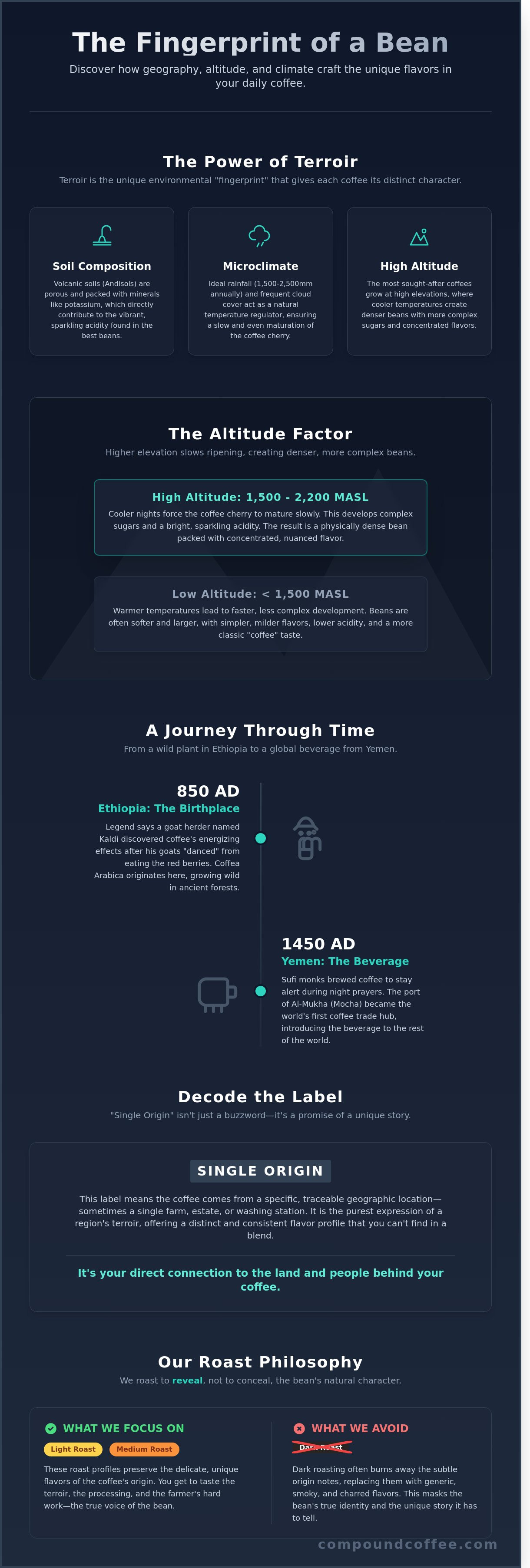
The "why" behind origin comes down to a unique fingerprint created by terroir. This includes the specific soil chemistry, local climate patterns, and the altitude of the farm. For instance, coffee grown at 1,500 to 2,200 metres above sea level (MASL) experiences cooler nights. This slow ripening process allows the plant to develop more complex sugars and acids. You might notice a bright, acidic spark in a Kenyan bean that is completely absent in a low-altitude Brazilian variety. These aren't additives; they're the natural results of the land itself.
Traceability is a cornerstone of the specialty coffee community. It's about knowing exactly which washing station or smallholder farmer produced your beans. This transparency ensures that the "unsung heroes" of the industry receive fair compensation for their labor. In Singapore, where a specialty bag might cost between S$20 and S$45, knowing the story behind the price tag adds value to every sip. Since we don't sell dark roast coffee, we rely on these origin characteristics to provide flavor. A dark roast often obscures the bean's identity with smoky, charred notes. We prefer to keep the roast profile lighter so you can taste the farmer's hard work. Remember that taste is entirely subjective. While we might describe a coffee as having notes of stone fruit, your palate might perceive it differently, and that's perfectly okay.
The Legend of Ethiopia: Where It All Began
The story of coffee starts in the 9th century with a goat herder named Kaldi. Around 850 AD, he noticed his goats dancing with unusual energy after eating bright red berries from a specific shrub. Ethiopia is the genetic birthplace of Coffea arabica, and it remains the only place where coffee grows wild in massive forests. These wild genetics are vital. They provide a massive reservoir of biodiversity that helps modern farmers develop varieties resistant to pests and climate change. When you drink an Ethiopian coffee, you're tasting a lineage that spans over a millennium.
Yemen and the Global Spread of Coffee
While Ethiopia gave us the plant, Yemen gave us the beverage. By 1450, Sufi monks in Yemen were brewing coffee to stay alert during long night prayers. The port of Al-Mukha became the world's primary coffee hub, which is why the name "Mocha" became famous centuries before it was associated with chocolate. You can learn more about this transition from a religious tool to a global commodity in The History of Coffee. This era marked the moment coffee moved into the social sphere, leading to the first coffeehouses in Cairo and Constantinople. Yemen's unique dry-processing methods and arid climate created a spicy, wine-like profile that set the standard for coffee origins for hundreds of years.
Terroir: The Science Behind the Flavour
Terroir is a concept borrowed from the wine world that describes how a specific environment shapes the physical traits, or phenotype, of a plant. When we explore various coffee origins, we aren't just looking at a spot on a map; we're looking at a complex biological interaction. The soil, the air, and the water all leave a fingerprint on the bean. At Compound Coffee Co., we see ourselves as curious students of these environmental factors. We believe that understanding terroir helps you navigate your own palate, though it's vital to remember that taste is deeply personal. What one person describes as "bright acidity," another might perceive as "citrus sweetness."
Soil composition serves as the foundation for these flavours. In many renowned growing regions, volcanic ash creates a soil type known as Andisols. These soils are incredibly porous and packed with minerals like potassium, calcium, and magnesium. These elements directly influence the chemical precursors of acidity within the bean. For example, high potassium levels are often linked to the vibrant, sparkling malic acidity found in high-quality East African lots. While these scientific markers are fascinating, they're simply guidelines to help you discover what you enjoy most in your cup.
Microclimates add another layer of complexity. Rainfall patterns, which often range from 1,500mm to 2,500mm annually in specialty regions, dictate how a tree manages its energy. Frequent mist and cloud cover act as natural temperature regulators. This shade slows down photosynthesis, allowing the coffee cherry to develop sugars more gradually. This slow maturation results in a higher concentration of precursors that lead to the diverse flavour profiles we love to experiment with during our roasting process.
Altitude and Bean Density
High altitudes, typically between 1,200 and 2,000 metres above sea level, create a challenging environment for coffee trees. The thinner air and cooler night temperatures slow the plant's metabolism significantly. This delay means the beans spend more time on the branch, often taking 25% to 30% longer to ripen than those in lower, warmer areas. This extra time allows for a more dense, compact cellular structure within the seed. Strictly Hard Bean is a quality marker used in high-altitude regions to indicate beans grown above 1,350 metres that possess superior density and flavour potential.
This density changes how a bean reacts inside our roaster. Harder beans can withstand higher heat applications without scorching, allowing us to develop complex sweetness while maintaining clarity. Because we want to celebrate the unique density and character of these coffee origins, we don't offer dark roast coffee. We've found that lighter roast profiles better preserve the structural integrity and the hard-earned flavours developed at these high elevations.
The Bean Belt: A Global Map
Coffee thrives in a specific latitudinal range known as the Bean Belt. This region spans the tropics between the Tropics of Cancer and Capricorn, roughly 23.5 degrees north and south of the equator. This area provides the consistent temperatures and distinct rainy seasons required for Arabica coffee to flourish. If you're interested in how these regions evolved over centuries, the National Coffee Association's History of Coffee offers a great look at how these geographic origins became the global powerhouses they are today.
The future of this map is currently facing significant shifts. Recent climate data suggests that by 2050, rising global temperatures could reduce the amount of suitable land for coffee production by nearly 50%. This change is pushing farmers to plant at even higher altitudes or experiment with more resilient varieties. We're committed to supporting our farming partners as they navigate these changes, ensuring that the community continues to grow together. If you're ready to start your own sensory journey, our curated selection of single-origin beans is a great place to begin exploring these unique terroirs from your home in Singapore.
Comparing Regional Flavour Profiles
Think of this guide as a sensory compass rather than a rigid map. While coffee origins provide a foundation for what you might taste in the cup, they aren't absolute rules. Every harvest is different; every roaster has a unique approach. We focus on light to medium roasts to highlight these natural characteristics, as we don't sell dark roast coffee. This ensures the hard work of the farmers isn't hidden behind a smoky profile. Exploring these regions is a shared journey where your personal palate is the ultimate judge.
African Origins: The Bright and Floral
Coffee from Africa often provides the most "eye-opening" experiences for those new to specialty brews. In Ethiopia, specifically regions like Yirgacheffe and Sidamo, you'll find beans that drink more like tea than the heavy coffee you might be used to. These often feature delicate notes of jasmine and bright citrus. If you trace The History of Coffee, you'll see why these ancient heirloom varieties are so prized for their complexity. Kenya takes this a step further with a distinct phosphoric acidity. It's punchy, often tasting like juicy blackcurrant or tomato. While these profiles are iconic, processing also plays a massive role in the final flavour. For a taste of how processing can shift a profile toward a creamy, honeyed sweetness, try something like the Semendo Honey Filter. It's a fantastic example of how modern techniques can create unique, fruit-forward experiences outside the traditional African mould.
Central and South American Origins: The Crowd Pleasers
The Americas are home to some of the most balanced and approachable coffees in the world. Brazil is the giant here, producing beans that are typically low in acid with heavy notes of peanut, milk chocolate, and caramel. These are the workhorses of the industry; they provide a stable, comforting base for many milk-based drinks. Colombia offers incredible versatility, often described as the classic "coffee-flavoured coffee" with a perfect mix of red apple acidity and nutty sweetness. These regions are staples for a reason. If you're looking for that reliable, balanced morning cup that pairs perfectly with a dash of milk or stands strong as a clean black coffee, we suggest exploring our Espresso Roasted Beans. You'll find these balanced profiles shine when brewed through an espresso machine or a stovetop pot, offering a familiar comfort that many Singaporean coffee lovers enjoy.
The Subjectivity of Taste Perception
It's vital to remember that individuals perceive taste differently. Genetics play a huge role in this; some people are "supertasters" who are highly sensitive to bitterness, while others might find those same notes pleasant and complex. Your past experiences also shape your palate. If you grew up drinking traditional Kopi in Singapore, the bright acidity of a Kenyan coffee might be a shock at first. That's okay. There's no "getting it wrong" when it comes to your own preferences. We encourage you to use these regional descriptors as a starting point for discovery rather than a test you need to pass. Use them to identify what you like. Do you prefer the earthy, spicy, and full-bodied notes often found in Asia-Pacific beans? Or do the floral heights of Africa excite you more? The diversity found within different coffee origins is meant to be celebrated, not mastered. Grab a bag, brew a cup, and let your own taste buds lead the way. Whether you're spending S$22 or S$35 on a bag of fresh beans, the most important thing is that you enjoy the ritual of the brew.
This principle of personal exploration is also central to the culinary world, where dining destinations like Cuisine Unplugged build their reputation on providing a complete sensory journey with carefully chosen ingredients.
How to Choose Your Perfect Origin
Finding the right bag isn't about following a set of rigid rules. It's a personal exploration of your own palate. Because we all perceive flavors differently, what tastes like a bright blueberry to one person might feel like a subtle floral note to another. Your journey through different coffee origins starts with a few simple steps to guide your curiosity rather than dictate your taste.
Your first step is to identify the flavor profiles you naturally gravitate toward. Do you prefer the crisp, tea-like acidity of a washed Ethiopian heirloom, or are you drawn to the heavy, chocolatey body of a Guatemalan bean? When you're browsing shelves in Singapore, a 250g bag of specialty coffee typically ranges from S$22 to S$38. Identifying whether you want "fruity and floral" or "nutty and rich" helps you narrow down the region without feeling overwhelmed by the options.
Look for "Single Origin" labels if you want a pure expression of terroir. These beans come from a specific farm, washing station, or cooperative, offering a transparent window into that specific soil and climate. It's a snapshot of a single harvest. Since we don't sell Dark Roast coffee, our focus remains entirely on highlighting these inherent traits through light and medium roast profiles that let the bean's natural character shine.
Processing methods significantly alter the final cup. A washed coffee often delivers a cleaner, more precise profile. In contrast, natural or honey processing allows the bean to dry inside the fruit, which adds a layer of sweetness and a certain "funk" to the base flavor. If you usually drink your coffee black, these processing differences become much more apparent.
Experimentation with brew methods is the best way to see how an origin behaves. A V60 pour-over might highlight the citrus spark of a Kenyan bean, while an Aeropress could bring out the creamy texture of a Colombian origin. In Singapore's specialty cafes, a single-cup filter brew can cost between S$7 and S$12, so brewing at home is a great way to test these variables affordably.
Documentation helps you find your "holy grail" bean faster. Keep a simple journal to track the farm name, altitude, and your personal tasting notes. After trying three or four different coffee origins, you'll start to see patterns. You might realize you love coffees grown above 1,800 meters or that you have a specific affinity for anaerobic fermentation. It's about empowering yourself with knowledge through your own experiences.
Single Origin vs. Blends
Choosing between these depends on your morning mood. A single origin acts as a focused lens on a specific place and time, perfect for when you want to sit down and savor the nuances of a unique harvest. Blends are about crafting a consistent, repeatable flavor profile. They combine different beans to create a balanced cup that tastes great every morning, providing a reliable comfort that holds up well with or without milk.
The Impact of Processing on Origin
Processing is the bridge between the tree and your cup. Washed processing removes the fruit before drying, which many enthusiasts consider the most honest way to taste the terroir. Natural and Honey processing allow the sugars from the coffee cherry to soak into the seed, adding sweetness and fruit intensity. You can explore these distinct profiles by browsing our range of Filter Coffee Beans to see how different methods transform the same region.
Empowering the Journey: The Compound Coffee Approach
We believe that coffee is a shared journey, not a destination where we hold all the answers. Our role is to act as friendly guides, helping you explore the vast landscape of specialty coffee without the pressure of "getting it right." We don't believe in rigid rules because taste is deeply personal. Individuals perceive flavor differently; what tastes like bright citrus to one person might feel like a mellow stone fruit to another. Our philosophy centers on providing you with the tools and knowledge to find what you love, respecting your unique palate every step of the way.
To keep the "voice" of different coffee origins clear, we focus exclusively on Light and Medium roasts. These roast profiles act as a clear window into the bean's history and environment. We don't sell Dark Roast coffee at Compound Coffee Co. because heavy roasting tends to mask the unique traits that make each origin special. Instead of tasting the volcanic soil of Guatemala or the high-altitude forests of Ethiopia, dark roasts often taste primarily of the roasting process itself. We want to celebrate the farmer's year of dedication, not hide it under a layer of carbon and char.
Our commitment to quality starts with direct trade relationships established since our founding in 2014. We maintain intimate connections with over 15 small farmers and their families across the globe. By paying premiums that often sit 50% above fair-trade minimums, we ensure producers can reinvest in their land and their communities. When a farmer is empowered with better resources and fair pay, the quality of the bean improves for everyone. It's a cycle of growth and passion that we're proud to support through every bag we roast.
This principle of valuing the source applies far beyond coffee. In the world of performance apparel, for example, partnering with expert manufacturers is key to creating exceptional products. For those curious about how specialized items like activewear and sportswear are made, you can check out Dar Lon Garment, a high-quality producer based in Vietnam.
Roasting as a Tool for Discovery
We treat the roasting process as a flexible guideline rather than a set of unbreakable laws. Every batch is an opportunity to unlock a bean's hidden potential through constant experimentation. We're always tweaking variables like charge temperature and development time to see how we can better highlight a specific profile. We don't believe in a single "perfect" roast, only the one that best expresses that specific harvest. If you want to dive deeper into this craft, we invite you to join our Coffee Classes. You'll get hands-on experience and learn to trust your own palate in a welcoming, ego-free environment.
From Farm to Singapore
Our mission is to empower every person in the coffee chain, from the soil to the server. This starts at the farm and continues right here in our Singapore facility. We've built our space to serve as a community hub where passion meets education. Whether you're a home brewer or a professional, our facility is a place to learn, grow, and share. We believe a rising tide lifts all boats. By sharing our research and techniques, we help the entire Singapore coffee scene thrive. Ready to start your own exploration? Grab a fresh bag of beans from our latest seasonal collection and discover the incredible diversity that different coffee origins have to offer.
Start Your Personal Tasting Adventure
Your path through the world of coffee origins is entirely personal. Research identifies over 1,000 volatile compounds in roasted coffee, which means the environmental factors of each farm create a complexity that's yours to discover. Since every individual perceives acidity and sweetness differently, we offer these regional profiles as helpful guideposts rather than rigid rules. We focus exclusively on light and medium roasts at our Singapore-based community roasting hub to ensure these natural nuances remain the star of the show. By maintaining intimate direct-trade relationships with producers, we bring you beans that reflect the precise heritage of specific farming families.
We don't offer dark roasts because we're passionate about preserving the clarity of the bean's journey from soil to cup. Whether you're a beginner or a seasoned pro, there's always a new flavor to experiment with in our lab. Take the next step in your exploration by browsing our current seasonal releases. Explore our curated selection of Single Origin Roasted Beans and find the profile that speaks to you today. We're excited to see where your curiosity takes you next.
Frequently Asked Questions
What does 'Single Origin' actually mean on a coffee bag?
Single origin means your coffee is traceable to a specific geographic location, such as a single farm or a collection of smallholders in one region. It's about celebrating the unique work of unsung heroes like the 500 small farmers who contribute to a specific washing station in Yirgacheffe. This transparency allows us to co-create better experiences by understanding exactly where your beans come from.
Which coffee origin has the least acidity for sensitive stomachs?
Coffee origins from lower elevations, typically below 1,200 meters, often have lower perceived acidity. Brazilian beans or certain Indian varieties are popular for their chocolatey, nutty profiles that feel gentler on the palate. Since we don't sell dark roast coffee at Compound Coffee Co., we recommend exploring medium-light roasts from these regions to find a balance that suits your individual perception. Taste is always subjective.
Is coffee from Ethiopia better than coffee from Brazil?
Neither origin is objectively better because your personal preference is the only metric that matters. Ethiopia is famous for floral and citrus notes, while Brazil often delivers nutty and chocolatey tones. We've found that 70% of our community members enjoy exploring both depending on the time of day or their mood. It's a journey of discovery rather than a competition between regions.
How do I know if a coffee origin will taste good with milk?
You'll likely enjoy origins with high natural sweetness and body, like those from Guatemala or Brazil, when adding milk. These beans often have flavor notes of caramel or cocoa that cut through the creaminess of S$5.50 lattes in Singapore cafes. We suggest experimenting with different ratios since every individual perceives the balance of coffee and milk differently. There's no single right way to enjoy your cup.
Why does altitude matter for the taste of my coffee?
Altitude affects the development of the coffee cherry, where higher elevations above 1,500 meters provide cooler temperatures that slow down the ripening process. This slower growth creates a denser bean with more concentrated sugars and complex acids. When you explore various coffee origins, you'll notice that high-altitude beans often have more vibrant, fruit-forward profiles compared to those grown at sea level.
What is the 'Bean Belt' and why are no coffee origins outside of it?
The Bean Belt is a horizontal strip of the globe between 23.5 degrees North and 23.5 degrees South of the equator. Coffee trees require specific conditions like stable temperatures between 18 and 24 degrees Celsius and consistent rainfall to thrive. While 100% of commercial coffee currently grows here, some researchers are experimenting with new climates as global temperatures shift.
Can the same origin taste different every year?
Yes, coffee is an agricultural product and flavors change based on annual rainfall or soil health. A 20% increase in rain during the flowering season can significantly alter the sweetness of the final cup. We embrace these variations as part of the shared journey of learning; we see each harvest as a unique snapshot of time from that specific farm and its environment.
How does the processing method change the flavour of a single origin?
Processing methods like Washed or Natural act as a lens that focuses different flavor attributes of coffee origins. A natural process, where the fruit dries on the bean for 14 to 28 days, often results in heavy body and wine-like fruitiness. In contrast, washed coffees are cleaned of fruit immediately, which usually highlights a cleaner, more acidic profile that many of our V60 workshop students love.


Comments