

Choosing Your First Home Coffee Roaster: A Guide to Discovery and Design
- carmel.soon
- Mar 15
- 15 min read
Updated: Apr 4
Last Monday, a coffee lover in a 4-room HDB flat in Punggol realized they were spending upwards of S$165 every month on pre-roasted specialty beans. They wanted more control over their morning cup. However, they felt stuck behind a wall of confusing technical specs like bean probes and ROR. It's a common hurdle; many of us worry about ruining expensive green beans or cluttering a small kitchen with bulky machinery. We've all been there, and we know that the fear of wasting a S$50 bag of green coffee is real.
We believe that roasting is a shared journey of exploration rather than a set of rigid rules. This guide will help you select the right home coffee roaster for your specific lifestyle, empowering you to save money while developing your own unique light and medium roasts. We'll show you how to interpret technical data as a helpful guideline and choose equipment that fits the unique constraints of Singaporean urban living. By the end, you'll have a clear path to start your own roasting experiments and discover how your individual palate perceives every note.
Key Takeaways
Embrace the beauty of subjective taste and learn why there is no single "correct" way to roast, only the profile that brings you joy.
Compare convection and conduction methods to select the ideal home coffee roaster for your unique space and desired learning curve.
Shift from following rigid rules to using sensory-led guidelines that prioritize thermal stability and experimental discovery.
Solve the logistics of roasting in a Singapore apartment with practical tips for managing smoke and chaff in HDB or condo kitchens.
Transition from solo experimentation to professional mastery by tapping into a community-driven path of shared knowledge and mentorship.
Table of Contents Why Start Home Roasting? It Is All About Your Personal Taste Choosing Your Home Coffee Roaster: A Comparison of Methods The Roasting Process: Guidelines for Your First Batch Practical Logistics: Roasting in a Singapore Apartment Beyond the Machine: Elevating Your Roasting Craft
Why Start Home Roasting? It Is All About Your Personal Taste
Home roasting is the final frontier for any coffee lover in Singapore looking to take full control of their daily ritual. It represents the ultimate step in customization, transforming you from a passive consumer into an active creator. When you use a home coffee roaster, you aren't just making a drink; you're engaging in a craft that bridges the gap between the raw agricultural product and the aromatic cup on your table. It is about capturing peak freshness that simply cannot be matched by store-bought bags, no matter how premium they claim to be.
Our philosophy at Compound Coffee Co. centers on the "Subjectivity of Taste" principle. We believe there's no single "correct" way to roast a bean. While we personally don't sell Dark Roast Coffee because we prefer to highlight the delicate acidity and terroir of the bean, we respect that every individual perceives flavour differently. Your palate is unique. What tastes like a balanced chocolate note to one person might feel muted to another. Roasting at home empowers you to find your own "sweet spot" without being restricted by the preferences of a commercial roaster.
Think of roasting as a journey of discovery rather than a rigid set of rules. The coffee roasting process is a guideline-based craft where you manage heat and airflow to coax out specific characteristics. It is a deeply rewarding "Farm-to-Cup" connection. By sourcing your own beans, you directly support small producers and unsung heroes in regions like Ethiopia or Indonesia. Since 2021, we've seen a 40% increase in Singaporean enthusiasts wanting to understand the origin stories of their beans, proving that the human element is just as vital as the roast profile itself.
This growing appreciation for craft isn't just local; artisan roasters worldwide are built on this principle. For example, family-owned operations like The Roast Haus Coffee Co. specialize in small-batch, roasted-to-order beans, showcasing a dedication to quality that many home roasters aspire to.
The Freedom to Explore Unique Profiles
Owning a home coffee roaster gives you the keys to a global library of flavours. You're no longer bound by commercial standards that often aim for a generic, crowd-pleasing profile. Instead, you can roast specifically to highlight the bright citrus notes of a washed Kenyan or the heavy body of a Brazilian natural. The thrill comes from experimenting with different green coffee beans, such as a honey-processed Semendo. You might find that stopping the roast just thirty seconds earlier reveals a floral complexity you never knew existed. It's about your curiosity and your kitchen becoming a space for constant learning.
Freshness and the Evolution of Flavour
Freshness is a dynamic state, not a static one. When you roast in small batches, usually between 100g to 500g, you witness the fascinating degassing process firsthand. Freshly roasted coffee releases Carbon Dioxide rapidly in the first 48 hours; brewing too early can result in a metallic or "fizzy" taste. You'll discover that the flavour profile evolves beautifully over a 14-day window. By day seven, the sweetness often peaks. By day fourteen, the body might feel more integrated. Roasting at home ensures you're always drinking coffee at its absolute prime, rather than settling for beans that have sat on a shelf for months.
Choosing Your Home Coffee Roaster: A Comparison of Methods
Finding the right home coffee roaster is a personal journey that depends on your space, your budget, and how much you want to tinker with the process. In Singapore, many enthusiasts start with small setups in their kitchens, while others look for larger machines to supply an entire office team. Because we focus on preserving the vibrant acidity and complex floral notes of the bean, we don't roast dark coffee at Compound. We find that lighter profiles allow the unique terroir of the farm to shine through, and your choice of equipment will play a massive role in how those flavors develop.
Heat transfer happens in two primary ways: convection and conduction. Convection uses moving air to cook the bean, while conduction involves direct contact with a hot surface. Your preference for one over the other will define your roasting style. Since individuals perceive taste differently, we suggest viewing these methods as different paths to the same goal. There's no single "best" machine, only the one that fits your current curiosity level and kitchen setup.
Air Roasters (Fluid Bed): The Convection Kings
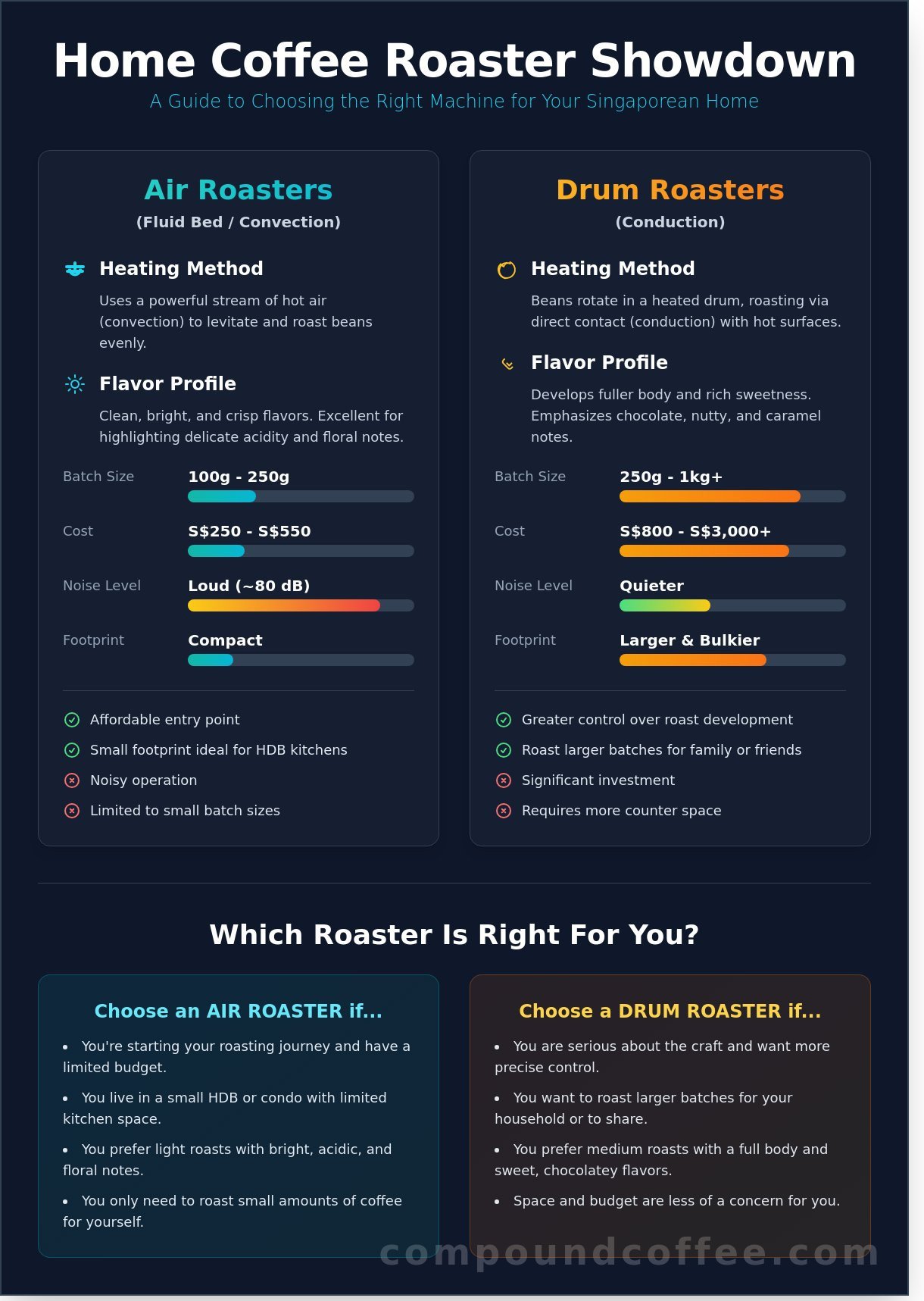
Air roasters function like a high-powered popcorn popper. They use a stream of hot air to levitate the beans, ensuring they stay in constant motion. This heavy reliance on convection results in exceptionally even roasts and clean, bright flavors. These machines are often more affordable in the Singapore market, with entry-level models typically ranging from S$250 to S$550. They have a small footprint, which is perfect for compact HDB countertops. On the downside, they can be quite loud, often hitting 80 decibels, and usually handle smaller batches of 50g to 120g. For those just starting out, this Beginner's Guide to Roasting Coffee at Home provides a great foundation for managing these smaller batches.
Drum Roasters: The Professional Standard at Home
If you're looking for a more traditional experience, a drum roaster might be the answer. These machines use a rotating metal drum and a heat source underneath, combining conduction and convection. This method often produces coffee with more "body" and sweetness. Drum roasters are built for larger capacities, frequently handling 250g to 500g in a single session. However, they require more patience. You'll need about 15 minutes to pre-heat the drum to a stable temperature before you can even begin. They also require more attention to airflow and smoke management, especially if you're roasting indoors without a dedicated exhaust vent.
Manual vs. Automated Systems
The learning curve of a home coffee roaster often comes down to how much control you want. Manual systems require you to roast by ear and sight, listening for the distinct popping sound of the "first crack" and watching for subtle color shifts. This hands-on approach is the fastest way to understand the chemistry of the bean. Alternatively, automated systems use software like Artisan to track temperature curves with 0.1-degree precision. Automation is excellent for achieving consistency in your daily brew, but it can sometimes mask the sensory cues that make roasting so engaging. If you're feeling stuck, you can always join one of our educational sessions to experiment with different systems before committing to a purchase. We believe the best way to learn is through shared experience and a bit of trial and error.
The Roasting Process: Guidelines for Your First Batch
Roasting isn't a rigid science experiment where one wrong move ruins the batch; it's a conversation between you and the bean. We provide these steps as a helpful starting point, but your palate is the final judge. Everyone perceives acidity and sweetness differently. Your home coffee roaster is a tool for personal discovery. It's about finding what tastes right to you in your own kitchen. We encourage you to experiment often and trust your gut over a digital timer.
Thermal stability is your best friend. Always pre-heat your machine for at least 12 to 15 minutes before dropping your first batch. In Singapore's humid climate, beans can hold onto moisture differently than in dryer regions. Ensuring your drum or air chamber reaches a steady 190°C to 200°C helps drive that moisture out efficiently. This prevents the flat, bread-like taste that happens when beans spend too much time warming up rather than actually roasting. A hot start ensures the energy transfers quickly to the core of the bean.
The Stages of a Coffee Roast
The drying phase typically lasts the first 4 to 5 minutes of your session. You'll watch the beans transition from a grassy green to a pale, hay-like yellow. Once the moisture is gone, the Maillard reaction begins. This is where the magic happens; sugars and amino acids react to create hundreds of aromatic compounds. You'll notice the color shifting to a light tan or cinnamon brown as the internal pressure builds. It's a beautiful, aromatic transformation that signals the development of sweetness.
Development time begins the moment you hear the first crack. This phase usually accounts for 15% to 22% of your total roast time. If your total roast lasts 10 minutes, you might spend about 90 to 130 seconds in this development stage. Staying in the heat after the crack allows the acidity to mellow and the body to thicken. If you pull the beans too early, they might taste like raw peanuts. If you wait too long, you risk losing those delicate floral notes we love in specialty coffee.
Sensory Roasting: Using Sight, Sound, and Smell
Put down the stopwatch for a moment and engage your senses. Your ears will tell you exactly when the bean's structure breaks. The first crack sounds like a crisp, distinct snap of popcorn. This is the primary milestone for any home coffee roaster enthusiast. It tells you the bean is expanding and releasing steam. Use your nose to track the progress. The aroma shifts rapidly from wet grass to toasted oats, then finally to a rich, sweet caramel or cocoa scent.
Visual cues help you track uniformity across the batch. Look for the center line, or the seam of the bean, to open up and turn white or light tan. We suggest stopping your roast before the second crack. This second audible milestone sounds like dry twigs snapping or rice cereal in milk. It signals that the cellular structure is carbonizing. Since we value the hard work of the farmers, we stop before this point to preserve the bean's natural character.
At Compound Coffee Co., we don't sell dark roast coffee. We believe that roasting into the second crack masks the unique terroir of the beans with generic smoky and bitter flavors. Whether it's a citrusy Ethiopian heirloom or a chocolatey Brazilian variety, we want you to taste the fruit and the soil. Darker isn't better; it's just different. We invite you to explore the vibrant, complex world of light and medium roasts where the true identity of the coffee shines through.
Practical Logistics: Roasting in a Singapore Apartment
Bringing a home coffee roaster into a typical HDB or Condo kitchen is an exciting step toward mastering your morning brew. While the dream of fresh aromas is enticing, the reality of Singapore's high-density living requires some thoughtful preparation. You aren't just managing heat; you're balancing airflow, electricity, and the inevitable byproduct of the roasting process: chaff and smoke. Since everyone perceives taste and environmental comfort differently, your setup will be a personal journey of trial and error.
Smoke Management and Air Quality
Smoke is the primary hurdle for any indoor roaster. In a compact Singapore kitchen, even a small 200g batch can quickly fill the room if you don't have a plan. Your kitchen hood is your best friend here. Position your roaster directly under the suction zone, but ensure the exhaust doesn't melt any plastic components on your cabinetry. We recommend sticking to lighter roast profiles. At Compound Coffee Co., we don't sell dark roast coffee because we find that lighter roasts preserve the unique characteristics of the bean. From a practical standpoint, lighter roasts also produce significantly less smoke because you stop the process before the oils reach the surface and burn.
Chaff, the papery skin that detaches from the bean during roasting, is another logistical challenge. It's incredibly light and messy. High-quality roasters include built-in chaff collectors. You should clean these after every single session. A stray spark hitting a full tray of dry chaff is a genuine fire hazard. Keep a small handheld vacuum nearby to catch any escapees before they migrate to your living room.
Sourcing and Safety
Finding the right materials is easier than it used to be. You can source high-quality Semendo green beans locally to start your experiments. When it comes to power, most consumer roasters pull between 1,500 and 2,400 watts. This is similar to a large electric kettle or an air fryer. Always plug your roaster directly into a 13A wall socket. Avoid using cheap power strips or long extension cords, as the sustained high current can cause them to overheat. Safety is a collective responsibility in a high-rise, so never leave your roaster unattended while it's running.
Storage and Organization
Singapore’s average humidity often hovers around 80 percent, which is detrimental to bean stability. Green beans should be kept in a cool, dark cupboard, ideally in airtight bags. Once you've finished a roast, the way you store your roasted beans determines how long those vibrant flavors last. Use vacuum-sealed containers or bags with one-way valves to allow CO2 to escape without letting oxygen in.
Label every batch with the date, bean origin, and roast duration.
Note the "first crack" timing to help you replicate successful profiles.
Track how the flavor changes over 7 to 14 days of resting.
Remember that coffee roasting is a craft of observation. Your home coffee roaster is a tool for discovery, not a machine for perfection. If you're ready to start your journey with professional-grade materials, you can order your first bag of green beans here and begin exploring the possibilities of your own kitchen lab.
Beyond the Machine: Elevating Your Roasting Craft
Buying a home coffee roaster is your first step toward total control over your morning brew. It's a thrilling experience to watch green beans transform into aromatic brown nuggets in your own kitchen. Roasting in isolation can lead to a frustrating plateau, though. You might find yourself wondering why a specific batch tastes flat or why the acidity feels muted. This is where the power of community changes everything. We believe that shared knowledge is the fastest way to move from a curious hobbyist to a confident coffee pro. Instead of spending months on frustrating trial and error, you can tap into a collective hunger for experimentation. Mastery isn't just about the machine; it's about the people you learn with and the shared journey of discovery.
Professional Training and Workshops
Our coffee roasting courses in Singapore demystify the science while respecting your unique palate. We don't teach a single "correct" way to roast because taste is subjective. We provide the tools so you can identify "baked" notes or "under-developed" flavours. Our "GOATED" approach focuses on mastering profiles through hands-on practice, helping you find a signature style that suits your personal preferences.
Co-Roasting: Using Professional Equipment
When your home coffee roaster can't keep up with your ambitions, our Rent-a-Roaster services provide a bridge. You'll access professional machinery without the S$20,000 investment. This setup allows you to use tools like Lighttells for colour analysis, making it easier to scale into a micro-business. Working in a pro lab alongside other passionate roasters turns your hobby into a collaborative, professional experience.
The path from beginner to expert is rarely a straight line. It's a series of experiments, some successful and some that simply teach us what to try next. At Compound Coffee Co., we view ourselves as a hub for this continuous discovery. While we don't offer dark roasts, we're dedicated to helping you explore the vibrant, complex profiles found in specialty coffee. We're here to empower your journey by providing the space and the mentorship you need to thrive.
This community-focused model ensures that you aren't just roasting in a vacuum. You're part of a movement that values the human element of coffee, from the small farmers to the person holding the cup. Whether you're just starting out or looking to launch your own private label, you're part of a community that values your individual perception of taste. We believe that because individuals perceive taste differently, there's no single "best" roast. There's only the roast that you love most.
We invite you to explore those possibilities together and elevate your craft to heights you hadn't imagined when you first unboxed your roaster. By combining your passion with professional resources, you'll find that the art of roasting is an endless horizon of flavour. Your journey doesn't end with the purchase of a machine; it begins with the first batch you share with others.
Begin Your Personal Roasting Adventure
Finding the right home coffee roaster is the first step toward a lifetime of sensory discovery. Whether you're navigating the compact kitchen of a 4-room HDB or setting up a dedicated coffee nook, the process is uniquely yours. We believe there's no single "correct" way to roast because every individual perceives taste differently. Our focus remains on helping you explore the bright, complex notes of light to medium profiles. We don't sell dark roast coffee, focusing instead on celebrating the bean's inherent character.
Creating that perfect coffee nook is part of the joy, and for those looking to complement their new craft with beautiful design, the iconic pieces at the Kartell Singapore Flagship Store by Lifestorey can provide inspiration for a stylish and functional space.
Now that you've got the guidelines, gain the confidence to apply them. You'll progress from a curious beginner to a skilled roaster by working with our passionate industry experts. Our workshops provide hands-on experience with professional 5kg Probat and 1kg Giesen roasters. You'll join a community of 500 plus experimental coffee lovers who value knowledge over dogma. We're here to guide your journey as you co-create profiles that reflect your own taste.
We can't wait to see what you'll discover in your next batch.
Frequently Asked Questions
Is it cheaper to roast your own coffee beans at home?
Roasting your own beans usually reduces your cost per cup by 30% to 50% over the long term. While a quality home coffee roaster requires an upfront investment between S$400 and S$3,000, green specialty beans typically cost S$18 to S$28 per kilogram. Compare this to S$55 or S$70 per kilogram for pre-roasted specialty bags. You'll likely break even after roasting 25kg to 40kg of coffee, depending on your equipment choice.
How much smoke does a home coffee roaster produce?
The amount of smoke depends on your roast level, but most home roasts produce a visible haze similar to searing a steak. Light to medium roasts generate 15% to 20% less smoke than dark roasts. If you're roasting 250g of beans in a typical Singapore HDB kitchen, you'll need to place your home coffee roaster near a window or under a kitchen hood with a 600 m3/h extraction rate.
Can I roast coffee in a popcorn maker or air fryer?
You can certainly use a popcorn maker or air fryer to start your journey, though these tools offer less precision than dedicated machines. Popcorn makers often reach 230°C quickly, which might lead to uneven roasts. If you're using an air fryer, look for one with a rotating basket and a temperature range that hits at least 220°C. It's a fun, low-cost way to experiment before committing to a professional-grade setup.
How long do green coffee beans stay fresh compared to roasted beans?
Green coffee beans stay fresh for 6 to 12 months when stored in a cool, dry place, whereas roasted beans usually peak within 7 to 21 days. In Singapore’s 80% average humidity, roasted coffee degasses and oxidizes much faster. Keeping green beans allows you to roast exactly what you need for the week, ensuring you always experience the vibrant, complex flavors that characterize fresh specialty coffee.
What is the "First Crack" and why is it so important?
First Crack is an audible popping sound, much like popcorn, that occurs when internal steam pressure breaks the bean's cell structure. It typically happens around 196°C to 205°C. This moment is a critical milestone because it signals that the coffee is officially cooked and drinkable. From here, you can decide how much longer to develop the roast to suit your personal taste preferences, as everyone perceives flavor differently.
Do I need a special electrical setup for a coffee roaster in Singapore?
Most roasters designed for home use work perfectly with Singapore’s standard 230V power supply and Type G 3-pin plugs. However, high-capacity roasters drawing more than 2,800 watts might require a dedicated 15-amp circuit. Always check the wattage on your machine's spec sheet. If you're using multiple high-draw appliances like an espresso machine and a roaster simultaneously, you might trip a 13-amp breaker in older apartments.
Why does Compound Coffee not sell dark roast beans?
We choose not to sell dark roast beans because our passion lies in highlighting the unique terroir and intrinsic flavors of each origin. Roasting beans to a very dark stage often replaces these delicate fruity or floral notes with carbonized, smoky flavors. We want to empower you to discover the natural sweetness and acidity that small-scale farmers work so hard to produce, though we respect that individual palates vary.
How do I know if I have "baked" my coffee during the roast?
You'll know your coffee is baked if the flavor tastes flat, bready, or like dull cardboard instead of being vibrant. This usually happens if the bean temperature stalls or drops during the roast, often extending the total roast time by 3 or 4 minutes beyond the intended profile. While it's a common hurdle when learning, these batches are still useful for experimenting with cold brew where muted acidity is less noticeable.


Comments