
What Grind Size for Pour-Over? A Brewer's Ultimate Guide
You’ve got the beautiful V60, the gooseneck kettle, and a fresh bag of single-origin beans from that new local roaster. You follow the recipe perfectly, yet the final cup is… disappointing. One day it’s sharp and sour, the next it’s muddy and bitter, and all that potential feels wasted. We’ve all been there. The secret to unlocking that consistently vibrant, delicious brew often comes down to one crucial variable: understanding exactly what grind size for pour over is right for your coffee.
This is where your coffee experience transforms. Forget confusing jargon and random guesses. At Compound Coffee Co., we're passionate about empowering you with the hands-on knowledge to take control of your brew. In this guide, we'll give you a clear, reliable starting point and, more importantly, teach you how to taste, diagnose, and confidently adjust your grinder. You’ll go from feeling frustrated to feeling like a pro, brewing coffee that truly expresses the passion and hard work behind every single bean, every single time.
Key Takeaways
Master coffee extraction by understanding how grind size is the number one variable controlling the flavour and sweetness in your final cup.
Discover the ideal starting point for what grind size for pour over-a medium-fine consistency-and learn clear visual cues to identify it perfectly.
Learn the hands-on technique of "dialing in" your grind, using taste as your ultimate guide to troubleshoot sour or bitter brews for a balanced profile.
Understand why a quality burr grinder is a non-negotiable tool for creating the particle consistency needed for a clean, delicious, and repeatable brew.
Go beyond a one-size-fits-all approach by learning how to adapt your grind for different coffee beans, roast levels, and brewers.
Table of Contents Why Grind Size Is the #1 Variable for Perfect Pour-Over Finding Your Starting Point: The 'Medium-Fine' Sweet Spot Dialing In: How to Adjust Your Grind by Taste and Time Beyond the Basics: Factors That Influence Your Ideal Grind Your Toolkit: Why a Quality Burr Grinder is Non-Negotiable
Why Grind Size Is the #1 Variable for Perfect Pour-Over
Welcome to the heart of your coffee journey. If you've ever brewed a cup that just didn't taste right, the answer probably wasn't the beans or the water temperature-it was your grind. In the passionate pursuit of the perfect pour-over, grind size is the single most powerful tool you have to control flavor. It is the master key that unlocks extraction, the beautiful process of dissolving coffee's soluble flavors into water. While many factors are at play, understanding grind is arguably the most impactful of all the key variables in coffee preparation.
Think of it like this: trying to extract flavor from coffee grounds is like running water through a pile of rocks. If you have large rocks (coarse grounds), water flows through the big gaps very quickly, barely touching the surface. If you have fine sand (fine grounds), the water has to work its way through a dense bed, creating far more contact time and pulling out much more from the vastly increased surface area. This is why knowing what grind size for pour over to use is so critical; it directly dictates how much flavor you pull from your beans and how fast.
The Flavor Spectrum: Under-Extraction vs. Over-Extraction
Your palate is the ultimate judge. By tasting your coffee, you can diagnose your grind and dial it in for the next brew. Every adjustment gets you closer to that perfect, balanced cup. The goal is to land in the sweet spot between two undesirable extremes:
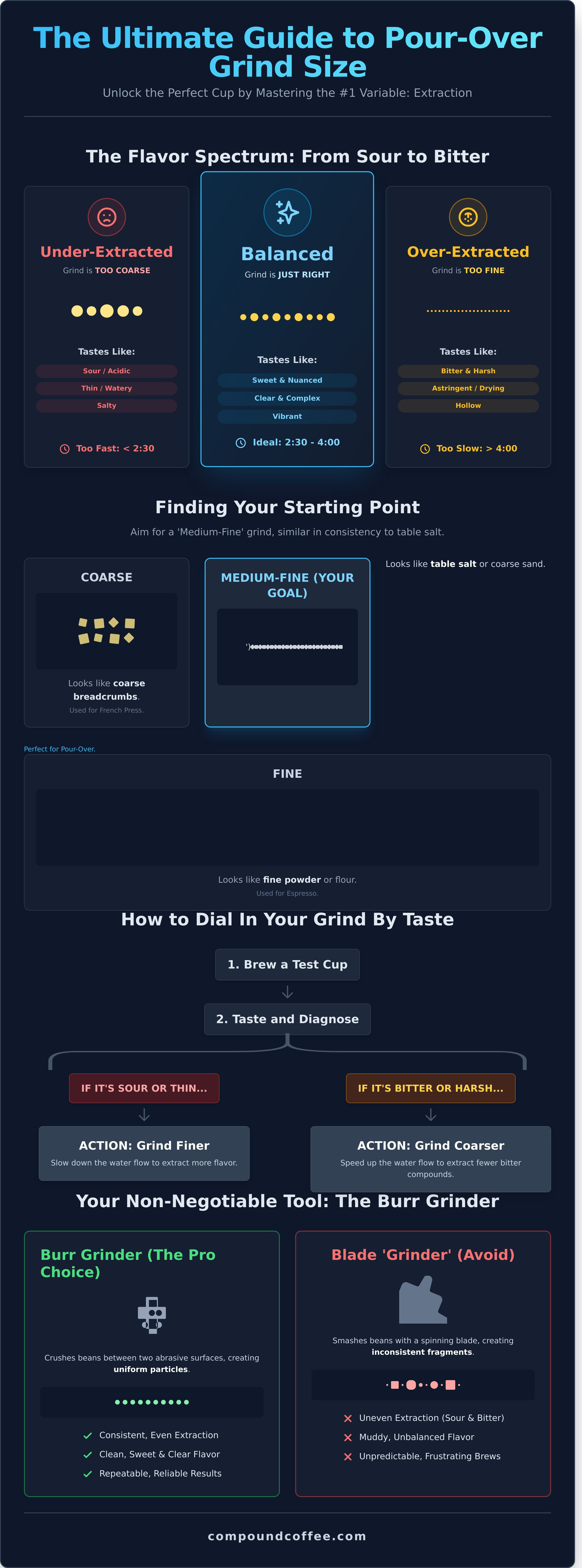
Under-extraction (Grind is too coarse): The water passes through too quickly, failing to dissolve enough of the good stuff. The coffee will taste disappointingly sour, acidic, thin, and sometimes even salty.
Over-extraction (Grind is too fine): The water is in contact for too long, pulling out unpleasant, bitter compounds. This results in a harsh, astringent, and hollow-tasting cup that can dry out your mouth.
The sweet spot is a balanced extraction that reveals the incredible sweetness, clarity, and nuanced complexity the farmer and roaster intended for you to experience.
How Grind Size Controls Your Brew Time
Grind size and brew time are directly linked. Finer grounds create more resistance in the coffee bed, slowing the flow of water and increasing the total contact time. Conversely, coarser grounds have larger gaps between particles, allowing water to channel through rapidly, leading to a much shorter brew time. For most pour-over methods like the V60 or Kalita Wave, the target brew time is a great indicator of a proper grind. You should be aiming for a total brew time between 2 minutes 30 seconds and 4 minutes. If your brew is finishing too fast, grind finer. If it's taking too long, grind coarser. It's that simple.
Finding Your Starting Point: The 'Medium-Fine' Sweet Spot
Let's cut right to it. If you're asking what grind size for pour over, the universal starting point is a medium-fine grind. Think of this not as a rigid rule, but as your base camp for an exciting flavour expedition. This is where the journey to unlocking the vibrant, nuanced notes of your specialty coffee begins. From here, we'll learn to listen to our brew and make small, purposeful adjustments to achieve that perfect cup.
Visualizing the Perfect Pour-Over Grind
So, what does "medium-fine" actually look and feel like? It’s all about hands-on comparison. Your goal is a consistency similar to table salt or coarse sand. If you pinch the grounds between your fingers, they should feel distinct and slightly gritty, not powdery like flour. Here’s how it stacks up against other methods:
Finer than: Standard drip coffee or French press (which looks like coarse breadcrumbs).
Coarser than: Espresso (which is a fine, almost talc-like powder).
This specific texture provides the ideal surface area for water to extract flavour evenly and efficiently within the typical 2-4 minute brew time of a pour-over. It's the key to balancing sweetness, acidity, and body without introducing bitterness from over-extraction or sourness from under-extraction.
Example Grinder Settings (Your Mileage May Vary)
To give you a practical starting line, we’ve gathered some popular grinder settings. Remember, every grinder is unique due to calibration and burr wear, so treat these as a launchpad for your own experimentation. While getting the grind right is crucial, it's just one part of the brewing equation. Factors like water temperature and coffee-to-water ratio, which you can explore in this helpful NCA guide to pour-over, also play a massive role in the final taste.
Baratza Encore: Start around setting 14-16.
Comandante C40: Begin with 22-26 clicks from zero.
Fellow Ode (Gen 2): Try a setting between 3 and 5.
Don't be afraid to move one or two clicks finer or coarser based on your results. This is your coffee, your palate, and your experiment. The numbers are just here to empower you to get started with confidence.
Dialing In: How to Adjust Your Grind by Taste and Time
Understanding the starting point for your grind is one thing, but mastering the art of "dialing it in" is the most crucial skill any home brewer can develop. This is where you move from following a recipe to truly understanding your coffee. We call this the Dial-In Loop, a simple yet powerful cycle: Brew → Taste → Adjust → Repeat. Your palate, not a chart, is the ultimate judge of a perfect extraction. To make this process effective, change only one variable at a time-and that variable should almost always be your grind size.
This hands-on experimentation is where the real magic happens. Of course, the journey is much smoother and more rewarding when you're working with a consistent foundation. Using freshly roasted, high-quality roasted coffee beans removes unwanted variables, allowing you to focus purely on how your grind adjustments impact the final taste in the cup.
Troubleshooting Your Brew: A Simple Framework
Taste and time are your two best guides. They provide instant feedback on your extraction and give you a clear direction for your next adjustment. This simple framework helps you diagnose your brew and decide on what grind size for pour over to try next.
Tastes Sour, Weak, or Watery? This is under-extraction. The water passed through the grounds too quickly, not pulling out enough flavour. Your action: Grind Finer.
Tastes Bitter, Harsh, or Unpleasantly Dry? This is over-extraction. The water spent too much time with the coffee, pulling out undesirable compounds. Your action: Grind Coarser.
Brew Finishes Too Fast (e.g., under 2:30)? This usually corresponds with under-extraction. Your action: Grind Finer to increase resistance and slow the flow.
Brew Chokes or Finishes Too Slow (e.g., over 4:00)? This often leads to over-extraction. Your action: Grind Coarser to allow water to pass through more easily.
Keeping a Coffee Journal
Turning frustration into a fun, experimental process is key to growth. A simple coffee journal empowers you to track your progress and see patterns emerge. Note down the bean, your dose, the grinder setting, the final brew time, and most importantly, your tasting notes. Over time, you’ll build an invaluable personal database that makes dialing in any new coffee faster and more intuitive.
Beyond the Basics: Factors That Influence Your Ideal Grind
So, you've found a solid starting point. But the journey to a truly exceptional cup doesn't stop there. The answer to what grind size for pour over isn't a universal number; it's a dynamic target that shifts based on your specific tools and beans. This is where you move from following a recipe to truly understanding your brew. Mastering these variables is the key that empowers you to adapt, experiment, and unlock the full potential of every coffee you brew. Think of each factor as a dial you can turn, making small adjustments from your baseline to achieve a consistently delicious result.
Your Pour-Over Brewer (e.g., V60 vs. Kalita Wave)
The design of your dripper has a massive impact on flow rate, which directly influences your grind. Different shapes demand different approaches to control extraction and achieve that perfect balance.
Conical Brewers (Hario V60): These brewers have a large single hole, promoting a fast flow. A slightly finer grind helps create more resistance, slowing the water down and ensuring it has enough contact time to extract flavour properly.
Flat-Bottom Brewers (Kalita Wave): With multiple small holes and a flat bed, these drippers restrict flow by design. This allows you to use a slightly coarser grind, which can result in a more even and forgiving extraction.
Full-Immersion Drippers (Clever Dripper): Since the coffee is fully immersed before draining, you'll need a much coarser, medium grind similar to a French press to avoid a silty, over-extracted cup.
Coffee Roast Level (Light vs. Dark)
Not all beans are created equal. The degree to which they've been roasted changes their physical structure and solubility, requiring a grind adjustment. Light roasts are denser and less porous, often needing a finer grind to properly extract their bright, nuanced flavours. In contrast, dark roasts are more brittle and soluble. Using a coarser grind is crucial to prevent the harsh bitterness that comes from over-extraction. Understanding this relationship is a core concept we explore in our hands-on coffee roasting course.
Dose Size and Water Quality
Finally, consider the scale of your brew and the water you're using. Brewing a larger batch for friends? A bigger coffee dose creates a deeper bed, which naturally slows down water flow. You'll likely need to grind a bit coarser to keep your total brew time in that sweet spot. Even your water matters. Singapore's water is relatively soft, which can extract coffee more efficiently. If your brews taste a little sharp, a slightly coarser grind might be the fix. The key is consistency-always use the same dose and water when you're dialing in.
Your Toolkit: Why a Quality Burr Grinder is Non-Negotiable
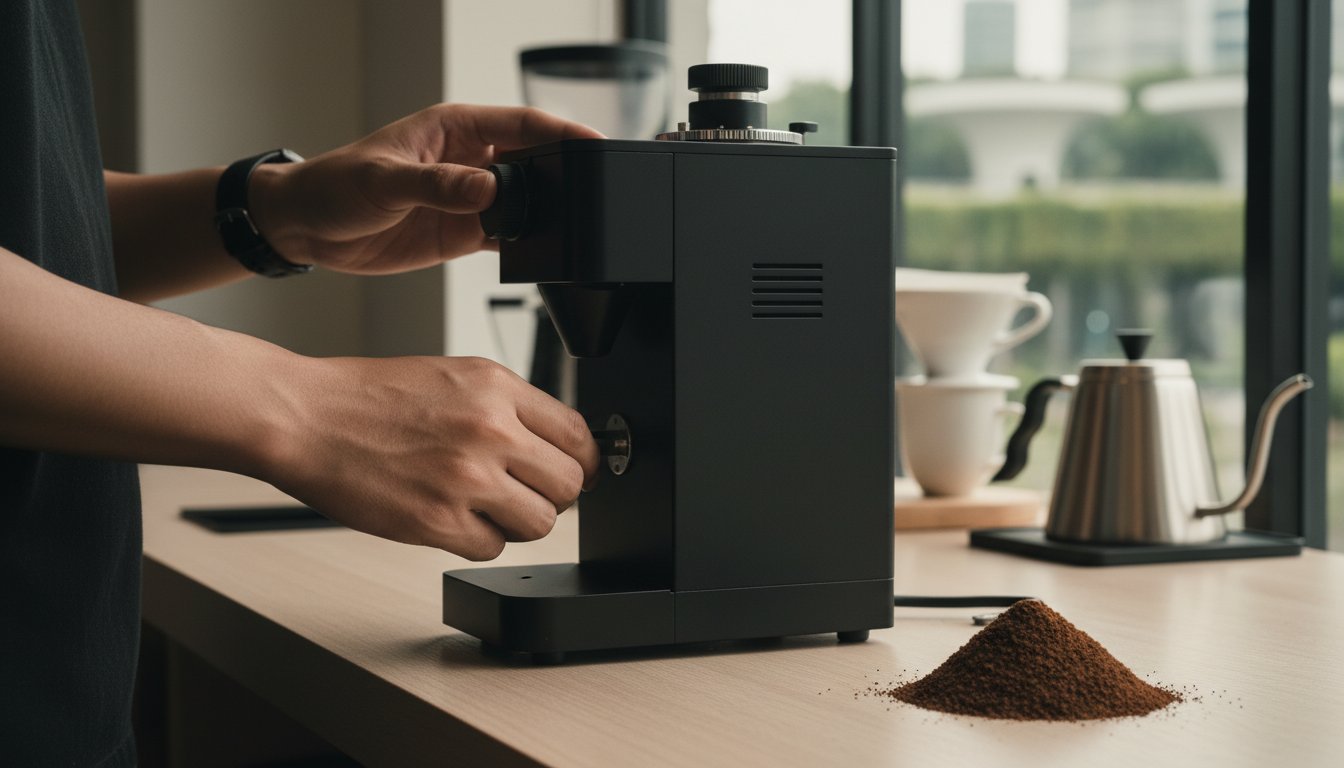
You can have the best beans in Singapore and a flawless pouring technique, but without the right tool, you're fighting a losing battle. In the passionate pursuit of a perfect cup, your grinder isn't just another piece of gear-it's the single most important equipment investment you can make. The entire goal of grinding is to create coffee particles of a uniform size, ensuring water extracts flavour evenly from every single particle.
When your grind is inconsistent, your brew becomes a tug-of-war in the cup. Larger grounds under-extract, releasing sour, acidic notes. Meanwhile, tiny, dust-like particles over-extract, contributing harsh bitterness. The result? A confusing, unbalanced cup that hides the true potential of your coffee.
Burr Grinders vs. Blade Grinders
The difference comes down to precision. A blade grinder is chaotic; it uses a spinning blade to randomly smash beans into pieces, creating a messy combination of large boulders and fine dust. In contrast, a burr grinder mills beans with control, crushing them between two revolving abrasive surfaces set to a specific distance. This process produces a dramatically more consistent and uniform particle size, which is absolutely essential for mastering your pour-over.
Understanding 'Fines' and Their Impact
‘Fines’ are the microscopic coffee dust produced during grinding. While even the best burr grinders create a small amount, cheap blade grinders produce an excessive quantity. These fines are the enemy of a clean cup. They migrate to the bottom of your paper filter, creating a layer of sludge that can clog it, choke the brew, and dramatically slow your drain time. This leads directly to over-extraction and that dreaded bitter, muddy taste, making it impossible to truly dial in what grind size for pour over brewing you need.
Elevate Your Skills with Hands-On Learning
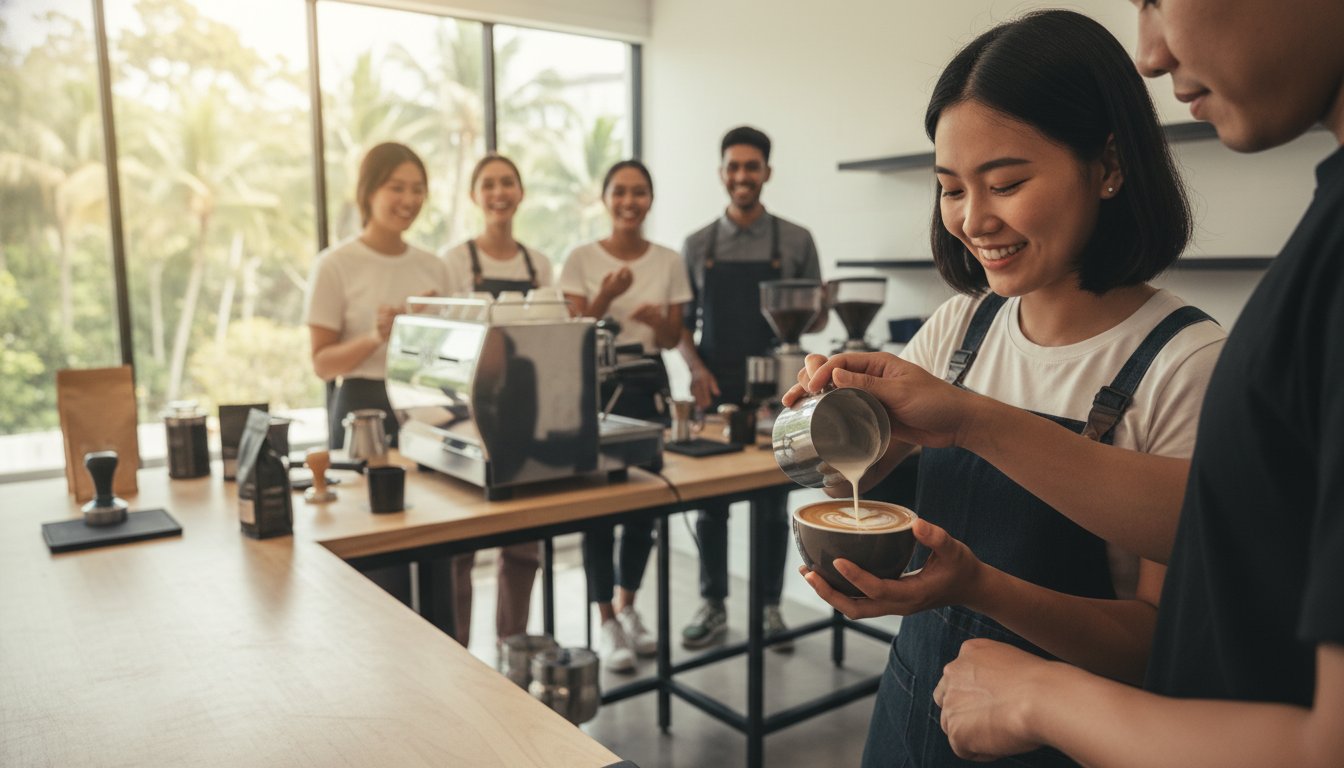
Reading about coffee theory is a fantastic start, but nothing accelerates your learning curve like guided, practical experience. Understanding how grind adjustments feel and taste in real-time is a game-changer. An expert instructor can provide immediate feedback on your technique, helping you connect the dots between grind size, pouring speed, and the final taste in your cup.
Ready to stop guessing and start brewing with confidence? Join one of our hands-on coffee classes and let us empower you on your coffee journey.
Master Your Grind, Master Your Brew
Mastering your pour-over ultimately comes down to controlling its most critical variable: your grind size. You now have the roadmap-start with a medium-fine grind as your baseline, and then let your senses guide you. By tasting for bitterness or sourness and monitoring your brew time, you can confidently answer the question of what grind size for pour over is perfect for your specific beans and brewer. Remember, a quality burr grinder isn’t a luxury; it’s the essential tool that unlocks this entire process of experimentation and discovery.
Reading about brewing is one thing, but true mastery is built with your hands. If you're ready to turn theory into practice and accelerate your learning curve, there's a place for you in our community. Join us for a hands-on experience that goes beyond the screen. Ready to turn theory into practice? Explore our hands-on coffee workshops in Singapore. Our passionate, expert-led education is designed to empower brewers from beginner to pro in a supportive, community-focused environment.
Your perfect cup isn't a mystery-it's just a few adjustments away. Happy brewing!
Frequently Asked Questions
Can I use pre-ground coffee for pour-over?
While you technically can, we passionately advise against it for the best pour-over experience. Pre-ground coffee starts losing its vibrant aromatic compounds the moment it's ground. More importantly, you lose all control over the grind size, which is the most critical variable for a balanced extraction. To truly empower your brewing and honour the work of our partner farmers, grinding fresh is a non-negotiable step that transforms your daily cup from good to exceptional.
What's the difference between a stepped and a stepless grinder for pour-over?
Think of it as control. A stepped grinder has pre-set "clicks" for grind size, which is great for repeatability and ease. A stepless grinder, however, offers infinite micro-adjustments between those clicks. For the passionate home brewer wanting to experiment and perfectly dial in a specific bean-like one of our single-origin geshas-a stepless grinder provides that ultimate precision. It allows you to make tiny changes to truly perfect your extraction and unlock the coffee’s full potential.
How do I know if my grinder is producing too many fines?
The biggest clue is in the cup and in your dripper. If your coffee tastes unexpectedly bitter or astringent despite a balanced recipe, excessive fines could be the culprit. Visually, you'll notice your brew bed choking or draining very slowly, often leaving a layer of dark sludge on top after the water has passed through. A quality burr grinder is your best tool for minimizing fines, which is a key factor when considering what grind size for pour over is truly best.
Does water temperature affect my ideal grind size?
Absolutely! Water temperature and grind size are partners in extraction. Hotter water extracts flavour more aggressively, so you may need to grind slightly coarser to prevent a bitter, over-extracted brew. Conversely, if you're brewing with cooler water (perhaps for a delicate bean), a slightly finer grind can help you achieve a full, balanced extraction. This interplay is where the hands-on fun of brewing begins, allowing you to experiment and tailor the recipe to each unique coffee.
How often should I clean my coffee grinder?
For a daily coffee brewer here in Singapore, a quick brush-out of the burrs and chute after each use or at the end of the day is a great habit. We recommend a more thorough cleaning with grinder-specific pellets or by disassembling the burrs once every month. This prevents the build-up of old coffee oils, which can go rancid in our humid climate and impart stale, unpleasant flavours onto your beautiful, fresh beans. It’s a simple act of maintenance that respects the coffee.
If my coffee is both sour and bitter, what should I adjust?
This is a classic sign of uneven extraction, a challenge every home brewer faces. It means some coffee grounds are under-extracting (sour) while the "fines" are simultaneously over-extracting (bitter). The first thing to check is your grinder's consistency. If that's sorted, the next step in figuring out what grind size for pour over to use is to go slightly coarser. This will reduce the bitterness from the fines, then you can focus on your pouring technique to more evenly saturate all the grounds.
Comments